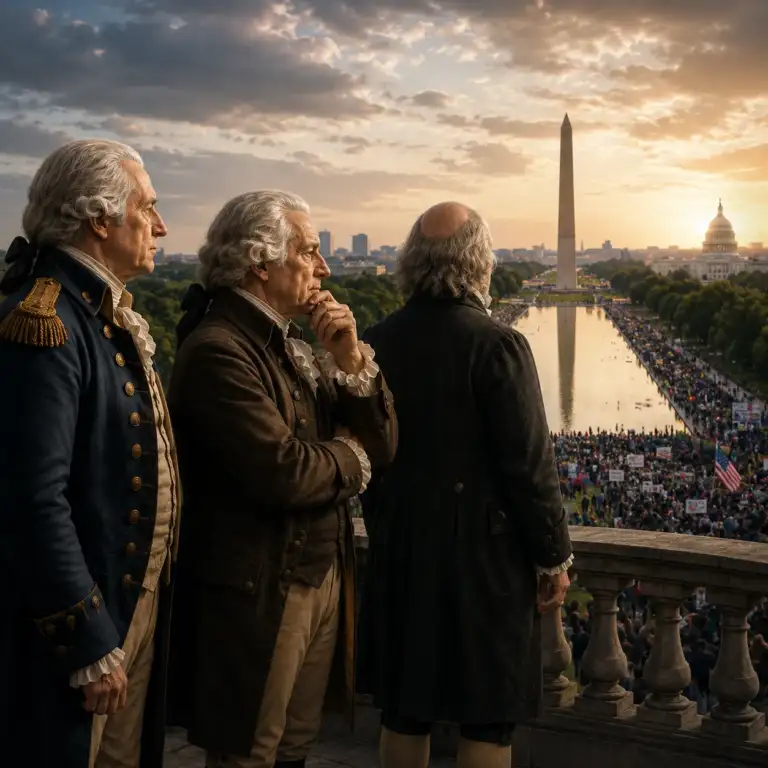
On July 4, 2026, the United States marked 250 years since fifty-six men in Philadelphia pledged their lives, fortunes, and sacred honor to a proposition most of the world considered reckless: that free people could govern themselves. A quarter of a millennium later, the honest question is not whether the founders would be proud. It is whether they would even recognize what their experiment became, and on that question, the evidence cuts in genuinely different directions depending on which founding principle you ask about.
By the Editors
America’s Semiquincentennial arrived this summer with fireworks, tall ships, and a genuine national effort to reflect on what 1776 actually promised. That reflection is worth taking seriously rather than treating as ceremony. The founders did not leave behind a vague wish for greatness. They left specific, articulated commitments: to self-government, to religious liberty, to a virtuous citizenry capable of restraining itself, to a federal structure that divided power rather than concentrating it, and to a model of individual responsibility that assumed free people would govern their own conduct so government would not have to. Measuring 2026 America against each of those five commitments produces neither the triumphant story official commemorations tend to tell nor the purely declinist one their critics prefer. It produces something more interesting: a mixed verdict, principle by principle, that the founders themselves, who argued fiercely with each other about exactly these tensions, might actually find familiar.
Self-Government: A Trust Collapse the Founders Might Have Predicted
Start with the principle at the very center of the American experiment: that government derives its legitimate power from the consent of the governed, and that citizens retain the right and capacity to govern themselves. By the most direct measure available, trust that the federal government actually does what is right, the picture is genuinely alarming. Pew Research Center’s long-running tracking shows public trust in the federal government at 73 percent in 1958, peaking at 77 percent in 1964, and collapsing to just 17 percent by September 2025, near the lowest level ever recorded. A separate Partnership for Public Service survey found only 33 percent of Americans trust the federal government at all, with a majority calling it “wasteful and inefficient.” Only 4 percent of Americans say the political system is working extremely or very well, and 63 percent say they have little or no confidence in its future.
Here is where the founders’ likely reaction gets genuinely complicated. Men who had just fought a revolution against a distant, unaccountable government did not design a Constitution premised on citizens trusting Washington unconditionally. They designed one premised on the opposite assumption, that concentrated power is inherently dangerous and must be checked, divided, and watched with permanent suspicion. James Madison wrote plainly in Federalist 51 that if men were angels, no government would be necessary, and that the entire structure of American government exists precisely because men are not angels, rulers included. A founder examining today’s 17 percent trust figure might not see civic failure so much as evidence that his own design’s central premise, that power deserves skepticism rather than deference, has been thoroughly internalized by the public, whatever the cost to functional governance. What would trouble him more is the second half of the data: not merely that Americans distrust their government, but that so few, only 4 percent, believe the system built to hold that government accountable is actually working as designed.
Fast Facts
17 percent: Americans who trust the federal government to do what is right, per Pew, down from 77 percent in 1964
870,000: Current U.S. Freemasonry membership, a historic low after decades of decline from a mid-century peak in the millions
30 percent: Rise in narcissistic personality traits among college students between 1982 and 2006
2025-2026: The Supreme Court decides Mahmoud v. Taylor and Catholic Charities Bureau v. Wisconsin, both expanding religious liberty protections
35 states: Now restrict or ban student cellphones in schools, passed almost entirely through state, not federal, legislative action
43 vs. 36 percent: Share of men versus women now attending church weekly, reversing a 25-year pattern
Religious Liberty: A Genuine Restoration Underway
If self-government presents a mixed picture, religious liberty offers this magazine’s readers real, documented cause for optimism, and a trajectory the founders would likely recognize as a correction rather than a decline. For much of the twentieth century, American courts drifted toward a reading of the Establishment Clause built more on a private 1802 letter from Thomas Jefferson than on the actual text of the First Amendment, treating visible religious expression in public life with growing suspicion. That drift has been meaningfully reversing. The Supreme Court’s 2022 decision in Kennedy v. Bremerton explicitly discarded the decades-old Lemon test in favor of a “history and tradition” standard, and the Court has since built on that foundation: in Mahmoud v. Taylor, it ruled that public schools cannot force religious families to accept instruction that undermines their children’s faith without an opt-out, and in Catholic Charities Bureau v. Wisconsin, a unanimous Court ruled that states cannot pick and choose which religious activities count as “religious enough” for legal protection. State legislatures have moved in parallel, with Louisiana, Texas, and other states passing laws permitting religious displays and expression in public schools that would have been unthinkable in courts just a decade ago.
A founder who watched the First Congress open its sessions with prayer and appoint paid chaplains the same year it ratified the Bill of Rights would likely find this shift not radical but restorative, a return closer to his own generation’s understanding that free exercise and public religious life were never meant to be enemies of each other. This is the one major founding principle where 2026 America may be moving toward the founders rather than away from them.
Civic Virtue: The Principle the Founders Warned Would Determine Everything
No founding principle receives less public attention today, and none would likely alarm the founders more urgently, than civic virtue, the belief that self-government is only possible among a people capable of restraining their own appetites and investing in something larger than themselves. John Adams stated the stakes as bluntly as any founder ever did, writing to the Massachusetts militia in 1798 that the Constitution “was made only for a moral and religious people. It is wholly inadequate to the government of any other.” That warning was not incidental to the founding project. It was, for men like Adams, the entire hinge on which the American experiment turned.
Measured against that standard, the data assembled by this magazine over the past year tells a genuinely sobering story. American Freemasonry, the fraternal society George Washington and dozens of other founders themselves belonged to, now counts roughly 870,000 members nationwide, a historic low after decades of decline from a mid-20th century peak in the millions. The Elks, Rotary, and Kiwanis have followed similar trajectories since their 1950s and 1960s heyday. The share of American men reporting zero close friends has climbed from 3 percent in 1990 to 21 percent today. College students’ narcissism scores rose 30 percent between 1982 and 2006, even as researchers found empathy declining over the same period. A founding generation that built an entire theory of self-government on the assumption that citizens would voluntarily associate, serve, and restrain themselves without needing government coercion to do it would find the collapse of exactly those voluntary associations, replaced too often by isolation or by algorithm-mediated parasocial substitutes, the single most alarming data point in this entire piece.
“Our Constitution was made only for a moral and religious people. It is wholly inadequate to the government of any other.”
— John Adams, letter to the Massachusetts Militia, 1798
There is real reason for hope buried in the same data, however, and this magazine believes it deserves equal weight. Church attendance among young American men has risen sharply enough that researchers now describe a genuine, measurable shift: 43 percent of men now attend weekly, compared with 36 percent of women, reversing a 25-year pattern, with commitment to faith rising 15 to 19 points among Gen Z and Millennial men since 2019. A grassroots, bipartisan movement is rebuilding legal protection for childhood independence and responsibility across eleven states. Young women are turning away from algorithm-driven dating toward more intentional courtship. None of these trends alone restores the civic infrastructure Adams assumed the Republic required. Together, they suggest the appetite for exactly that kind of virtue-forming community has not disappeared. It has simply gone looking for new vessels after the old ones emptied out.
Federalism: Working Roughly as Designed, at the State Level at Least
Of all five principles, federalism may be the one functioning most recognizably close to the founders’ original design, at least at the level of state policy experimentation the founders explicitly intended. James Madison and the Constitution’s other architects built a system expecting states to serve as separate laboratories, free to reach different conclusions on contested questions rather than having a single answer imposed uniformly from Washington. That is, in fact, precisely what is happening across a remarkable range of current policy fights. Thirty-five states have independently restricted student cellphone use in schools, largely through state rather than federal legislation. Eleven states have passed their own versions of “reasonable childhood independence” laws. States remain sharply divided on medical aid in dying, now legal in fourteen jurisdictions but firmly rejected in most others. Louisiana, Texas, and Arkansas have each taken their own distinct path on religious displays in public schools, producing exactly the kind of varied legal experimentation, and the resulting friction as cases work their way toward the Supreme Court, that federalism was designed to generate.
Where a founder would likely feel more disoriented is at the federal level itself, where the sheer scope of agencies, regulations, and centralized authority exercised from Washington today bears little resemblance to the deliberately limited federal government the Constitution’s framers actually built, regardless of which political party currently controls it. The state-level laboratory Madison envisioned still functions with real vigor in 2026. The restraint he expected to accompany it at the federal level has proven far harder to sustain across two and a half centuries of national growth, crisis, and expansion, a tension every American generation since the founding has had to renegotiate for itself.
Individual Responsibility: A Culture Still Deciding Which Way to Turn
The founders’ vision of ordered liberty assumed something the self-esteem era of the past several decades quietly abandoned: that a free people must first govern themselves before they can be trusted to govern a nation. This magazine has documented in detail how the self-esteem movement’s emphasis on unconditional affirmation, rather than character formed through discipline, effort, and responsibility, measurably increased narcissism while providing none of the promised benefits to actual achievement or resilience. Research on childhood independence tells a parallel story: parents today supervise children far more intensively than the objective risks justify, denying an entire generation the small, self-directed responsibilities, walking to a store, resolving a disagreement without an adult intervening, that built the self-reliant character the founders assumed citizens would bring with them into adulthood.
Yet here too, the data this magazine has gathered over the past year points toward genuine correction rather than simple decline. Eleven states and a bipartisan coalition in Congress are actively working to restore exactly the kind of childhood independence earlier generations took for granted. Young Americans are increasingly turning away from algorithm-optimized dating and social media toward more intentional, effortful relationships and community. None of this fully answers Adams’s warning about a Constitution built for a self-governing people. But it suggests the pendulum, having swung a long way toward unrestrained self-expression and manufactured self-esteem, may have reached the point where it is beginning, unevenly and without any coordinated plan, to swing back.
What Would Genuinely Startle Them, and What Would Feel Familiar
Set the specifics aside for a moment and a broader pattern emerges. A founder transported directly into 2026 would find the physical texture of American life almost entirely alien: the scale of the federal government, the speed of communication, a religiously and ethnically diverse population governing itself under the same founding documents, technology capable of putting every argument in the country in front of every citizen simultaneously and instantly. But the underlying arguments Americans are actually having, about how much power to trust to a distant government, about whether religious conviction belongs in public life, about whether citizens still possess the self-restraint self-government requires, about how much authority states should retain against a growing federal center, about whether responsibility or comfort should organize a free life, would likely feel immediately, uncomfortably familiar to him. These are not new debates America is having for the first time in its 250th year. They are the same debates the founders themselves were having in Philadelphia in 1776 and 1787, never fully resolved then and evidently never meant to be fully resolved now, but continually renegotiated by each generation that inherits the same founding documents and the same founding tensions.
The Bottom Line
Would the founders recognize America at 250? Not entirely, and this magazine sees no value in pretending otherwise for the sake of a tidier anniversary story. They would be heartened by a genuine restoration of religious liberty jurisprudence closer to their own understanding, and by a federal system whose states still function, in real and measurable ways, as the independent laboratories Madison designed them to be. They would be alarmed, in Adams’s own explicit terms, by the collapse of the voluntary civic associations and personal virtue he considered the actual precondition for everything else in the Constitution to function at all, and by a citizenry that has grown to distrust the very government it consented to create. What would likely surprise them most, in the end, is not any single verdict on decline or triumph, but the discovery that two and a half centuries later, free people are still arguing, loudly and imperfectly, about the exact same questions they themselves never finished settling. That argument, more than any single data point in this piece, may be the most authentic inheritance the founders actually left behind.
References
ALEC, “A Resolution Commemorating the 250th Anniversary (Semiquincentennial) of the Founding of the United States of America”
Newsweek, “US 250th Anniversary: 2026 dates, events and celebrations,” December 2025
The Washington Times, “Celebrate 250 honors America’s founding and core values,” July 2026
U.S. Department of State, “Freedom 250”
Visual Capitalist, “Charted: Trust in the U.S. Government Fell From 77% to 17%,” February 2026
Pew Research Center, “Public Trust in Government: 1958-2025,” December 2025
Partnership for Public Service, “The State of Public Trust in Government 2025”
Cornell Brooks Public Policy, “What Americans Really Mean by ‘Good Government’,” November 2025
Gallup, “Trust in Government,” Historical Trends
Pillar to Post, “Americana: Guide to Service Clubs & Fraternal Orders,” August 2025
Justia U.S. Supreme Court Center, “Religion Supreme Court Cases”