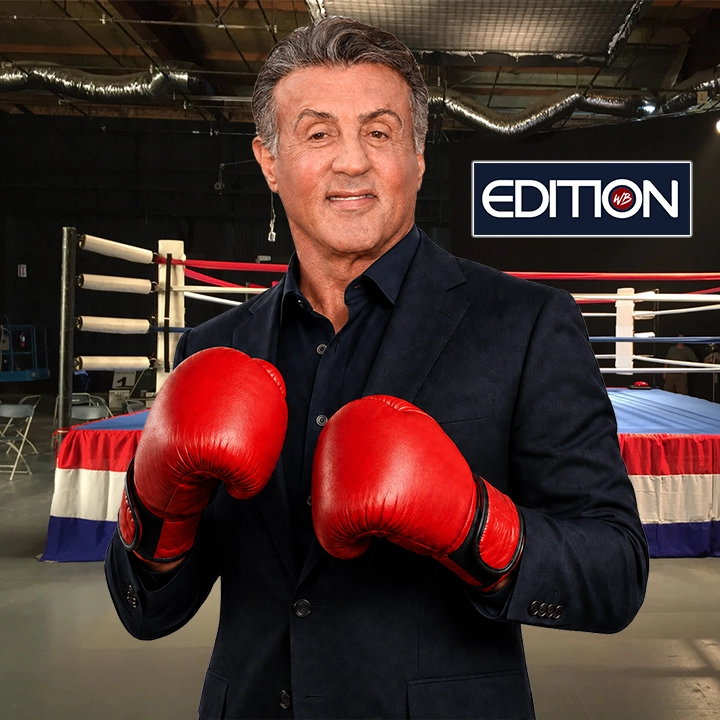
Before he was a franchise, an action icon, or a friend to presidents, Sylvester Stallone was a broke twenty-nine-year-old with $106 in the bank and a script nobody wanted to make with him in it. What he built instead of taking the easy money became one of the purest expressions of the American spirit ever put on film, and the man behind it has spent the last several years reminding Hollywood what that spirit actually looks like.
There is a moment near the end of the original Rocky, after the final bell has rung and the fight is technically over, when Rocky Balboa is not looking for the judges’ decision. He is screaming for Adrian, his girlfriend, pushing through a chaotic ring shouting her name because the thing he actually came to prove had nothing to do with a championship belt. He came to prove he could go the distance, that he was not just another bum from the neighborhood, and by the time the credits roll, he already has, win or lose. Fifty years later, that scene still works on audiences the way it worked in 1976, because it captures something American movies had largely stopped trying to say with a straight face: that ordinary people, through discipline and heart alone, can become something extraordinary. Sylvester Stallone wrote that scene, and that whole movie, out of his own life, and in doing so gave this country a character who has spent half a century quietly making the case for American values that Hollywood has otherwise spent that same half century running away from.
A Kid From Hell’s Kitchen Who Refused to Take No
Stallone’s own story is, without exaggeration, as unlikely as Rocky’s. Born Michael Sylvester Stallone in New York’s Hell’s Kitchen in 1946, he arrived by a difficult forceps delivery that damaged nerves in his face, leaving him with a partial paralysis that still shapes his distinctive drawl and slightly asymmetrical expression today. He was, by his own account and his family’s, a difficult kid, bounced from more than a dozen schools before he turned fifteen. He eventually found his way to drama study at the University of Miami and then to New York and Los Angeles chasing an acting career that, for the better part of a decade, refused to materialize. He worked the deli counter. He ushered at movie theaters. In one of the leaner stretches, he appeared in a softcore film simply to pay rent, a fact that would later supply the nickname “Italian Stallion” for the character that made him famous. By his own telling, on his twenty-ninth birthday he had $106 to his name.
What happened next has become one of the genuine legends of American filmmaking, and unlike most Hollywood origin stories, this one holds up under scrutiny. In March 1975, Stallone watched a closed circuit broadcast of a fight between heavyweight champion Muhammad Ali and a little known New Jersey club fighter named Chuck Wepner, a massive underdog who, against every expectation, went the distance with the champion before losing in the final round. Something about Wepner’s stubborn refusal to fall struck Stallone, and he sat down and wrote the screenplay for Rocky, by most accounts, in roughly three and a half days. What he did next mattered even more than what he wrote. Producers Irwin Winkler and Robert Chartoff loved the script and offered Stallone real money, tens of thousands of dollars, later reportedly climbing toward a much larger sum, to buy it outright with an established star in the lead role. Stallone, broke, with a pregnant wife and a dog he had famously sold and then bought back once the deal came through, said no. He would sell the script only if he could star in it himself. It is difficult to overstate how reckless that decision looked at the time, and how thoroughly it was vindicated.
Fast Facts
1946: Sylvester Stallone born in Hell’s Kitchen, New York City
1975: Broke and struggling, Stallone writes the Rocky screenplay in roughly three days, inspired by boxer Chuck Wepner
1976: Rocky is filmed in 28 days on a $1 million budget and becomes the highest grossing film of the year, earning over $200 million worldwide
1977 Academy Awards: Rocky wins Best Picture, Best Director, and Best Film Editing; Stallone earns nominations for Best Actor and Best Original Screenplay, joining Charlie Chaplin and Orson Welles as one of the only people ever nominated for acting and writing on the same film
1976 to 2023: Eight sequels and spinoffs follow, including Rocky IV, Rocky Balboa, and the Creed trilogy, with Stallone earning a third Oscar nomination for Creed in 2015
November 2024: Stallone introduces Donald Trump at the America First Policy Institute Gala, calling him the “second George Washington”
2025: Stallone is selected by President Trump as a Kennedy Center Honoree
The Movie Nobody Believed In
Rocky was shot in twenty-eight days on a budget of roughly one million dollars, a shoestring even by 1976 standards, with director John G. Avildsen relying on inventive, low-cost solutions, including becoming the first feature film to make extensive use of the newly invented Steadicam, most famously during Rocky’s now iconic training run up the steps of the Philadelphia Museum of Art. Nobody involved expected much from it. It opened against a field of far more prestigious, critically fashionable films that year, including All the President’s Men and Network, movies steeped in the disillusionment, cynicism, and institutional distrust that defined post-Watergate, post-Vietnam American cinema. Rocky offered something almost defiantly different: sincerity. It went on to gross well over two hundred million dollars worldwide, becoming the highest grossing film of 1976, and at that year’s Academy Awards it walked away with Best Picture, Best Director, and Best Film Editing, beating out those very films the critics had favored. Stallone himself picked up nominations for both Best Actor and Best Original Screenplay, a feat so rare that only Charlie Chaplin and Orson Welles had previously been nominated for writing and acting in the same film. A man who had been sleeping in bus terminals a few years earlier was, almost overnight, standing in the same sentence as two of the greatest names in the history of the medium.
The Philadelphia Museum of Art steps, forever after known simply as the Rocky Steps, became one of the most visited tourist attractions in the city, and a bronze statue of the character now stands nearby, visited by millions of tourists who have never seen a single Rocky film but understand instinctively what the image represents: a man alone, arms raised, having earned something the hard way. That is not incidental cultural trivia. It is evidence of how deeply the character embedded himself in the American imagination, not as a superhero or a fantasy figure, but as an ordinary, flawed, working class man who simply refused to quit.
An American Character for an Anxious Decade
To understand why Rocky mattered as much as it did, and still does, it helps to remember what kind of decade it arrived in. The mid-1970s were not an optimistic moment for American self-confidence. Vietnam had ended in humiliation. Watergate had shattered public trust in the presidency. Inflation and unemployment were both climbing, oil shortages had citizens waiting in line for gasoline, and the prestige cinema of the era reflected all of it, paranoid, cynical, morally compromised. Into that landscape walked a Philadelphia club boxer with a heart of gold, a stumbling romance, a run-down apartment, and an absolute, uncomplicated belief that hard work and heart could still take a nobody somewhere. Rocky Balboa was not naive. He knew exactly how stacked the deck was against him. He simply refused to let that be the end of the story. That refusal, delivered without a trace of irony at a moment when irony was the dominant mode of serious American filmmaking, is precisely what made the character revolutionary, and precisely what Hollywood has struggled to replicate honestly ever since.
Stallone built an entire body of work on that same instinct. Where so much of the industry treated sincerity as embarrassing, treated patriotism as naive at best and suspect at worst, Stallone kept writing and playing characters who loved their country, honored their families, and believed that individual effort mattered more than circumstance. That was true of Rocky. It was equally true of John Rambo, another working class veteran who Stallone insisted on writing with genuine sympathy for the men who fought and suffered in Vietnam, at a moment when Hollywood largely preferred to use veterans as symbols of national shame rather than as human beings worthy of honor.
Rocky IV and the Cold War America Needed to See
Nowhere did Stallone’s instinct for unapologetic American patriotism show up more vividly than in 1985’s Rocky IV, a film critics of the era sometimes dismissed as cartoonish and which audiences, tellingly, made into one of the highest grossing films of the entire decade. The plot could not have been more direct: Rocky’s friend and former rival Apollo Creed dies in the ring at the hands of Ivan Drago, a towering, seemingly emotionless Soviet fighter built and backed by the full machinery of the Soviet state, and Rocky travels to Moscow itself to avenge him, training in the Siberian snow with nothing but sheer will while Drago trains with steroids, laboratories, and state of the art equipment. The metaphor was not subtle, and it was not meant to be. This was Reagan era America putting its actual ideological confidence on screen: the free individual, training alone in a barn with logs and mountains rather than machines, standing toe to toe with the full weight of a totalitarian state and winning on will alone.
What makes the film’s ending still resonate is what happens after Rocky wins. The hostile Moscow crowd, initially chanting against him, slowly turns, then rises to its feet cheering an American. Rocky, bloodied and exhausted, delivers a short, unscripted-sounding speech directly into the moment, telling the crowd that if he can change, and they can change, everybody can change. It is worth sitting with how audacious that scene actually was to put in a mainstream film at the height of Cold War tension: not a message of American superiority over the Soviet people, but a message of shared humanity and the possibility of change, delivered by an American to a stadium full of Soviets, and received by that stadium as truth. Stallone was not simply making an action movie. He was making an argument, on the biggest possible stage, for the superiority of a system built on individual liberty over one built on state control, without once losing sight of the humanity of the people trapped inside that system.
“If I can change, and you can change, everybody can change.”
— Rocky Balboa, Rocky IV
A Franchise That Kept Choosing Dignity Over Cynicism
What separates the Rocky series from most long running franchises is how consistently it refused the temptation to curdle into cynicism as it aged, even as its lead actor grew older on screen alongside his audience. Rocky II, III, and V each found new ways to test the character’s dignity rather than simply escalating the spectacle. By the time Rocky Balboa arrived in 2006, with Stallone in his sixties writing and directing himself as an aging former champion stepping back into the ring one last time, the film played less like a nostalgia cash-in and more like a meditation on purpose, aging, and refusing to let the world tell you your best days are behind you, a message that resonated with an entirely new generation of viewers who had never seen the original in theaters.
That generational handoff became explicit with Creed in 2015, in which Stallone, now playing mentor rather than fighter, trained Michael B. Jordan’s Adonis Creed, the son of his old friend and rival Apollo. Rather than resist passing the torch, Stallone embraced it fully, earning his third career Oscar nomination, this time for Best Supporting Actor, nearly forty years after his first. Two more Creed films followed, extending the world Stallone built in three sleepless days in 1975 into its fifth decade, still built on the same bones: family, discipline, humility, and the belief that a man’s worth is measured by how he gets back up rather than by how hard he was knocked down. Across nearly fifty years and nine films, the character never once became a vehicle for grievance, victimhood, or cynicism about the country that made his rise possible. That consistency was a choice, made by the same man, film after film, decade after decade.
The Man Behind Rocky Refuses to Bow to Hollywood’s Politics
It should surprise no one who has actually watched these films closely that the man who wrote them has, in recent years, become one of the more openly patriotic and politically candid figures in an industry that overwhelmingly discourages both. Stallone is a registered Republican, a fact that alone sets him apart in an industry where conservative voices are famously scarce and frequently punished for speaking up. But he has gone well beyond quiet registration. In November 2024, Stallone took the stage at the America First Policy Institute Gala at Mar-a-Lago to introduce then-president-elect Donald Trump, and rather than offering the safe, hedged remarks typical of celebrity political appearances, he compared Trump’s political comeback directly to Rocky’s own arc of metamorphosis and declared, without qualification, that America had “the second George Washington.” It is hard to imagine many A-list actors of Stallone’s stature making that comparison publicly, in front of cameras, at the literal moment the industry that employs them was still processing an election result most of Hollywood had loudly opposed.
That was not an isolated moment. Later, when President Trump personally selected the honorees for the 2025 Kennedy Center Honors after reshaping the institution’s leadership, Stallone was among the artists chosen, alongside Gloria Gaynor, George Strait, Michael Crawford, and KISS, with Trump noting bluntly that he had “turned down plenty who were too woke.” At the ceremony itself, Stallone spoke warmly and at length about his three decade personal friendship with Trump, describing a private side of the man, generous, attentive to family details, that the public rarely sees. The remarks drew criticism from some corners of the entertainment press, exactly the kind of criticism that has made so many of Stallone’s peers, including his old friend and fellow action icon Arnold Schwarzenegger, who has been consistently and publicly critical of Trump, careful never to say anything so direct. Stallone, characteristically, said it anyway.
Why That Refreshes So Many Americans
There is a reason so many Americans, and particularly the kind of readers this magazine exists to serve, find Stallone’s public posture so refreshing rather than merely notable. For decades, expressing sincere, uncomplicated love of country, unashamed admiration for hard work over grievance, and open respect for traditional institutions has become almost taboo among Hollywood’s biggest names, treated as evidence of naivety at best and moral failing at worst. Stallone has simply never accepted that premise, not in the characters he wrote and not in the man he has been willing to be in public. Rocky Balboa never once blamed the system for his circumstances. He trained. He worked. He got back up. That is not a coded political message, but it is a value system, one built on personal responsibility, family loyalty, and quiet patriotism, that has become genuinely rare to see modeled without apology by a man of Stallone’s fame and standing.
It would be easy to dismiss this as simple nostalgia, an aging action star clinging to old fashioned ideas in a rapidly changing industry. The far more accurate read is that Stallone built an entire body of work, spanning nearly fifty years and multiple generations of moviegoers, on the bet that those old fashioned ideas were never actually old fashioned at all. They were simply true, and audiences, across every one of those five decades, have kept proving him right at the box office, film after film, long after critics moved on to the next fashionable cynicism. A boxer from a rundown corner of Philadelphia who refuses to fall, and the broke, stubborn, gifted man who wrote him into existence rather than sell him for a paycheck, have quietly done more to keep a certain vision of American character alive on screen than almost anyone else of his generation.
The Bottom Line
Sylvester Stallone did not simply create a beloved movie character. He created, and then spent half a century defending, a version of American identity built on grit, family, faith in oneself, and an unashamed love of country, at a moment when the industry around him was moving decisively in the opposite direction. He bet everything he had on that vision when he refused to sell his script without starring in it, and the country has been better for it ever since, from a broke Philadelphia club fighter running up museum steps to a Cold War underdog turning a hostile Moscow crowd, to a seventy-nine-year-old actor standing in front of the cameras at his own Kennedy Center Honors, still saying exactly what he believes without flinching. Rocky Balboa taught two generations of Americans that it does not matter how hard you get hit, it matters whether you keep moving forward. Sylvester Stallone has spent his entire career, on screen and off, proving he actually believes it.
References
No Film School, “How Sylvester Stallone Fought to Keep the ‘Rocky’ Script From Being Sold Without Him,” February 2026
TCM, “Rocky (1976)”
Britannica, “Sylvester Stallone”
History.com, “Sylvester Stallone starts filming ‘Rocky,'”
TotalRocky.com, “The Making of Rocky: How the Movie Became a Classic”
Variety, “‘I Play Rocky’ First Look: Anthony Ippolito Is Sylvester Stallone”
Fox News, “Sylvester Stallone calls President-elect Trump ‘second George Washington’ during AFPI Gala introduction,” November 15, 2024
Fox News, “Frank Stallone reflects on big brother Sylvester’s surprise onstage moment with President Trump,” March 20, 2025
People, “What’s Going on With President Trump and the Kennedy Center? All About the 2025 Honors”
Atlanta Black Star, “Sylvester Stallone’s Over-the-Top Trump Praise Has Fans Turning Sour,” January 18, 2026
IMDb, “Sylvester Stallone and Arnold Schwarzenegger Still Can’t See Eye to Eye When It Comes to US Politics”