
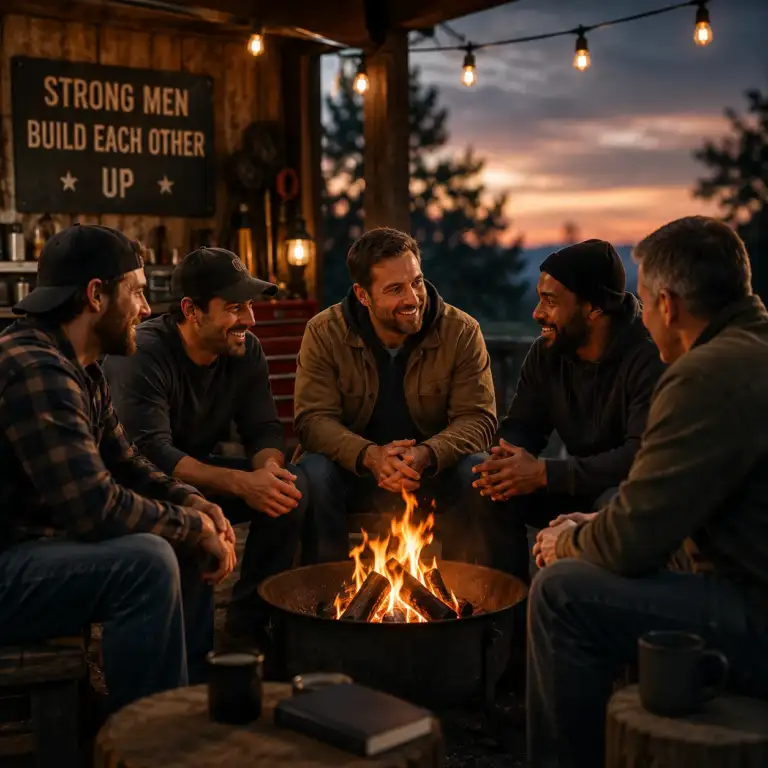
A man can watch four hours of podcasts a day, absorb a dozen influencers’ worth of advice on discipline, purpose, and masculinity, and still go to bed having spoken to no one who actually knows him. That is not a hypothetical. It is, increasingly, the ordinary condition of American manhood, and no algorithm, however well produced, is built to fix it.
Something has genuinely broken in how American men connect to one another, and the numbers describing it are not subtle. In 1990, when the General Social Survey asked American men how many close friends they had, 3 percent said none. When the Survey Center on American Life asked the identical question in 2021, that number had climbed to 15 percent. By 2023, it had reached 21 percent, one in five American men reporting no close friends at all, and among men under 30, the figure was already 15 percent, the highest rate ever recorded for that age group. Gallup data released in early 2026 found that a full 25 percent of American men between 15 and 34, one in four, report feeling lonely on a daily basis. This is not a problem confined to any single political tribe or region; researchers have found men who identify as conservative and men who identify as liberal report friendlessness at strikingly similar rates, as do rural and urban men alike. Something structural is happening to American male friendship, and the response many men have found easiest to reach for, hours of podcasts, influencer content, and online communities promising brotherhood, cannot actually deliver the thing it promises.
A Friendship Recession Four Decades in the Making
The scale of this shift deserves to be understood in full before turning to what might fix it. A 2023 study by the nonprofit Equimundo found that two-thirds of men aged 18 to 23 agreed with the statement “no one really knows me well,” with Gen Z men showing the highest agreement of any generation surveyed. The consequences of that isolation are not abstract. Men account for nearly 80 percent of all suicides in the United States, and the male suicide rate has continued climbing even as public awareness of the crisis has grown. Loneliness researchers have coined a specific term for how this often shows up in men’s lives: masked loneliness, a pattern where the underlying isolation surfaces not as a man saying he feels lonely, a word many men are culturally trained not to reach for, but as sleep problems, vague physical complaints, an obsessive relationship with the gym, or irritable withdrawal from the people closest to him. The disguise is costly twice over. It delays anyone, including the man himself, from recognizing what is actually happening, and many of the coping behaviors that mask the loneliness end up deepening the very isolation they are unconsciously trying to manage.
Fast Facts
3 to 21 percent: Share of American men reporting zero close friends, 1990 to 2023, a sevenfold increase
25 percent: American men ages 15 to 34 who report feeling lonely daily, per 2025 Gallup data
Two-thirds: Men ages 18 to 23 who agree that “no one really knows me well,” per a 2023 Equimundo study
870,000: Current U.S. Freemasonry membership, a historic low after decades of decline from a mid-20th century peak in the millions
80 percent: Share of all U.S. suicides accounted for by men
43 vs. 36 percent: Share of men versus women now attending church weekly, a reversal of a 25-year pattern, per Barna Group
The Honest Complication: This Isn’t Simply “Men Are Lonelier”
A genuinely careful examination of this issue has to include a finding that complicates the popular narrative, because getting the diagnosis right matters more than repeating the most dramatic version of the story. A 2025 Pew Research Center study found no statistically significant gender gap in overall loneliness itself, just a one-point difference, with 16 percent of men and 15 percent of women reporting feeling lonely or isolated all or most of the time. Men are not, by that measure, meaningfully lonelier than women in the moment-to-moment sense. What Pew did find, and what this magazine believes is the actual heart of the problem, is that men are significantly less likely than women to turn to friends, family, or mental health professionals for support when they are struggling, and men communicate with their existing friends far less frequently. The crisis, in other words, is not primarily that men feel more isolated than women do. It is that men have fewer functioning structures for turning that feeling into real connection, and less practice using the ones that remain. That distinction matters enormously for figuring out what actually helps, because it points away from simply telling men to feel differently and toward rebuilding the institutions and habits that used to make reaching out automatic rather than exceptional.
Where the Old Brotherhoods Went
Understanding why men in particular have lost this capacity requires looking at what disappeared underneath them. Researchers studying male friendship have found that men’s social bonds depend disproportionately on institutional venues, school, sports teams, military or national service, and stable long-term workplaces, compared with women, whose friendships more often survive independent of any shared institution. That matters because adult life has spent the past half century systematically dismantling exactly those venues, one by one, for men and women alike, but with a disproportionate cost falling on men precisely because they had fewer alternative ways of maintaining connection once the institution was gone. Political scientist Robert Putnam documented the broader version of this collapse in his landmark 2000 book “Bowling Alone,” charting the decline of American civic and fraternal life across nearly every category: church attendance, union membership, PTA participation, and the fraternal lodges and service clubs that had once been fixtures of nearly every American town. That decline has only continued since Putnam’s book was published. American Freemasonry, the oldest fraternal society in the country, now counts roughly 870,000 members nationwide, a historic low after decades of steady decline from a membership that numbered in the millions at its mid-20th century peak. The Elks, the Rotary Club, the Kiwanis, organizations built explicitly around structured, recurring, in-person male fellowship and shared civic purpose, have followed similar trajectories, their membership rolls a fraction of what they were during their heyday from the 1950s through the 1970s. A man born in 1955 grew up assuming he would eventually join something like this, a lodge, a union hall, a men’s civic club, simply as a normal part of adult life. A man born in 1995 has, in most American towns, no comparable institution left to join at all.
Into the Vacuum Stepped the Feed
Into that genuine institutional vacuum has stepped an entirely different kind of offering: podcasts, YouTube personalities, and online communities explicitly marketed around brotherhood, discipline, and masculine purpose. Some of this content offers real value, practical advice, honest conversation about struggles men rarely discuss elsewhere, and a sense, however mediated, that other men share the same confusion about work, fatherhood, and identity that any individual listener might be feeling alone. But researchers studying this shift describe the fundamental limitation plainly: podcasts, feeds, and parasocial relationships with online personalities offer what one analysis called “simulated contact at zero vulnerability cost.” A listener can feel a genuine sense of connection to a podcast host he has never met, in an environment that asks absolutely nothing of him in return, no accountability, no reciprocal presence, no risk of rejection, and therefore no actual practice at the very skill, vulnerable, reciprocal disclosure, that real friendship requires and that men, per the Pew data above, already underuse. That is not a harmless supplement to real connection. At heavy enough doses, researchers warn, it substitutes for real contact rather than supplementing it, offering just enough of the feeling of belonging to quiet the ache without ever actually resolving it.
The darker edge of this same vacuum is what has come to be called the manosphere, a loosely connected network of influencers who have recognized, correctly, that millions of isolated young men are searching for exactly the sense of brotherhood and purpose this piece describes, and who have built enormous audiences by offering it, often bundled with a worldview that blames feminism or women broadly for the isolation these men are genuinely feeling. Critics have rightly noted that this approach tends to deepen the underlying problem rather than solve it, teaching young men to interpret a structural, institutional collapse as evidence that half the population is their adversary, which further alienates them from exactly the real, in-person relationships, with women and with other men alike, that could actually address the loneliness driving them toward that content in the first place.
“Simulated contact at zero vulnerability cost.”
— Researchers describing the structural limitation of podcasts and parasocial online communities as a substitute for real male friendship
What Real Brotherhood Actually Requires That Content Cannot
The distinction worth drawing clearly is not that online content is worthless, but that it structurally cannot perform certain functions real, embodied community performs almost by default. A mentor who has watched a young man fail and shown up again the next week has extended a form of trust a podcast host, by the very nature of the medium, cannot offer any individual listener. A friend who notices a man has gone quiet for two weeks and drives over uninvited is providing exactly the kind of unprompted accountability that masked loneliness depends on nobody providing. A team, a men’s Bible study, or a service organization that meets on the same night every week, whether or not any individual member feels like showing up, builds the kind of accumulated shared history that cannot be downloaded, skimmed, or consumed passively between other tasks. These structures work precisely because they cost something, time, physical presence, the risk of being truly known and occasionally disappointing someone who now expects you, and that cost is not a flaw in the model. It is the actual mechanism by which real belonging gets built, the same mechanism zero-cost parasocial content is structurally incapable of replicating no matter how much genuine wisdom the content itself contains.
The One Institution Already Rebuilding This
There is real, measurable evidence that when men are offered a genuine structure rather than only more content, they respond. This magazine has previously documented the remarkable rise in young men’s church attendance, driven not by content consumption but by actual weekly, in-person commitment: Barna Group’s research found that weekly church attendance among American men now stands at 43 percent compared with 36 percent among women, a reversal of a pattern that held for a quarter century, with commitment to following Jesus rising 15 points among Gen Z men and 19 points among Millennial men since 2019 alone. That shift did not happen because young men discovered a better sermon podcast. It happened because churches, at their best, still offer exactly the ingredients this piece has described as missing everywhere else: a mentor who shows up in person, a small group that notices absence, a shared weekly commitment that costs something real, and a community built around something larger than any individual member’s convenience. Every civic institution watching its own membership numbers decline, service clubs, sports leagues, veterans’ organizations, fraternal lodges, has a genuine opportunity in front of it right now, if it is willing to build the same kind of costly, in-person, accountable structure the church is already proving young men will still choose when it is genuinely offered to them.
The Bottom Line
American men are not lonely because they lack access to enough content about masculinity, brotherhood, or purpose. If anything, they have more of that content available to them than any generation in history, and the loneliness statistics have only worsened throughout the same years that content proliferated. Men are lonely because the actual institutions that once made male friendship structural rather than optional, the lodge, the team, the union hall, the weekly men’s group, have quietly disappeared from most American towns, and nothing offered in their place asks anything real of the men consuming it. Fixing that will not come from a better podcast, however honest its advice. It will come from men choosing, deliberately and repeatedly, to show up in person for something that costs them time, risks their comfort, and asks to actually know them, the same unglamorous, costly commitment that has built real brotherhood in every generation before this one, and the only thing that has ever actually built it since.
References
New Guard Times, “Loneliness Study: What It Tells Men,” April 2026
The Boar, “What is the ‘male loneliness epidemic’ and who does it affect?” February 2026
National Organization for Women, “A New Era of Dating: What the ‘Male Loneliness Epidemic’ Discourse Signals,” January 2026
Gooding Wellness, “The Male Loneliness Epidemic and the Manosphere: How Isolation Is Impacting Young Men Today,” May 2026
Simply Psychology, “Men and Loneliness: Inside the Epidemic,” June 2026
The University News, “The rise of modern misogyny and the new manosphere,” April 2025
Survey Center on American Life, friendship data cited via multiple sources, 2021 and 2023
Pillar to Post, “Americana: Guide to Service Clubs & Fraternal Orders,” August 2025
Barna Group, State of the Church research on men’s church attendance, cited via prior reporting
Robert Putnam, “Bowling Alone: The Collapse and Revival of American Community”