
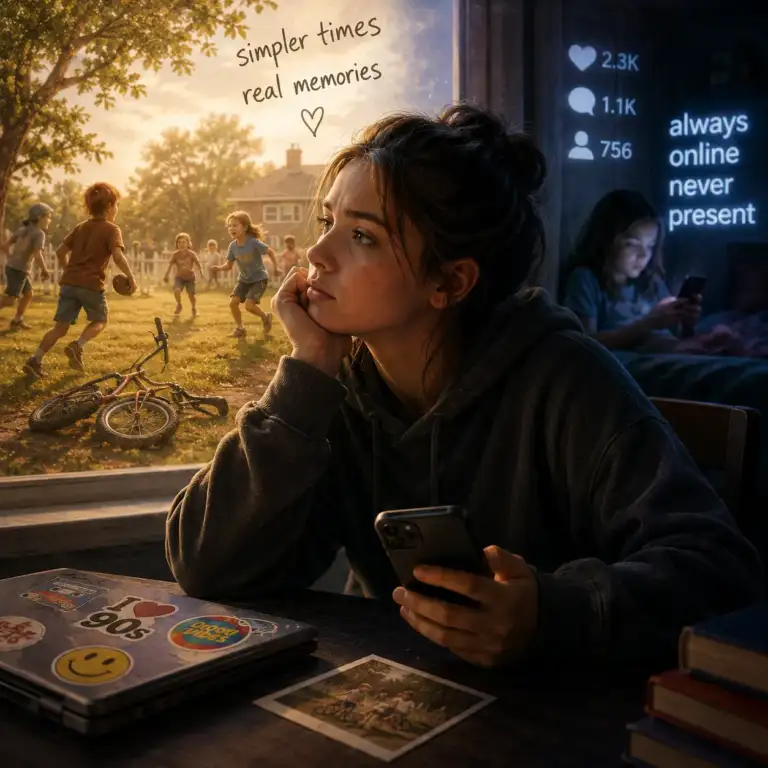
Walk into a wedding reception this year and you’re as likely to find a basket of disposable cameras on the table as a photo booth. Ask a twenty-two-year-old about her new phone and she may proudly tell you it can only call and text. There is a word for what’s happening here, and it isn’t simple nostalgia. It’s something stranger and more revealing: an entire generation grieving a version of childhood it barely got to live.
Psychologists have a term for the specific ache Gen Z keeps reaching for: anemoia, nostalgia for a time a person never actually lived through. It is a strange thing to watch play out in real time. The oldest members of Generation Z, born in 1997, were children when flip phones were still common and social media was still a slow, strange frontier rather than a corporate machine. The youngest, born in 2012, have never known a world without a smartphone in every hand at the dinner table. And yet across the entire cohort, from twenty-nine-year-olds to teenagers, the same instinct keeps surfacing: a hunger for slower technology, physical objects, unfiltered friendship, and the kind of stable, present family life that the algorithm-optimized childhood so many of them actually had never quite delivered. This is not costume nostalgia, the harmless kind older generations indulge every time bell-bottoms or shoulder pads cycle back into fashion. This is a generation raised inside the most engineered, most monitored, most optimized childhood in human history, quietly telling anyone paying attention that it wants something else.
Ditching the Smartphone That Raised Them
Start with the phones themselves, since nothing captures the trend more literally. Brick and flip phone purchases among 18 to 24 year olds surged 148 percent between 2021 and 2024, even as smartphone use in that same age group actually declined by 12 percent, according to data compiled by Spokeo. Google searches for “dumbphones” rose 89 percent between 2018 and 2021, and the TikTok hashtag #bringbackflipphones has now accumulated nearly 60 million views, a genuinely enormous number for a trend built almost entirely around wanting less technology rather than more. Nokia’s parent company HMD reported flip phone sales doubling between 2022 and 2023 alone, a jump it attributed directly to that same TikTok trend. The Light Phone, a minimalist device built explicitly to do almost nothing beyond calling and texting, has sold more than 100,000 units across three generations of hardware. Market analysts now project the global feature phone market will grow from roughly $39 billion in 2025 to nearly $50 billion by 2030, a genuinely strange growth curve for a category of device most people assumed smartphones had permanently killed.
The reasoning young people give for this is remarkably consistent, and remarkably self-aware. This is a generation that, by its own admission, spends more than seven hours a day on a smartphone, with nearly half of American teens reporting they are online “almost constantly.” A 2025 University of Gothenburg study found that simply switching a phone’s display to grayscale, removing the saturated colors that make apps so visually addictive, cut average daily phone use by 35 percent within a single week. Gen Z did not need a peer-reviewed study to tell them what years of doomscrolling had already taught them by feel: the device that promised connection had, somewhere along the way, started extracting something instead. Trading a smartphone for a flip phone is not really about the Y2K aesthetic, however stylish it has become. It is a twenty-something building a small, deliberate wall between herself and a machine she has learned not to fully trust.
Fast Facts
148 percent: Increase in brick and flip phone purchases among 18 to 24 year olds, 2021 to 2024
$1.2 billion: U.S. vinyl record revenue in 2024, outselling CDs for consecutive years
74 percent: Share of Gen Z who bought physical media in the past year, even without hardware to play it on
59.8 million: Views on the #bringbackflipphones hashtag on TikTok
$1 billion: Amount Starbucks is investing to restore its stores as a Gen Z-targeted “third place”
35 percent: Reduction in daily phone use from simply switching a screen to grayscale, per a 2025 University of Gothenburg study
Records, Film, and the Return of Things You Can Actually Hold
The retreat from purely digital life extends well past the phone in a pocket. American vinyl record revenue hit roughly $1.2 billion in 2024, continuing a streak of outselling CDs for years running, while cassette tape sales have quadrupled over the past decade, an almost absurd resurrection for a format most people assumed was permanently retired to landfill. Kodak has doubled its film production since 2022 to keep pace with demand, and Polaroid and Fujifilm have both reported double-digit growth in instant camera sales specifically among younger buyers. Disposable cameras, once a wedding-table relic of the 1990s, are back on wedding tables today, not as ironic decoration but as a genuinely preferred way for young guests to capture the night. Perhaps the most telling statistic in this entire trend is the simplest: 74 percent of Gen Z say they bought some form of physical media in the past year, and a meaningful share of them did so without owning any device capable of actually playing it. The vinyl sits on a shelf. The point was never really the playback. The point was owning something that exists whether or not an app, a subscription, or an algorithm decides to keep serving it to them.
There is a genuine logic underneath what might look, from the outside, like pure aesthetic indulgence. A vinyl record plays two sides and then stops. A film camera gives you twenty-four exposures and forces you to actually decide what is worth capturing before you press the shutter. A cassette cannot autoplay the next track an algorithm has decided will keep you watching. Every one of these objects shares a quality that has become almost extinct in a Gen Z childhood defined by infinite scroll and endless recommendation engines: a natural stopping point. That, more than any specific decade’s fashion, appears to be what’s actually being purchased.
Chasing the Ghost of the Early Internet
The nostalgia runs deepest, and strangest, when it turns toward the internet itself, the very medium that raised this generation in the first place. Members of the oldest Gen Z cohort, born in the final years of the 1990s, describe growing up on Skype, MySpace, Club Penguin, and Stardoll, early platforms one Gen Z writer described as “unstructured, unpredictable, and ours,” a digital wilderness rather than the manicured, corporatized mall the internet has since become. That same writer put the shift in language worth sitting with: the internet went from feeling like a living, breathing frontier to feeling like a shopping center engineered to keep you inside just a little longer. Vaporwave art, which deliberately mimics the glitchy surrealism of early web design, has become a genuine aesthetic movement rather than an inside joke. Apps like Huji and Dazz exist purely to fake the grain and timestamp of an old film camera onto a modern phone photo. Geocities-style personal websites, blinking text and all, are being rebuilt by hand, not as a joke but as a genuine act of digital homesteading against platforms that increasingly feel like they were never built for the user in the first place.
There is even a generational split emerging inside Gen Z itself. Cultural analysts have started distinguishing “Gen Z 1.0,” the older cohort nostalgic for the early 2000s they can dimly remember, from “Gen Z 2.0,” teenagers now old enough to be nostalgic for a decade they were simply too young to properly experience: the 2010s. This past January, social feeds briefly filled with a wave of reposted photos from exactly a decade earlier, Snapchat dog filters, flower crowns, the particular brand of unguarded, un-ironic optimism that defined 2016 before it curdled into the exhausted detachment so much of online youth culture has run on since. As one culture writer observed, growing up in perpetual crisis and constantly narrating that crisis online has simply stopped being fun, for anyone, and what’s rising to replace it is a small but genuine turn toward sincerity.
The Mall, the Third Place, and the Ache for Real Life
Even physical spaces long left for dead are being quietly resurrected by demand. Starbucks announced a billion-dollar investment specifically aimed at restoring its stores as what sociologists call a “third place,” a location that is neither home nor work, somewhere young people can simply exist around other people without an obligation to perform for a camera. That is a striking bet for a company to make, and it is a direct response to research showing rising rates of loneliness and digital burnout among a generation that, by its own reporting, feels more anxious and less satisfied the more time it spends online. Apps like BeReal and Lapse, both built specifically to resist the curated, filtered performance culture of Instagram and TikTok, found early Gen Z audiences precisely because they promised something closer to an actual moment rather than a manufactured one. Malls, dismissed for years as a dying relic of Millennial adolescence, have become genuine gathering points again for teenagers who, it turns out, still want a physical place to walk around with friends that has nothing to do with a feed.
“The internet was a living, breathing wilderness instead of a mall.”
— A Gen Z writer, describing the early internet she barely remembers
A Quiet Return to Home and Hearth
The most culturally significant thread in all of this, and the one this magazine’s readers should find most encouraging, is the quiet resurgence of interest in traditional homemaking and family life among young women who never actually lived it. The “tradwife” trend, along with its gentler cousin “cottagecore,” idealizes the domestic rhythms of the 1950s and 60s: baking bread from scratch, tending a garden, raising children with unhurried presence, building a home around a single, stable center rather than a career optimized for maximum output. Commentators have described this movement plainly as nostalgia for a life its young adherents never experienced firsthand, an ache for something they only glimpsed through old photographs and their grandmothers’ stories. Critics have raised fair questions about how the trend gets marketed and monetized online, and this magazine will not pretend every version of it is equally sincere. But underneath the branding sits a genuinely serious cultural signal: young women who grew up watching burnout, digital exhaustion, and the promise that a career and a phone could substitute for rootedness are increasingly choosing, deliberately, to center the home instead, describing the shift not as regression but as relief.
That instinct deserves to be taken seriously rather than dismissed as costume play. A generation raised to believe fulfillment could be engineered through productivity apps, curated feeds, and algorithmic optimization is discovering, the hard way, that a life built entirely on those terms leaves something essential missing. The home, the family table, the unhurried presence of a parent who is actually paying attention, these are not nostalgic props. They are the things human beings have always needed, and a generation that grew up without enough of them is now reaching, however imperfectly, to build them back.
What This Generation Is Actually Telling Us
Taken individually, a flip phone, a vinyl record, and a sourdough starter look like unrelated fashion choices. Taken together, they form a coherent message this magazine believes deserves to be heard clearly: the generation raised most completely inside an algorithm-optimized childhood is the one now working hardest to climb back out of it. This is the same generation this magazine has written about repeatedly, the one turning to AI companions for friendship because real connection felt scarce, the one whose own parents were too often distracted by the very devices now being traded for flip phones. Gen Z did not simply stumble into liking old cameras and record players by accident. They are reaching, consciously and repeatedly, for anything with a natural stopping point, a fixed shape, a permanence no update can quietly take away, because the world engineered for their childhood offered remarkably little of any of that.
There is real irony in the fact that much of this rejection of algorithm-driven life is itself organized, discovered, and broadcast through algorithm-driven platforms, TikTok trends promoting flip phones, Instagram accounts styled like old Tumblr pages. This magazine will not pretend that tension doesn’t exist. But the direction of the yearning matters more than the medium currently carrying it. A generation raised by screens is telling anyone willing to listen that it wants fewer screens, more permanence, and more of the unhurried, present, faith-and-family-centered life that earlier generations too often assumed technology would only ever improve. That is not a fad. That is closer to a correction.
The Bottom Line
Gen Z cannot actually return to a childhood most of them barely got to have, the slow internet, the flip phone, the mall with nowhere better to be. What they can do, and appear to be doing in genuinely large numbers, is build something adjacent to it now, as adults, with far more intention than any of it was given to them the first time around. A twenty-something buying a disposable camera for a wedding, deleting the apps, and dreaming of a quiet kitchen is not performing nostalgia for its own sake. She is naming, as clearly as her generation knows how, exactly what was missing the first time, and reaching, imperfectly but genuinely, for a version of childhood, and adulthood, actually worth remembering.
References
Yahoo Lifestyle, “Wait…Gen Z wants flip phones?”
BGR, “Flip Phones Are Making A Comeback – And Gen Z Is Leading The Charge”
Vertu, “Why Gen Z is Buying Dumb Phones | Digital Minimalism Trends,” January 2026
SlashGear, “Is Gen Z Bringing Back Dumb Phones?”
Brainstamped, “Flip Phone Summer: Why Gen Z Is Leading the Biggest Digital Detox of 2026,” May 2026
Spokeo/AOL, “The flip phone renaissance: 9 retro phones that Gen Z is obsessed with in 2025”
Medium, Anna, “Nostalgia in the Age of AI: Gen Z is Romanticising Early Internet,” April 2025
Ayerhs Magazine, “Why Gen Z Is Craving Real Life Again in 2026,” November 2025
The Up and Up, “Everything millennial is cool again,” February 2026
Culture Codes, “Gen Z’s Nostalgia Obsession and Brand Marketing,” June 2025
GEN-ZiNE, “Why is trad-wife culture appealing to Gen-Z? It could be about work.”
Fortune, “Starbucks chases Gen Z nostalgia, betting $1 billion on plan to bring back the ‘third place,'” September 2025
Fortune, “The $130 Barbie dumbphone is targeting Gen Z’s nostalgia for an era they can’t remember”