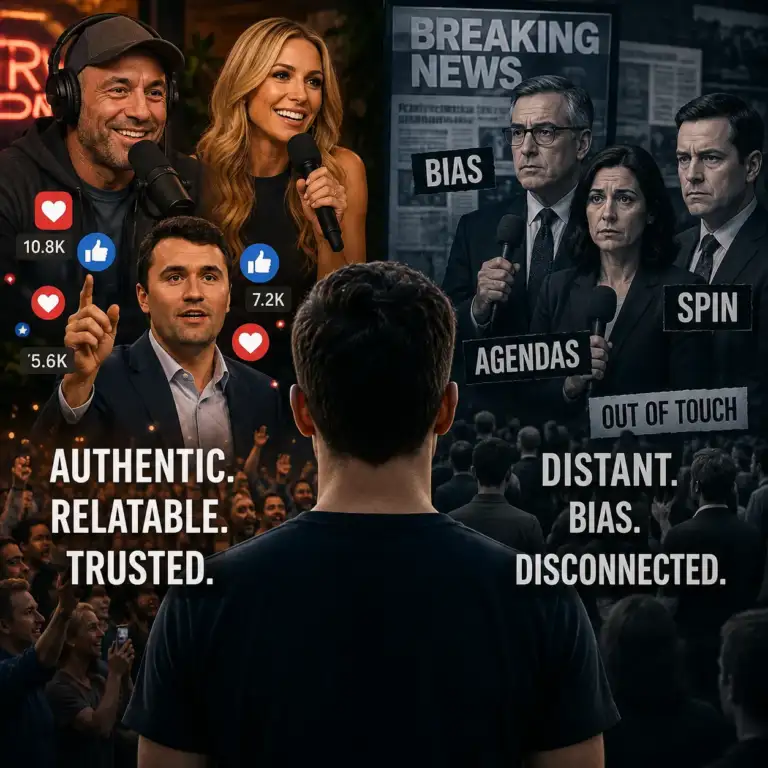
Americans’ trust in newspapers, television, and radio to report the news fully, accurately, and fairly just hit a new all-time low of 28 percent. Meanwhile, a growing share of the country, more than a third of adults under 30, now regularly gets its news from independent podcasters, YouTubers, and online commentators instead. The obvious question is whether that shift represents Americans finally demanding more honesty from the people who inform them, or simply trading one set of biases for another, less accountable one. The honest answer is more complicated, and more interesting, than either side of that argument wants to admit.
Something fundamental has broken in the relationship between the American press and the American public, and the break did not happen overnight. Gallup’s polling found in October 2025 that trust in newspapers, television, and radio to report the news “fully, accurately, and fairly” had fallen to just 28 percent, a new record low in a decline that has been running for decades. The Reuters Institute’s 2026 Digital News Report, the largest survey of its kind, covering nearly 100,000 respondents across 48 countries, found global trust in news at its lowest level since the survey began tracking it in 2015, with the United States ranking near the very bottom of every country measured. At the exact same moment traditional journalism has been hemorrhaging both its audience and its credibility, an entirely different class of media figure, the independent podcaster, the online commentator, the one-person newsletter, has been quietly building an audience that in some cases now rivals entire newsrooms. This magazine believes that shift deserves a serious, honest examination rather than either uncritical celebration or reflexive dismissal.
A Trust Collapse Four Decades in the Making
The scale of the distrust is worth sitting with before assigning any cause to it. Gallup’s 28 percent figure represents an institution that, within living memory, was one of the most trusted in American life. The Reuters Institute found that trust had actually declined in 38 of the 48 countries it surveyed over the past year alone, with the United States among the nations posting a measurable drop. When researchers asked audiences why, the answers were strikingly consistent across the world: large majorities said media owners and corporate parent companies exert undue influence over coverage (70 percent), that government and political pressure shapes the news (70 percent), and that advertisers quietly steer editorial decisions (59 percent). This is not a public confused about journalism’s purpose. It is a public that has concluded, rightly or wrongly, that the institutions delivering the news answer to someone other than the reader.
The partisan dimension makes the picture starker still. A June 2025 Pew Research Center survey found that trust in major national outlets now breaks almost perfectly along party lines: 58 percent of Democrats trust CNN while 58 percent of Republicans distrust it; 56 percent of Republicans trust Fox News while 64 percent of Democrats distrust it. When trust in a news organization can be predicted almost entirely by knowing a person’s party registration, that organization has stopped functioning, in the eyes of half the country, as a neutral source of information at all. It has become just another team jersey.
Fast Facts
28 percent: Americans’ trust that newspapers, TV, and radio report news fully, accurately, and fairly, a new record low, per Gallup, October 2025
37 percent: Global trust in news overall, the lowest level recorded since Reuters Institute tracking began in 2015
27 percent: Share of people worldwide who encountered news content from an independent news influencer or creator in the past week
37 percent: Share of Americans under 30 who now regularly get news from online creators and influencers, per Pew Research
3,434: Journalism jobs cut across the U.S. and U.K. in 2025 alone, with 2026 already tracking worse
2.6 million: Subscribers to historian Heather Cox Richardson’s independent Substack newsletter, a readership approaching that of The Washington Post
The Newsroom That Used to Be There
Part of what is driving Americans toward new voices is simply that the old ones are disappearing. The collapse in traditional journalism over the past year has been severe even by the industry’s grim recent standards. The Washington Post cut roughly 300 to 375 newsroom positions in February 2026 alone, close to a third of its staff, eliminating its sports department entirely and sharply curtailing its foreign and local coverage. The Atlanta Journal-Constitution cut 15 percent of its workforce the same year. Perhaps most symbolically, the Pittsburgh Post-Gazette, a paper that had continuously published since 1786, printed its final edition on May 3, 2026, eliminating roughly 170 jobs and ending 240 years of continuous operation in a single announcement. Across the industry, at least 3,434 journalism jobs were eliminated in the U.S. and U.K. in 2025, and by the spring of 2026 the pace of cuts was already outrunning that grim total. Newspapers have lost more than 60 percent of their newsroom employees since 2008.
The damage is not confined to a handful of famous mastheads. Northwestern University’s Local News Initiative found that nearly 40 percent of all local American newspapers have vanished over the past two decades, leaving 50 million Americans with limited or no access to a reliable source of local news, and 39 states now have fewer than 1,000 working journalists within their borders combined. Print circulation nationwide has fallen by an estimated 80 million copies, a 70 percent decline, since 2005, and even the digital side of the business is shrinking, with monthly unique visits to the websites of the 100 largest American papers down more than 40 percent over just the past four years. When a community loses its local paper, it does not typically gain a well-funded digital newsroom in its place. It usually gains silence, filled eventually by whatever national voices, credible or not, happen to fill a resident’s phone screen instead.
Where America Actually Went Instead
Into that vacuum has stepped a genuinely new category of media figure. The Reuters Institute found that 27 percent of people worldwide encountered news content from an independent creator or influencer in just the past week, and Pew Research found that 21 percent of American adults, and a full 37 percent of adults under 30, now regularly get news from these online personalities rather than from traditional outlets. The audiences are not simply passive consumers, either. Nearly three-quarters of podcast listeners, 73 percent, told Reuters researchers that podcasts helped them “understand issues more deeply than other types of media,” and podcast audiences reported unusual willingness to actually pay for high-quality, deeply reported content, a sharp contrast to the broader public’s growing reluctance to pay for news at all. Some independent voices have built audiences that now rival entire institutions: historian Heather Cox Richardson’s Substack newsletter reaches more than 2.6 million subscribers, a readership approaching The Washington Post’s own, built by a single writer rather than a newsroom of hundreds. Submissions to independent platforms like Substack, YouTube, and podcasts have grown more than fourfold since 2022, according to media relations tracking firm Qwoted, a pace that, if it continues, could see independent creators receiving as much outreach as traditional newsrooms within the next year.
The political establishment has noticed this shift as clearly as anyone. Donald Trump’s 2024 campaign made a deliberate strategic choice to court popular podcasters and YouTubers, including Joe Rogan and the Nelk Boys, treating those appearances as seriously as any legacy television interview, a decision that reflected a simple calculation: these audiences were real, large, and increasingly more trusting of the host than of any traditional news anchor covering the same candidate.
Greater Honesty, or Just a Different Kind of Bias?
Here is where an honest magazine has to resist the temptation to simply cheer the trend and move on, because the data complicates the tidy story more than most coverage of this shift acknowledges. A November 2025 Hawkeye Poll conducted at the University of Iowa asked Americans to directly rank their trust in six different news sources against one another, and the results cut against the popular narrative in an important way: when forced to choose, respondents still ranked local news and traditional national outlets above podcasts, YouTube, and social media influencers. Only 6 percent ranked podcasts and YouTube as their single most trusted source, while 41.3 percent ranked that category dead last, the least trusted option on the entire list. Friends and influencers on social media fared similarly poorly in direct comparison, with just 6 percent ranking them most trusted and 26.9 percent ranking them least trusted. The picture that emerges is not that Americans have decided personality-driven media is more trustworthy than journalism. It is that Americans increasingly consume personality-driven media anyway, for reasons that have less to do with trust than with access, relatability, and the simple fact that a familiar voice talking directly to a listener for ninety unscripted minutes feels more honest than a sixty-second segment squeezed between commercial breaks, whether or not it actually is.
The Reuters Institute’s own researchers add an important caution here too: much of the content produced by news influencers involves little to no original reporting at all, and instead repackages, reacts to, and often simply appropriates journalism that traditional outlets, however diminished, are still the ones actually producing. Independent commentary can offer something real that legacy media increasingly cannot: freedom from the corporate ownership pressures, advertiser sensitivities, and access journalism concerns that the public itself names as its top reasons for distrust. But that same independence removes the guardrails that, when they function properly, are supposed to catch a journalist’s errors before they reach an audience: editors, fact-checkers, corrections desks, legal review, institutional reputations that can be damaged by getting a story wrong. Reuters’ own researchers note plainly that online influencer content is, by audiences’ own admission, considered less reliable even by the people consuming it, a genuinely uncomfortable finding for anyone tempted to romanticize this shift uncritically. The honest conclusion is not that personality media is more honest than institutional journalism. It is that both are operating under real, different, and equally serious failure modes, one captured by corporate and political pressure, the other unaccountable to almost anyone but its own audience’s appetite for confirmation.
“These data tell an indisputable story about the ongoing decline of journalism.”
— Victor Pickard, Professor, University of Pennsylvania’s Annenberg School for Communication
What This Means for a Magazine Like Ours
This is precisely the opening this magazine believes a values-driven, editorially independent publication is built to fill, but only if it takes the honest half of that analysis as seriously as the flattering half. The trust collapse in legacy media is real, earned, and unlikely to reverse on its own; readers are right to want journalism that does not answer first to a distant corporate parent or an advertiser’s sensitivities. But the same data shows plainly that independence alone does not automatically produce accuracy, and that audiences, even as they migrate toward personality-driven media in growing numbers, still say, when asked directly, that they trust it the least of all their options. The opportunity in front of an outlet like this one is not simply to be louder, more opinionated, or more personality-forward than a legacy newsroom. It is to combine the genuine independence audiences are hungry for with the actual discipline, sourcing, and accountability that gave traditional journalism its credibility in the first place, before that credibility was spent by decades of the very corporate and political capture readers now name as their chief complaint. A publication that can offer both, a clear editorial point of view without hiding it, and real verifiable reporting behind it, is not chasing a fad. It is building exactly what a trust-starved public says, in survey after survey, that it is still looking for.
The Bottom Line
The collapse of trust in American journalism is not a mystery, and neither is the rise of the personalities filling the space it left behind. Traditional media spent decades accumulating the very conflicts of interest the public now cites as its top reason for walking away, corporate ownership, advertiser pressure, political access, while simultaneously shedding tens of thousands of the journalists who might have done something about it. Independent voices rushed into that vacuum not because audiences concluded they were more honest, but because they were more present, more direct, and free of the institutional baggage readers had grown to resent, even as those same audiences admit, when asked plainly, that they trust those very voices the least of all. The winner of this transition will not be whoever shouts the loudest into the vacuum. It will be whoever proves, patiently and over time, that independence and honesty were never actually in tension in the first place.
References
Gallup, “Americans’ Trust in Media Falls to New Low,” October 2025
Reuters Institute for the Study of Journalism, “Overview and key findings of the 2026 Digital News Report,” June 2026
GIJN, “‘Unsettled Time’: 2026 Reuters Institute Digital News Report Finds Rise of Social Media, Video Creators, and AI Chatbots Amid Falling News Interest and Trust”
GIJN, “2025 Reuters Institute Digital News Report: Eroding Public Trust, Growing Misinformation Threats, and Investigative Journalism’s Appeal”
Reuters Institute, “Mapping news creators and influencers in social and video networks,” 2025
Center for Integrity in News Reporting, “New poll results: Trust in the media stays low, but confidence in specific national outlets runs higher”
University of Iowa Hawkeye Poll, “Trust in Media Release,” November 2025
Northwestern University Local News Initiative, “The State of Local News 2025”
Press Gazette, “Journalism job cuts in 2026 tracked”
Media Copilot, “The 2026 journalism layoff wave is already worse than last year — and it’s only March”
News Pain Points, “Journalism’s Hiring Crisis Is a Firing Crisis,” April 2026
Qwoted, “The Rise of Independent Journalism: Why Journalists Are Turning to Substack,” October 2025
Civic Blueprints, “The decline of traditional media and the rise of something new”