
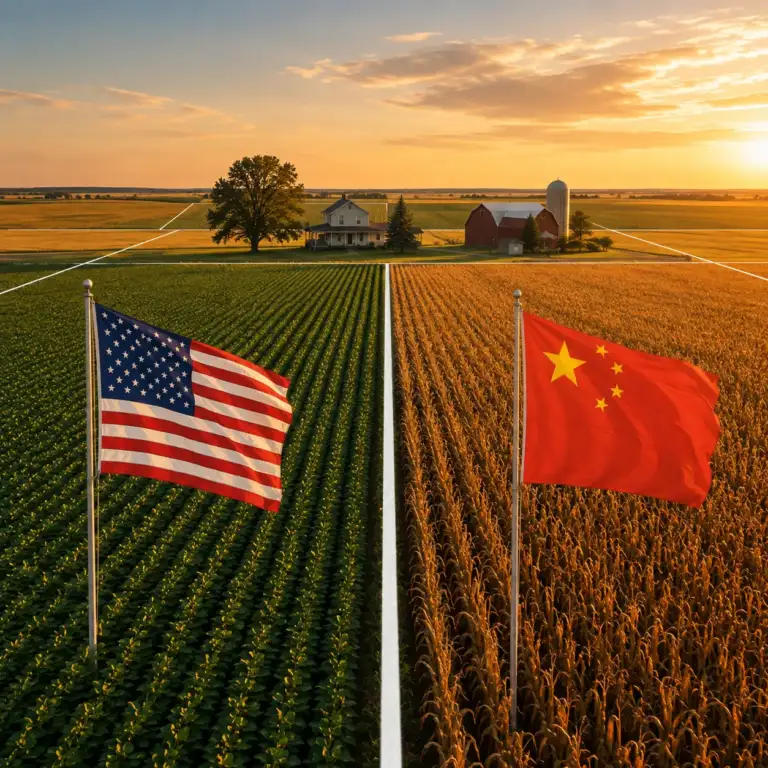
Ask most Americans who owns the nation’s farmland, and the answer they expect involves China. The actual data tells a considerably different, and in some ways more unsettling, story: foreign nations, adversarial or otherwise, own a genuinely small sliver of American agricultural land, while a much larger and faster-growing share is quietly being absorbed by Wall Street pension funds, insurance companies, and a handful of billionaires, reshaping who actually controls America’s food-producing land far more than any foreign government ever has.
Farmland occupies a unique place in the American imagination, tied inseparably to ideas about self-reliance, family legacy, and national food security. That makes the question of who actually owns it a genuinely important one, and this magazine believes it deserves a more careful answer than the version currently dominating political conversation. The honest picture involves two separate stories that get frequently conflated: a foreign ownership trend that is real but considerably smaller and more benign than headlines suggest, and a domestic financialization trend that is larger, faster-growing, and drawing far less political attention than it probably deserves.
The Foreign Ownership Panic, and What the Data Actually Shows
Start with the numbers, because they complicate the political narrative considerably. According to the USDA’s Farm Service Agency, foreign individuals and entities held an interest in more than 46 million acres of U.S. agricultural land as of the end of 2024, representing 3.6 percent of all privately held agricultural land in the country, up from just 26 million acres in 2011, a 67 percent increase between 2014 and 2023 alone. That growth is real and worth watching. What the same USDA data makes clear, and what political rhetoric frequently obscures, is who is actually doing the buying. Canada alone accounts for roughly 33 percent of all foreign-held agricultural land, more than 14 million acres, and more than 60 percent of total foreign-owned farmland belongs to close American allies: Canada, the Netherlands, Italy, the United Kingdom, and Germany. China, the country dominating the political conversation around this issue, owns just 277,336 acres as of the most recent data, roughly 0.02 percent of all privately held U.S. farmland and under 1 percent of all foreign-held acreage, a figure that has actually declined 27 percent since a 2021 peak as a result of divestments and blocked deals near sensitive military sites.
Fast Facts
46 million acres: Total U.S. agricultural land held by foreign entities, 3.6 percent of privately held farmland
277,336 acres: Chinese-owned share of that total, roughly 0.02 percent of all U.S. farmland and down 27 percent since 2021
60+ percent: Share of foreign-held farmland belonging to allied nations, led by Canada at roughly one-third
76 percent: Share of 2018-2023 foreign farmland growth driven specifically by renewable energy leases, not food production
242,000 to 275,000 acres: Bill Gates’s U.S. farmland holdings, making him the largest single private farmland owner in the country, and yet still only about 0.03 percent of total U.S. farmland
19 to 166: Growth in the number of dedicated farmland investment funds worldwide between 2005 and 2020
Why the Land Is Actually Being Bought: Renewable Energy, Not Food Control
Understanding what is actually driving the recent growth in foreign farmland holdings matters as much as the topline number, because it points toward a very different story than the one dominating political debate. The American Farm Bureau Federation’s own research found that renewable energy entities accounted for 76 percent of the total growth in foreign-owned agricultural land between 2018 and 2023, contributing 7.55 million of the 9.96 million acre increase over that period, driven by companies acquiring land specifically for wind and solar projects rather than food production of any kind. In just the single year between 2022 and 2023, entities with renewable energy-related terms in their names accounted for 54 percent of that year’s growth alone. Nationally, the composition of foreign-held land breaks down as roughly 48 percent forest and timber land, 29 percent cropland, and the remainder pasture, buildings, and infrastructure, meaning the food-producing cropland at the center of most political anxiety represents a meaningfully smaller share even of the already small foreign-owned total. USDA Secretary Brooke Rollins and the Trump administration have made banning Chinese-owned farmland a stated national security priority, and this magazine does not dispute that specific holdings near sensitive military installations warrant serious scrutiny. What the broader data does not support is the implication that foreign nations, adversarial or otherwise, currently exercise anything close to meaningful control over America’s food supply through land ownership.
The Bigger Story: Wall Street, Not Beijing
The far larger, faster-growing, and less politically discussed trend is the steady financialization of American farmland by domestic institutional capital, and no single figure illustrates it more vividly than Bill Gates. Through his investment vehicle Cascade Investment, Gates has spent more than a decade quietly acquiring farmland across nearly 20 states, building holdings that now total between 242,000 and 275,000 acres, concentrated heavily in Louisiana, Arkansas, Nebraska, Washington, and Florida, making him the single largest private owner of farmland in the entire United States. It is worth noting immediately that this remarkable concentration still represents only about 0.03 percent of America’s roughly 876 million total farmland acres, a reminder that even the largest individual holding in the country is tiny relative to the whole. What makes the Gates example significant is not its scale in isolation but what it represents as a leading indicator of a much broader shift. The Teachers Insurance and Annuity Association of America, through its asset management arm Nuveen, has become one of the largest institutional farmland investors in the world, and the broader universe of dedicated farmland investment funds grew from just 19 funds globally in 2005 to 166 by 2020, a nearly ninefold increase driven substantially by momentum following the 2008-2009 financial crisis, when institutional investors seeking safe, inflation-resistant alternatives to bonds and traditional real estate discovered farmland’s remarkably stable long-term performance. The NCREIF Farmland Index, the industry’s standard benchmark, generated average annual returns of roughly 6.6 percent between 2014 and 2025 with comparatively low volatility, a track record attractive enough to draw pension funds, insurance companies, and ultra-wealthy individuals into a market that, for most of American history, was dominated almost entirely by the families actually working the land.
“When we have less small farms, it tends to be less farmer owned and operated land; it tends to be a nonfarming landowner leasing it out to farmers.”
— Agricultural land use researcher, describing the shift toward institutional and absentee farmland ownership
What Happens to the Family Farm When the Landlord Is a Hedge Fund
The practical consequence of this shift shows up directly in farm consolidation data across the country. In Washington state, a representative example, the number of farms fell from 38,200 to 35,600 between 2010 and 2019, even as average farm size grew from 382 to 410 acres and total farm acreage remained essentially unchanged, meaning the same land is simply being consolidated into fewer, larger operating units. Researchers studying this trend describe a specific, consequential shift: as institutional and billionaire investors acquire farmland, the people actually working that land increasingly do so as tenants leasing from an absentee owner rather than as owner-operators building equity of their own, a dynamic that reduces the long-term wealth-building capacity available to working farmers, an effect researchers have found falls particularly hard on women and minority farmers who already face steeper barriers to land ownership. In many cases, the day-to-day reality for a farmer on newly institutionally owned land changes remarkably little; the same family may keep farming the same fields, simply signing a rent check to a distant investment manager instead of owning the ground outright. What changes is who ultimately captures the land’s appreciating value, and who makes the major decisions, about water rights, land use, and long-term farming practices, decisions increasingly made hundreds of miles away by an investment committee rather than by the family whose name was once on the deed.
Food Security: A More Complicated Question Than It Sounds
The honest answer to whether this concentration threatens American food security is more nuanced than either side of the debate typically allows. In most cases documented so far, institutional ownership has not removed land from food production; investors generally have every financial incentive to keep productive cropland productive, and existing tenant farmers frequently continue working the same ground under new ownership with little immediate disruption to output. The more legitimate concern is not an imminent collapse in food production but a slower, structural one: decision-making authority over increasingly large shares of America’s most productive land shifting away from farming families and rural communities and toward distant financial institutions whose primary obligation is to their investors’ returns rather than to the long-term health of any particular region’s agricultural economy. Water rights present a particularly sharp version of this concern, as institutional buyers increasingly target land specifically for its water access in regions where that resource is growing scarcer, a dynamic that could eventually disadvantage smaller, less capitalized farmers competing for the same increasingly limited water.
What Should Actually Worry Americans
This magazine believes the honest conclusion here cuts against the more politically convenient narrative. The version of this story that generates the most political heat, foreign nations, and China specifically, quietly buying up American food-producing land, is real enough to warrant continued monitoring and legitimate scrutiny of specific holdings near sensitive sites, but it remains, by every available measure, a genuinely small phenomenon relative to the size of American agriculture as a whole. The version of this story receiving far less political attention, the steady, decades-long financialization of American farmland by domestic pension funds, insurance companies, and billionaire investors, is considerably larger in scale, growing faster, and arguably poses a more serious long-term threat to the traditional family farm model this country has always associated with genuine food security and rural community stability. A farmland market increasingly dominated by institutional capital chasing a reliable 6.6 percent annual return is not the same thing as a farmland market controlled by hostile foreign powers, but it represents its own genuine transformation of who actually holds power over America’s food-producing land, and this magazine believes it deserves at least as much serious attention as the more headline-friendly foreign ownership story currently commands.
The Bottom Line
Who owns America’s farmland is not, in the end, a story primarily about Beijing. It is a story about Wall Street, about pension funds and insurance companies and a small number of extraordinarily wealthy individuals who have discovered, over the past two decades, that owning the ground American food grows on is a remarkably stable place to park capital. That shift is not illegal, and this magazine does not believe every institutional farmland purchase represents a crisis. But a nation that prizes the family farm as a genuine cultural and economic institution, not merely a nostalgic image, owes itself an honest reckoning with which trend is actually reshaping that institution fastest. On the evidence assembled here, it is not foreign governments buying up American soil. It is American capital, increasingly concentrated in fewer and fewer hands, quietly becoming the landlord of the nation’s food supply.
References
Investigate Midwest, “US farmland continues folding to foreign-owned interests,” May 2025
USDA Farm Service Agency, “Foreign Holdings of U.S. Agricultural Land,” Annual Report to Congress, 2024 data
Capital Press, “USDA targets Chinese-owned farmland,” 2026
American Farm Bureau Federation, Market Intel, “Foreign Footprints: Trends in U.S. Agricultural Land Ownership,” January 2025
National Land Realty, “Is China Buying Up U.S. Farmland? What the Numbers Actually Say,” December 2025
Doolly, “China’s US Farmland Ownership: 2025 Facts & Risks,” June 2026
Global Affairs, “How Much US Land Do China and Other Countries Really Own?”
AgFunderNews, “He says it’s not about climate. So why is Bill Gates investing in farmland?” January 2025
Cascade PBS, “Bill Gates is investing big in American farmland,” June 2025
Barchart, “Bill Gates now owns nearly 0.03% of all U.S. farmland but promises there isn’t some grand scheme involved”
FarmTogether, “Who Owns America’s Farmland?” May 2026, citing NCREIF Farmland Index and the 2026 Land Report 100