
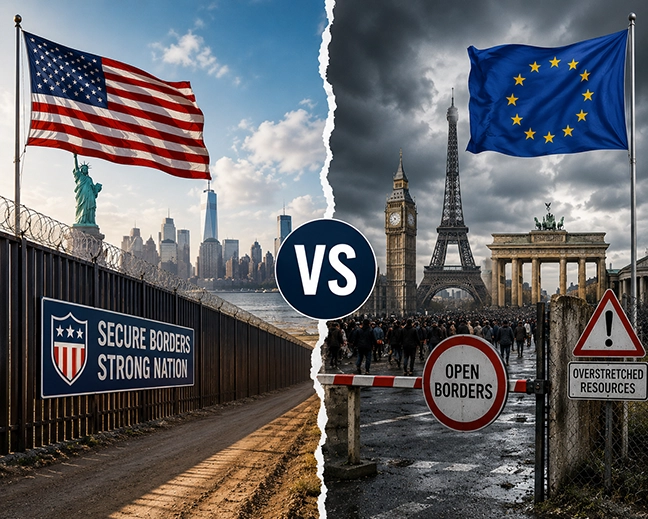
A British government audit that found officials “shied away” from confronting the ethnicity of organized abuse rings. German crime data that show sharp, measurable disparities by migration status. A Swedish prime minister who stood up in 2022 and said the word “failed” out loud. French crime statistics that rose across nearly every category in 2025. And now, from the Netherlands to Denmark to Italy, governments across the continent, not just the far right, are reversing course. Watching from across the Atlantic, an American administration drew its own conclusion, and reversed course on immigration more sharply than at any point in modern US history rather than risk repeating what Europe is now reckoning with.
For years, raising concerns about Europe’s integration failures in polite company was treated as evidence of prejudice rather than observation. That posture is becoming harder to sustain against the government’s own numbers, and it is no longer confined to Britain, Germany, and Sweden. In 2025, a British government commissioned audit concluded that officials at every level had, in its own words, “shied away” from confronting the ethnicity of men convicted in organized child exploitation rings. Germany’s federal police published crime data showing sharp, specific disparities tied to migration status. Sweden’s prime minister told her own country plainly that integration had failed. And in France, the interior ministry’s own 2025 crime figures rose across nearly every category tracked, while the Netherlands, Denmark, Italy, and Belgium have each, in their own way, abandoned the multicultural assumptions they operated under for decades. None of what follows is a verdict on a faith practiced by two billion people worldwide, the overwhelming majority of whom will never come near any of the failures described here. It is an accounting of what happens when governments choose comfort over honesty, and increasingly, it is a story about an American government that watched it happen and chose, deliberately, not to follow the same path.
Britain’s Reckoning: What “Shied Away From” Actually Cost
The scandal known in Britain simply as the grooming gangs case did not begin in 2025. Convictions in towns like Rotherham, Rochdale, and Telford stretch back over a decade, and a 2022 national inquiry led by Professor Alexis Jay had already found institutional failings affecting tens of thousands of victims across England and Wales. What changed in 2025 was the government’s willingness to name why those failures happened. Baroness Louise Casey, tasked with a rapid national audit, reported in June 2025 that data collection on offender ethnicity had been inconsistent nationally, but that in the local datasets that did exist, suspects were disproportionately represented, and that authorities had avoided examining the pattern out of concern for how it would look. The government accepted her recommendation for a full statutory inquiry, which formally began work in April 2026 under Baroness Anne Longfield, with explicit instructions to examine the ethnicity, religion, and culture of both perpetrators and victims, precisely the question officials had spent years declining to ask.
It is worth being precise here, because precision is the entire point of this piece. A separate, privately funded inquiry this year claimed as many as 250,000 predominantly white girls may have been exploited nationally, a figure that fact-checkers, and Professor Jay herself, have said is not supported by official national data and should not be extrapolated from localized findings in Rotherham. That specific number does not hold up, and a magazine committed to accuracy should say so plainly rather than repeat a viral figure because it is convenient. What does hold up, on the government’s own authority, is this: a national audit found that fear of being called racist caused British institutions to look away from real, documented, organized abuse of children for years.
Fast Facts
June 2025: Baroness Casey’s national audit finds British officials nationally “shied away” from examining offender ethnicity in grooming gang cases
8.8 percent: Share of criminal suspects in Germany’s 2024 BKA data classified as migrants, against roughly 4 to 5 percent of the population
80 and 64 percent: Share of Swedish shooting victims and perpetrators, respectively, with an immigrant background, per 2025 research using Swedish police data
Up to 8 percent: Rise in sexual violence recorded by France’s Interior Ministry between 2024 and 2025, with nearly every other crime category rising as well
2002 and 2004: The assassination of Pim Fortuyn and murder of Theo van Gogh, the twin shocks that reversed decades of Dutch multiculturalism
~60 percent: Drop in illegal sea arrivals to Italy under Giorgia Meloni’s government, through naval enforcement and bilateral deals with North African states
6,478: US Border Patrol encounters in December 2025, down from a peak of 249,740 in December 2023, the lowest level in more than 50 years
Germany’s Numbers, and Sweden’s Parallel Societies
Germany’s Federal Criminal Police Office, the BKA, does not hide from publishing this data, which is itself worth noting; the German state, unlike Britain’s for so long, has chosen transparency. Its 2024 report found that of nearly 1.97 million known criminal suspects nationwide, 172,203, or 8.8 percent, fell into the BKA’s specific “migrant” category, covering asylum seekers, people with temporary protection status, and undocumented residents, a group that makes up a meaningfully smaller share of Germany’s overall population. In Bavaria, the state’s Interior Minister cited BKA regional data showing Syrian nationals with a crime rate sixteen times that of German citizens, and Afghan nationals at fourteen times. German researchers themselves attach an important caveat: those without German citizenship are, on average, more exposed to the social and demographic risk factors that correlate with offending regardless of origin, and are more likely to be stopped and checked by police in the first place. That caveat is real. It does not erase the underlying numbers.
Sweden’s prime minister has been the bluntest voice on the continent. In 2022, Magdalena Andersson told her country directly that Sweden had failed to integrate the large numbers of immigrants it had welcomed over two decades, and that the result was parallel societies and organized gang violence. Research using current Swedish police data found that individuals with an immigrant background account for 80 percent of shooting victims and 64 percent of shooting perpetrators today, though Sweden’s own police credit more proactive tactics with bringing shootings down significantly since 2022, a genuine improvement worth acknowledging.
France: A Distinctly French Deterioration
France presents the starkest recent data point on the continent. Following the release of 2025 immigration figures, the French Interior Ministry published crime statistics showing that nearly every indicator it tracks, aside from burglary, rose between 2024 and 2025: physical violence and homicides up roughly 5 percent on average, sexual violence up as much as 8 percent. Analysts cross-referencing that data with Eurostat figures have noted something specific to France: neighboring countries with comparably large migrant populations have not seen the same across-the-board deterioration, suggesting the issue is not simply “Europe” in the abstract but a distinctly French combination of policy and enforcement failures. France counted more than 7.3 million third-country nationals as of January 2024, roughly 10.8 percent of its population, and has spent years tightening its response, five separate revisions to asylum law between 2015 and 2022, a 45 percent increase in border spending, and a rise in the income threshold required to sponsor family reunification, changes that suggest a government aware something had gone wrong well before the 2025 numbers confirmed it.
The clearest illustration may not be a crime statistic at all but a classroom one. A 2020 survey by the polling institute IFOP found teachers in France’s marginalized banlieue housing estates reporting real, practical difficulty simply teaching the Holocaust to their students, a finding that predates and helps explain the recurring unrest, including riots following Paris Saint-Germain football matches in 2025 and 2026 that observers noted were, remarkably, worse after the club’s own championship wins than after past losses, involving what reporting described as French citizens of African origin from communities that had lived in France for two and three generations without integrating into the values of the nation that had, on paper, already made them citizens.
The Pattern Spreads Across the Continent
France and Britain are not outliers anymore; they are simply the two countries where the reckoning became most visible first. The Netherlands underwent its own reversal two decades ago, triggered by the 2002 assassination of the anti-immigration politician Pim Fortuyn and the 2004 murder of filmmaker Theo van Gogh by an Islamist extremist, shocks that pushed Dutch policy away from its historic “pillarization” model of parallel cultural communities and toward mandatory civic integration contracts, language testing, and sanctions for noncompliance. That shift mainstreamed further still when Geert Wilders’ Party for Freedom surged in the 2023 elections and entered government pursuing what observers called the strictest asylum policy in Europe, a coalition that eventually collapsed in 2025 over internal migration disputes but left hardline assimilation demands as the new political baseline rather than a fringe position.
Denmark, governed by a center-left party, took an even more direct step: creating what officials originally called a “ghetto list,” now rebranded a “parallel society list,” a formal government tool identifying residential districts where concentrations of non-Western immigration correlate with high crime, low employment, and educational underperformance, districts subject to specific redevelopment and integration requirements as a matter of law. Italy under Giorgia Meloni has pursued a different lever entirely, achieving roughly a 60 percent reduction in illegal sea arrivals through expanded naval enforcement and bilateral agreements with Tunisia and other North African departure points. Belgium extended its own mandatory integration pathway for newcomers from eighteen months to three years in 2025 under a new nationalist Asylum and Migration Minister, part of a governing coalition that has made civic integration a central condition of citizenship. And in May 2025, nine EU governments at once, Italy, Denmark, Austria, Belgium, the Czech Republic, Estonia, Latvia, Lithuania, and Poland, formally petitioned Brussels to make it easier to deport foreign nationals convicted of crimes, a coalition notable for including center-right and center-left governments alike rather than only self-described far-right parties.
Why Institutions Looked Away
What ties these countries together is not a single religion. It is a single institutional posture, repeated across seven different governments and seven different political systems: a decades-long unwillingness to enforce the ordinary expectations of integration, and to say plainly when specific immigrant communities were disproportionately involved in specific documented harms, out of fear that doing so would be branded bigotry. Baroness Casey did not conclude that Islam caused British authorities to look away from grooming gangs. She concluded that fear of being called racist did. That is a conclusion about institutional cowardice and multicultural policy, not about a faith, and it is precisely the distinction that matters if the goal is actually fixing the problem rather than simply having an argument about it.
“Sweden has failed to integrate the vast numbers of immigrants it has taken in.”
— Magdalena Andersson, Prime Minister of Sweden, 2022
The Voters Have Noticed, Everywhere
European voters have stopped waiting for permission to say what their governments were reluctant to. In August 2025, for the first time in modern history, right-populist parties simultaneously led national polling in Europe’s three largest economies at once: Germany’s AfD overtook the governing CDU, France’s National Rally under Jordan Bardella has held a commanding lead near a third of the vote heading into 2027, and Britain’s Reform UK swept the May 2025 local elections with 677 council seats. But the same rightward shift on enforcement, as the nine-country deportation letter shows, is no longer confined to parties branded far-right. Even Denmark and the UK’s incumbent center-left governments have pared back citizenship and residency rights in the past year, a sign that the political center itself has moved rather than simply being outflanked.
The Warning Reaches Washington
Europe’s reckoning did not stay in Europe. In January 2025, Elon Musk spent weeks publicly pressing UK Prime Minister Keir Starmer over his earlier role prosecuting grooming gang cases, dragging a British domestic scandal directly into the American news cycle and helping build pressure toward Britain’s eventual national inquiry. The American policy response has been to chart a starkly different course, deliberately. Border Patrol encounters at the southern border fell from a peak of 249,740 in December 2023 to just 6,478 in December 2025, the lowest level in more than fifty years, according to Pew Research Center. The administration reports roughly 2.2 million self-deportations alongside more than 675,000 formal deportations in its first year back in office, alongside terminated protected status for numerous countries and paused visa processing for nationals of 75 countries deemed high risk. Net international migration to the United States, which peaked at 2.7 million people in 2024, is projected to fall to roughly 321,000 in 2026, a reversal without precedent in the modern American era.
The Bottom Line
The evidence assembled here, now spanning seven countries and two continents, is real, specific, and sourced from government audits and official crime statistics rather than viral social media claims. It supports a hard conclusion about policy: multiculturalist orthodoxy, enforced more by institutional fear than by evidence, allowed real and serious harms to go undocumented and unaddressed across Britain, Germany, Sweden, France, and beyond for years, and voters, followed increasingly by governments of every political stripe, are now correcting course. What the evidence does not support is a verdict on an entire religion or the ordinary Muslim families across Europe and America who are themselves neighbors, taxpayers, and in many documented cases the loudest voices calling for exactly the reforms described here. The failure was never that a faith existed. The failure was that governments across an entire continent refused to say plainly what their own data was already telling them, and America, watching closely, has already decided it does not intend to pay the same price. All in all, Islam is Incompatible with Western Culture and there is no denying it.
References
House of Commons Library, “The Independent Inquiry into Grooming Gangs,” 2026
Al Jazeera, “UK announces national inquiry into ‘grooming gangs’ after pressure,” June 2025
The Express Tribune, “The 250,000 UK grooming gang figure is not based on official data”
InfoMigrants, “Germany: Changing attitudes towards migrants, asylum seekers and refugees a decade after Cologne station assaults,” December 2025
DeZIM-Institut, “Fact check on integration”
Uppsala University Department of Economics, “The ripple effect of gang violence”
Euronews, “Swedish PM says integration of immigrants has failed, fueled gang crime,” 2022
The European Conservative, “French Crime Breaks New Records,” January 2026
Tablet Magazine, “Paris Is Burning,” June 2026
European Commission Migration and Home Affairs, “Migrant integration in France”
The Local, “‘Continued crackdown’: How immigration laws could change in Europe in 2026,” December 2025
Context by TRF, “Fortress Europe: Migration flashpoints in 2025,” December 2025
European Commission Migration and Home Affairs, “Changes to integration support and migration policy in Belgium,” February 2026
NBC News, “Far-right populists top polls in Germany, France and Britain for the first time,” August 2025
Brookings Institution, “How 2026’s divisive immigration politics could lead to a solution down the road,” April 2026
Pew Research Center, Border Patrol encounter data