
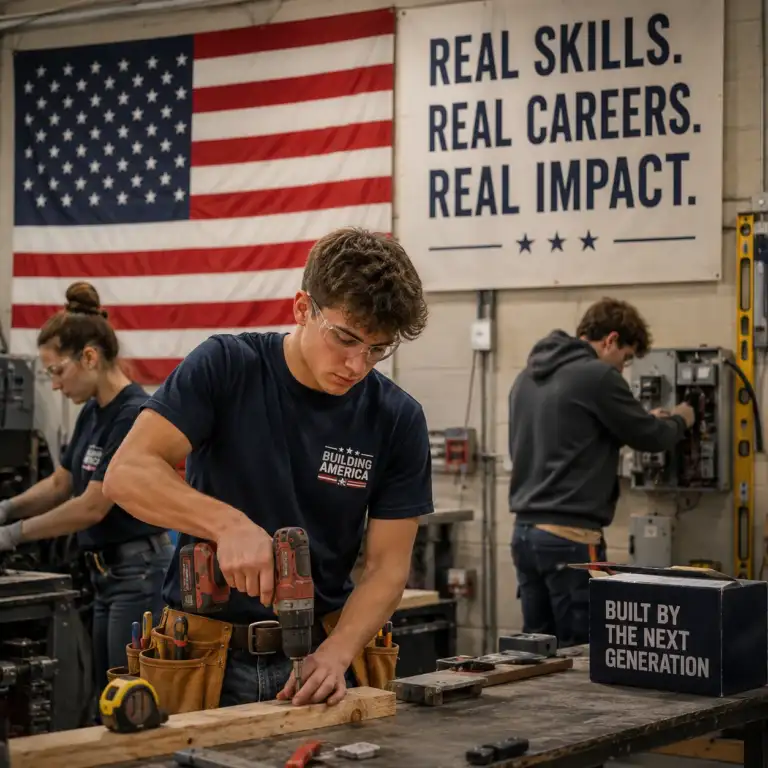
Elijah Rios has not graduated high school yet. He already has a job offer worth $68,000 a year. Kayden Evans, an eighteen-year-old senior in Mesa, Arizona, has never seriously entertained a college application, choosing instead to walk straight from graduation into an apprenticeship. Neither of them is an outlier anymore. They are part of a genuine, measurable generational shift, one this magazine believes deserves to be told through the actual young Americans living it rather than through statistics alone.
For most of the past three decades, American teenagers were handed a nearly universal script: work hard, get into the best college you can, and everything else follows. A growing share of Gen Z is quietly rewriting that script, not out of rebellion but out of arithmetic, watching an older generation absorb crushing student debt for degrees that too often failed to deliver the promised return, and concluding that a different path, one that starts with a paycheck instead of a tuition bill, makes more sense for them personally. This magazine set out to tell that shift through the young people actually living it.
Elijah Rios Already Has a Job Offer, and He’s Still in High School
Elijah Rios is seventeen years old, a junior at Father Judge, a Catholic high school in Philadelphia that partners closely with local employers seeking skilled trades workers. He will not graduate until next year. He already has a job offer waiting for him worth $68,000 annually, secured through the welding classes his school built specifically to connect students with companies desperate for trained labor, according to reporting in the Wall Street Journal. Rios’s story captures something this magazine believes deserves far more attention than it currently receives: a genuine, employer-backed pipeline that lets a high school junior lock in a starting salary most recent college graduates would consider a strong outcome, before he has spent a single dollar on tuition or taken on a cent of debt.
Fast Facts
$68,000: Starting job offer secured by 17-year-old welding student Elijah Rios before graduating high school
57 percent: Share of Gen Z citing student loan debt as a top concern about pursuing college, per Jobber’s annual survey
71 percent vs. 7 percent: Share of Gen Z who see more stigma attached to vocational school than college, compared with the share of their parents who actually prefer the trades route
6 in 10: Gen Z adults who said they planned to pursue “blue collar” work in 2026, per a January 2026 Resume Templates survey
1.4 million: Trade jobs projected to go unfilled by 2030 due to retirements and rising infrastructure demand, per the nonprofit Bring Back the Trades
11.7 to 23 percent: Range of recent year-over-year growth in vocational and construction trades enrollment at community colleges, depending on the specific program measured
Kayden Evans Skipped the College Question Entirely
Kayden Evans, an eighteen-year-old senior at Mountain View High School in Mesa, Arizona, represents a version of this shift that never really involved wrestling with the traditional script in the first place. Currently interning at Empire Cat, a company that sells, rents, and services heavy construction equipment, Evans plans to move directly from high school graduation into a formal apprenticeship with the company, building toward his own eventual business rather than toward a bachelor’s degree he never particularly wanted. Evans has also expressed a confidence common among the young tradespeople this magazine spoke with in researching this piece: a belief that his chosen path offers him something increasingly rare in the broader labor market, genuine insulation from the artificial intelligence disruption reshaping so much of white-collar entry-level hiring.
The Electrician Who Bet on Himself
A young electrician identified in CBS News reporting simply as Palmer offers perhaps the clearest financial case for this generational shift. After discovering college was not the right fit for him, Palmer entered the trades as an apprentice electrician and launched his own business in 2024. That business generated $90,000 in revenue in its very first year and was on track to exceed $150,000 in 2025, a growth rate topping 30 percent, achieved entirely without a college degree. Palmer’s own account of the decision emphasizes independence as much as income: “I am very happy doing what I am doing now because it has given me the opportunity to work for myself and be independent,” he told CBS News. On the question of artificial intelligence specifically, the anxiety increasingly shadowing white-collar entry-level careers, Palmer sounded genuinely unworried: “I don’t feel overly threatened by the growth of AI in my industry. That will be a pretty impressive robot that can do my job one day, if it ever happens.”
From Stigma to TikTok Pride
Not every young tradesperson found the transition easy, and the cultural resistance many of them describe is worth taking seriously in its own right. One HVAC business owner identified in New York Times reporting as Shikhman built his own company after choosing trades over college, and now earns more than $100,000 a year. Getting there required overcoming real skepticism, including from his own parents, before his visible success eventually won them over. Shikhman has since become an outspoken advocate for exactly the path he chose, posting under the handle “Trades Over College” on TikTok and Instagram, including one widely shared video of him welding captioned simply, “POV: AI can’t replace HVAC.” His experience mirrors a broader pattern documented in that same reporting: a young man identified only as Glass left college after a single year to pursue trade work instead, part of what the Times described as an entire cohort of young tradespeople encountering well-meaning but genuine pushback from family members, school counselors, and friends who assumed college remained the only respectable path forward, precisely the assumption this new generation is actively working to overturn.
“Young people watched a generation take on serious debt for degrees that didn’t guarantee much, and they did the math. An apprentice earns while learning instead of paying to learn.”
— Industry commentary on the shift toward trades, The Epoch Times, 2026
The Numbers Behind Their Choice
The stories above are not isolated anecdotes; they sit on top of a genuine statistical shift. Enrollment at public, two-year vocational and trade-focused colleges grew nearly 20 percent between 2020 and 2025, according to National Student Clearinghouse data, with a particularly sharp 11.7 percent jump in the spring of 2025 alone. Construction trades enrollment specifically surged 23 percent in a single recent year, while HVAC and vehicle maintenance programs grew 7 percent over the same period. A January 2026 survey of 1,250 Gen Z adults found six in ten planned to pursue blue-collar work that year, and 57 percent of Gen Z respondents to Jobber’s annual survey named student loan debt directly as a top concern discouraging them from the traditional college path. Yet the same research reveals a genuine generational tension still working itself out inside American families: 71 percent of Gen Z respondents said they perceive more social stigma attached to vocational school than to college, even as only 7 percent of their own parents said they actually preferred the trades route for their children. That gap, a generation increasingly choosing trades despite continuing to sense real stigma around the choice, and parents who have not fully caught up to their children’s own confidence in it, is precisely the tension young tradespeople like Shikhman describe navigating in real time.
Not Every Trade Story Is a Success Story
Fairness requires including the complications this generational shift genuinely carries, and this magazine does not want to present an uncritical success story. A 2026 WalletHub study ranking the best and worst entry-level jobs in America found several trade occupations, welders, automotive mechanics, boilermakers, and drafters among them, ranking near the bottom of the list, scored down specifically for limited job availability in some regions, weaker long-term growth projections relative to other fields, and genuinely hazardous working conditions. Steven Morgan, a licensed master plumber and certified HVAC technician, offered a similarly grounded caution in recent reporting: “The body takes a beating. You’re in attics in August, and the real money comes after years of licensing and hard experience.” That is an important corrective to any version of this story that presents trades as an easy or immediate shortcut to wealth. The young people profiled in this piece did not simply skip college and land in comfortable prosperity overnight; Rios’s job offer reflects years of dedicated coursework, Palmer’s business took real time and real risk to build past its first profitable year, and Morgan’s warning about the physical toll of decades of trade work deserves to be weighed honestly alongside every optimistic statistic in this piece.
Why This Generation Sees a Different Ceiling
What distinguishes this generation’s approach to trades from earlier ones, several industry voices in recent reporting argue, is a growing recognition that the trades represent not a career ceiling but one of the more direct paths toward eventual business ownership available in the American economy today. An apprentice electrician or plumber does not simply learn to fix a circuit or a pipe; over years of real, paid, on-the-job training, many transition into project managers, estimators, or eventually business owners in their own right, developing genuine financial literacy and customer-facing skills alongside their technical craft, a trajectory this magazine has documented in detail in its own reporting on the surprising wealth-building potential of skilled trades ownership. Rios, Evans, Palmer, and Shikhman are not simply choosing a job over a degree. On the evidence of their own stated ambitions, several of them are choosing the earliest possible entry point into eventually owning something of their own, years before most of their college-bound peers will have finished paying off the debt required just to start.
The Bottom Line
The young Americans profiled in this piece did not arrive at their decisions through rebellion against their parents’ generation, and none of them describe their choice as a rejection of ambition. They describe it, consistently, as the more carefully calculated option: a paycheck instead of a tuition bill, a skill instead of a credential, and, in a labor market increasingly reshaped by artificial intelligence displacing exactly the kind of entry-level knowledge work this magazine has documented elsewhere, a trade that cannot be automated away by a language model no matter how capable it becomes. Elijah Rios will graduate high school next year already earning what many of his college-bound classmates will still be chasing five years after their own graduation. That is not a story about a generation giving up on the American Dream. It is a story about a generation quietly deciding the traditional map to it no longer matches the terrain, and choosing, with real clear-eyed calculation, to draw their own.
References
CBS News, “As AI threatens white-collar work, more young Americans choose blue-collar careers,” October 2025
StudentNewsDaily, “More young Americans choosing skilled trades over college,” October 2025, excerpting The Wall Street Journal, May 2025
The Epoch Times, “Students Seek to AI-Proof Their Careers With Trades Over College,” July 2026
ZeroHedge, “Students Seek To AI-Proof Their Careers With Trades Over College,” reprint of Epoch Times reporting
Fortune, “Gen Z is ditching college for ‘more secure’ trade jobs—but boilermakers and welders actually rank among the worst entry-level jobs,” June 2026, citing WalletHub
DNYUZ/The New York Times, “Mom, Dad, I Want to Be a Welder,” July 2026
JobAdvisor, “Mom, Dad, I Want to Be a Welder,” July 2026, citing a 2025 Jobber report
TradeColleges.org, “I Have a Bachelor’s Degree — Should I Go Into the Trades? (2026),” citing National Student Clearinghouse and BLS OEWS data
AOL/Fortune, “More Gen Z choosing trade school over college to become welders and carpenters”