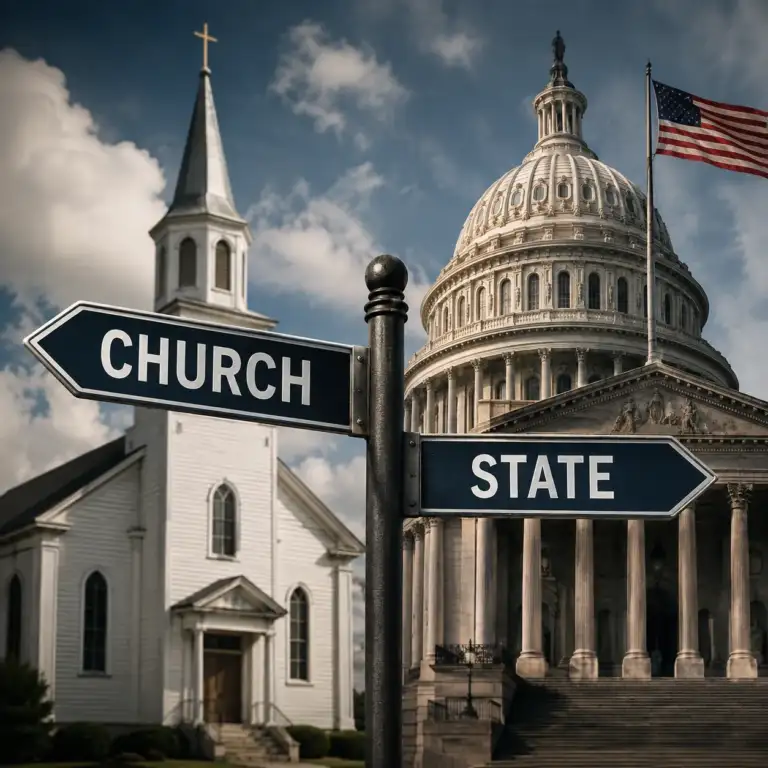
“Separation of church and state” has been treated for a generation as settled constitutional law. It isn’t a phrase in the Constitution at all. What the document actually says, in sixteen words, is considerably narrower, and considerably more protective of religious Americans, than most people have been taught. That gap between the myth and the text is exactly why religious liberty has become one of the most consequential legal battlegrounds in the country again.
Ask most Americans what the Constitution says about religion, and they will confidently recite something close to “separation of church and state.” Ask them to find that phrase in the document itself, and they cannot, because it is not there. What the First Amendment actually says is this, in full: “Congress shall make no law respecting an establishment of religion, or prohibiting the free exercise thereof.” Sixteen words, two distinct commands, and neither one is “keep faith out of public life.” Understanding the real text, where the popular phrase actually came from, and how dramatically the Supreme Court’s own approach to these questions has shifted in just the past few years, is the only way to make sense of why church and state have returned to the center of American politics, and why that return should be understood as a correction rather than a crisis.
What the Constitution Actually Says
The Establishment Clause and the Free Exercise Clause were written together, in the same sentence, for a reason. The Founders had watched centuries of European history in which state-sponsored churches, the Church of England chief among them, used government power to punish religious dissenters, tax citizens to fund a single approved denomination, and require public office holders to swear allegiance to specific doctrines. The Establishment Clause was aimed squarely at preventing that outcome: no official national church, no government preference for one Christian denomination over another, no coerced financial support for a state religion. The Free Exercise Clause was aimed at the opposite failure mode: government actively suppressing religious practice, which the colonists had also experienced firsthand. Read together, the two clauses were never in tension in the Founders’ own minds. They were two halves of a single guarantee: government stays out of the business of running or restricting religion, and citizens remain free to practice their faith without the state’s permission or interference.
What the text does not say is equally important. It does not say government must be religiously neutral in the sense of scrubbing faith from public institutions. It does not say elected officials cannot invoke God, that public buildings cannot reference Scripture, or that schools cannot acknowledge the religious history of the nation. The First Congress, the same body that approved the First Amendment’s language, opened its sessions with prayer, appointed paid chaplains for the House and Senate, and just one day after finalizing the Bill of Rights, passed a resolution asking President Washington to proclaim a national day of public thanksgiving to God. The Northwest Ordinance of 1787, reenacted by that same Congress, declared plainly that “religion, morality, and knowledge, being necessary to good government and the happiness of mankind, schools and the means of education shall forever be encouraged.” Men who genuinely believed the Constitution demanded the eradication of religion from public life would not have written that sentence into federal law within a year of ratifying the amendment supposedly requiring it.
The Phrase That Isn’t There
So where did “separation of church and state” actually come from? Not the Constitution, and not the Constitutional Convention. It comes from a private letter Thomas Jefferson wrote in 1802, more than a decade after the First Amendment’s ratification, to the Danbury Baptist Association in Connecticut, a religious minority that had written to Jefferson worried about government interference in their worship. Jefferson responded that the First Amendment built “a wall of separation between church and state,” reassuring the Baptists, who were themselves a persecuted religious minority in a state with an established Congregationalist church, that the federal government could not reach into their religious practice. It was a letter about protecting religious exercise from government control, not a call to strip religion from public life, and Jefferson himself, as president, attended religious services held in the House of Representatives and signed treaties with Native American tribes that included direct federal funding for Catholic missionary priests.
That phrase sat largely dormant in American law for well over a century. It was the Supreme Court, not the Founders, that elevated Jefferson’s letter into the centerpiece of constitutional doctrine, in the 1947 case Everson v. Board of Education, when Justice Hugo Black wrote that the Establishment Clause required a wall “high and impregnable” between church and state, even while the Court in that same case allowed the government funding at issue to stand. From that point forward, “separation of church and state” became the operative shorthand in American legal and popular culture, even though the phrase itself remains, to this day, absent from the actual constitutional text.
Fast Facts
1789: The First Amendment is ratified: “Congress shall make no law respecting an establishment of religion, or prohibiting the free exercise thereof”
1802: Thomas Jefferson’s private letter to the Danbury Baptists coins the phrase “wall of separation between church and state,” never used in the Constitution itself
1947: Everson v. Board of Education elevates Jefferson’s phrase into Supreme Court doctrine
1971 to 2022: The three-part “Lemon test” governs Establishment Clause cases before being explicitly discarded by the Supreme Court
2022: Kennedy v. Bremerton School District replaces Lemon with a “history and tradition” standard
2025 to 2026: The Supreme Court decides Mahmoud v. Taylor, Catholic Charities Bureau v. Wisconsin, and splits 4-4 on Oklahoma’s religious charter school case, while Louisiana’s Ten Commandments classroom law is cleared to take effect
From “Wall of Separation” to “History and Tradition”
For fifty years after Everson, the Supreme Court’s Establishment Clause cases were governed by a three-part standard known as the Lemon test, drawn from the 1971 case Lemon v. Kurtzman, which asked whether a government action had a secular purpose, whether its primary effect advanced or inhibited religion, and whether it created “excessive entanglement” between government and religious institutions. In practice, the test produced years of famously inconsistent rulings, courts allowed a Ten Commandments monument on the Texas capitol grounds while striking down a nearly identical display inside a Kentucky courthouse, upheld some public nativity scenes while striking down others based on how many secular decorations sat nearby. Even justices who had applied the test for decades openly criticized it as unpredictable and unmoored from the actual history the Establishment Clause was meant to reflect.
That began changing meaningfully with Town of Greece v. Galloway in 2014, which upheld a town council’s practice of opening meetings with sectarian prayer by looking to historical practice rather than the Lemon factors, and it reached its full conclusion in 2022 with Kennedy v. Bremerton School District, the case of a public high school football coach disciplined for praying at midfield after games. The Supreme Court did not merely rule in the coach’s favor. It explicitly stated that Lemon and its “endorsement test” offshoot did not control Establishment Clause cases at all, and that courts must instead look to “historical practices and understandings” to determine what the Founders actually meant the clause to prohibit. That single doctrinal shift, from a modern, judge-invented three-part balancing test to a return to founding-era history, is the legal hinge on which nearly every major religious liberty case since has turned.
The Court’s New Docket
The results of that shift have shown up quickly and consequentially. In Mahmoud v. Taylor, decided in 2025 with an opinion by Justice Alito, the Supreme Court ruled that Montgomery County, Maryland’s public schools could not require students to sit through LGBTQ-themed storybook instruction without allowing religious parents to opt their children out, holding that the government cannot condition access to public education on parents accepting instruction that poses a genuine threat to the religious beliefs they are raising their children in. In Catholic Charities Bureau v. Wisconsin Labor and Industry Review Commission, decided the same year in a unanimous opinion by Justice Sotomayor, the Court struck down a Wisconsin unemployment tax scheme that exempted only religious organizations engaged in specific, state-approved forms of “typical” religious activity, ruling that the state had unconstitutionally put itself in the business of deciding which religious practices counted as sufficiently religious, precisely the kind of denominational favoritism the Establishment Clause was written to forbid.
Not every case has resolved cleanly. In Oklahoma v. Drummond, the closely watched fight over whether Oklahoma could approve the nation’s first publicly funded religious charter school, St. Isidore of Seville Catholic Virtual School, the Supreme Court split 4-4, with Justice Barrett recused, leaving in place an Oklahoma Supreme Court ruling that blocked the school without setting any national precedent either way. That question, whether a state can fund and operate an explicitly religious charter school as part of its public education system, remains entirely unresolved and will almost certainly return to the Court in a future term. And in March 2026, the Court ruled 8-1 in Chiles v. Salazar that a Colorado law restricting what licensed counselors could say to clients about gender identity constituted unconstitutional viewpoint discrimination under the Free Speech Clause, a decision closely watched by faith-based counseling organizations navigating the collision between religious conviction and state licensing requirements.
The Ten Commandments Fight
No current controversy illustrates the stakes more vividly than the wave of state laws requiring Ten Commandments displays in public school classrooms. Louisiana became the first state in a generation to pass such a law in 2024, requiring a poster-sized display in every K-12 classroom and public university lecture hall in the state. Families and the ACLU sued immediately, pointing to Stone v. Graham, a 1980 Supreme Court decision that struck down a nearly identical Kentucky law. A federal district court agreed and blocked Louisiana’s law, and in June 2025 a three-judge panel of the notoriously conservative Fifth Circuit Court of Appeals affirmed that block, ruling the law facially unconstitutional. Louisiana then asked the full Fifth Circuit to rehear the case, and in February 2026, sitting en banc, the full court voted 12 to 6 to lift the block, ruling, on narrower procedural grounds, that it was premature to judge the law’s constitutionality before the displays had actually gone up in the plaintiffs’ own classrooms. Governor Jeff Landry celebrated the ruling bluntly: “Common sense is making a comeback!” Not every judge agreed even in dissent from the earlier panel ruling; Judge James Dennis, a Clinton appointee, had written pointedly that the law was “precisely the kind of establishment the Framers anticipated and sought to prevent,” a reminder that this fight cuts across the usual partisan lines of judicial appointment more than commentary on either side sometimes suggests.
The ruling cleared the way for Louisiana’s displays to proceed, and a parallel April 2026 Fifth Circuit decision did the same for a similar, even more sweeping Texas law that took effect the previous September, the widest-reaching mandate of its kind in the country. Arkansas is fighting an equivalent lawsuit in federal court right now. The ACLU has said plainly it intends to ask the Supreme Court to intervene, meaning the question Stone v. Graham seemed to have settled more than four decades ago, whether the Ten Commandments can hang in an American public school classroom, is very likely headed back to the nation’s highest court, this time facing a bench operating under a completely different Establishment Clause framework than the one that decided it the first time.
“Common sense is making a comeback!”
— Louisiana Governor Jeff Landry
Why This Fight Matters Now
None of this is happening in a vacuum. It is unfolding alongside a broader national argument over whether the last several decades of American public life quietly enforced a different kind of establishment altogether, not the establishment of a church, but the establishment of a strict secularism that treated any visible religious expression in a government space as inherently suspect. Parents watching school curricula shift rapidly on questions of gender and sexuality, without being told they could opt their children out, experienced that shift as exactly the kind of government imposition on conscience the Free Exercise Clause was written to prevent. Religious charities watching state governments carve out narrower and narrower definitions of what counts as “real” religious activity for tax and benefit purposes experienced that as the state picking theological winners and losers, the very entanglement the Establishment Clause forbids. And a generation of Americans that has watched church attendance decline for decades, even as the Supreme Court’s own doctrine shifted toward greater accommodation of public religious expression, has found itself asking a genuinely constitutional question rather than a merely cultural one: which vision of neutrality does the actual text and history of the First Amendment support, the modern “wall” invented in 1947, or the founding-era practice that had chaplains opening Congress in prayer the same year the Bill of Rights was ratified?
The Bottom Line
The Constitution does not establish a national church, and it never will under any credible reading of its text. It also does not require Americans to hide their faith from public life, exclude religious families from public benefits available to everyone else, or treat a poster of the Ten Commandments as more dangerous to the Republic than the poster hung right beside it. For most of the last eighty years, American courts drifted toward a reading of the Establishment Clause detached from the history it was actually built on, borrowing its most famous phrase from a private letter rather than the document itself. The Supreme Court’s return to history and tradition as the guide for these cases is not a radical break from the Constitution. It is, this magazine believes, a return to it, and the fights now playing out in Louisiana classrooms, Oklahoma charter schools, and Wisconsin unemployment offices are simply the overdue argument this country has needed to have for a very long time about what the First Amendment’s sixteen words actually meant, and to whom they were always meant to belong.
References
Justia U.S. Supreme Court Center, “Religion Supreme Court Cases”
USCCB, “2026 Annual Report on the State of Religious Liberty,” Section V
Congress.gov, CRS Report R48645, “Establishment Clause Limits on Government Support for Religion”
Constitution Center, “A trio of religion cases marks Spring on the Supreme Court’s argument docket,” February 2025
Holtzman Vogel, “Religious Liberty at the Supreme Court: What Every Faith-Based Organization Should Be Watching in 2026,” July 2026
NPR, “Court blocks Louisiana law requiring schools to post Ten Commandments in classrooms,” June 2025
Times of Israel, “US court okays Louisiana law requiring Ten Commandments to appear in classrooms,” February 2026
CNN, “Court clears way for Louisiana law requiring Ten Commandments in classrooms to take effect,” February 2026
ACLU, “Fifth Circuit: Too Soon to Rule on Constitutionality of Louisiana Law Requiring Public Schools to Display Ten Commandments,” April 2026
WWNO, “Louisiana’s Ten Commandments law is now enforceable. Here’s what to expect,” February 2026
National Archives, “Northwest Ordinance (1787)”
Library of Congress, Thomas Jefferson letter to the Danbury Baptist Association, 1802