
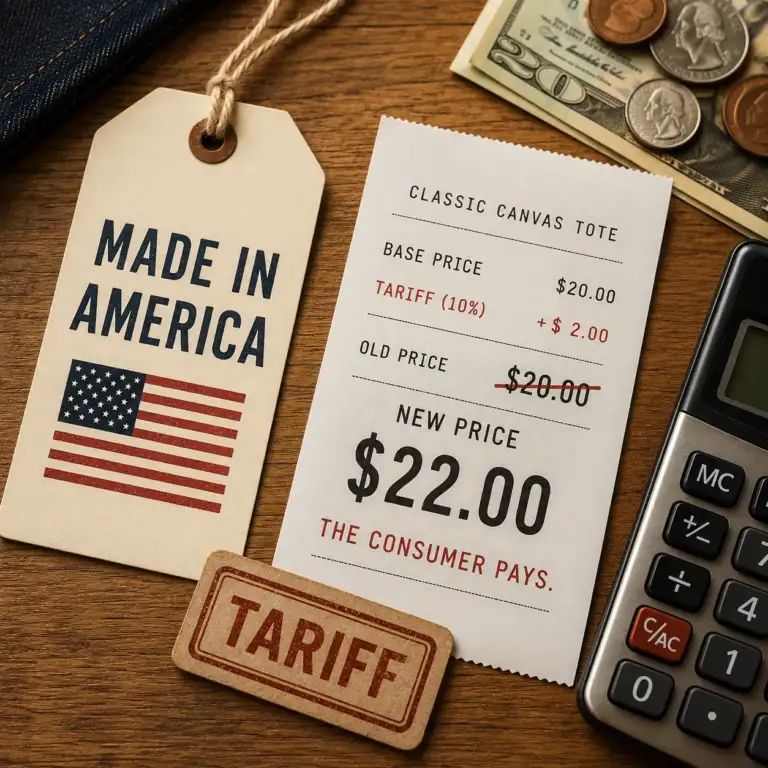
“It’s not going to be a cost to you,” President Trump told supporters in September 2024, promoting his tariff plan. “It’s going to be a cost to another country.” Every major independent study of the actual data published since then, from the Federal Reserve Bank of New York to the Peterson Institute for International Economics to the nonpartisan Tax Foundation, has reached the opposite conclusion. This magazine believes the honest answer to who pays matters more than which political story is more convenient, and the honest answer is now about as well-documented as an economic question gets.
Tariffs occupy a strange place in American political rhetoric: a tax whose entire political appeal rests on the claim that someone else pays it. That claim has now been tested directly, with real data from a real, sustained round of tariffs implemented throughout 2025, and measured independently by multiple research teams using different methods and different data sets. This magazine believes readers deserve the actual finding, not the more comfortable version, before weighing whether the policy is worth its price.
A Simple Question With a Well-Studied Answer
The economic mechanism is not actually complicated, even if the politics around it often obscure it. When the United States imposes a tariff on an imported good, that tariff is collected, as a matter of law, from the American company importing the product, not from the foreign company selling it. What happens next, whether the American importer absorbs that added cost in lower profit margins, passes it forward to the American consumer through higher prices, or successfully pressures the foreign exporter to lower its own price to offset the tariff, is called tariff “incidence,” and it is precisely the question economists have now measured with unusual rigor. President Trump reiterated his position as recently as a January 2026 Wall Street Journal op-ed, writing that “the data shows that the burden, or ‘incidence,’ of the tariffs has fallen overwhelmingly on foreign producers and middlemen.” The Federal Reserve Bank of New York published its own direct measurement of that same data two weeks later, and reached a starkly different conclusion.
Fast Facts
94 percent: Share of 2025 tariff costs borne by American importers and consumers in the first eight months of the year, per the Federal Reserve Bank of New York
86 percent: That same share by November 2025, after foreign exporters began absorbing a somewhat larger portion
90 percent: The consumer and firm burden found across multiple independent 2026 studies, per a Peterson Institute review of the research
$1,000 to $1,300: Estimated added household cost from tariffs in 2025, rising in 2026, per the nonpartisan Tax Foundation
0.7 percentage points: Contribution of 2025 tariffs to the overall U.S. inflation rate, per the National Bureau of Economic Research
44 to 47 percent: Share of tariff-paying American firms in mid-2026 who say further tariff-driven price increases are still coming
What the New York Fed Actually Found
The most detailed and most closely watched analysis came from a team of Federal Reserve Bank of New York economists, Mary Amiti, Chris Flanagan, and Sebastian Heise, published in February 2026 under the direct title “Who Is Paying for the 2025 U.S. Tariffs?” Their answer, drawn from detailed import price and export price data covering January 2024 through November 2025, was unambiguous: through the first eight months of 2025, 94 percent of tariff costs were borne by American importing firms and, ultimately, American consumers, with only 6 percent absorbed by foreign exporters cutting their own prices to stay competitive. By November, as global supply chains began adjusting, that split had shifted only modestly, to an 86 percent American share and a 14 percent foreign share. In concrete terms, the researchers found that a 10 percent tariff produced only a 0.6 percentage point decline in foreign export prices early in the year, rising to a 1.4 percent decline by November, nowhere close to the full offset that would be required for foreign countries to be genuinely “paying” the tariff in any meaningful sense. “In sum,” the authors wrote, “U.S. firms and consumers continue to bear the bulk of the economic burden of the high tariffs imposed in 2025.”
It’s Not Just One Study
What makes this finding difficult to dismiss as a single research team’s methodology or bias is how consistently independent researchers, using different data and different techniques, have arrived at essentially the same number. A review of the broader 2026 research literature published by the Peterson Institute for International Economics found that studies by Amiti and colleagues, by economists Pablo Fajgelbaum and Amit Khandelwal, and by Gita Gopinath and Brent Neiman, all converged on a finding that American buyers of imports, consumers and firms together, bore roughly 90 percent of the total 2025 tariff burden. A separate study by economists Minton, Ray, and Somale found that pass-through to consumer prices becomes essentially complete within about seven months of a tariff taking effect. None of this represents a genuinely new or surprising discovery to economists who study trade policy; the same research teams had already documented nearly identical, near-complete pass-through during the more limited 2018 and 2019 round of tariffs during Trump’s first term, a precedent this magazine believes should have tempered expectations about how differently the 2025 round would play out.
What This Actually Costs a Family
Translating these percentages into household terms is where the policy becomes tangible rather than academic. The nonpartisan Tax Foundation calculated that 2025’s tariffs functioned as an effective tax increase of roughly $1,000 per American household for the year, with that figure projected to climb to an additional $1,300 in 2026 as previously announced tariffs continue phasing in and businesses work through the pipeline of cost increases still ahead of them. The Tax Foundation’s analysis characterized the cumulative tariff program as the largest U.S. tax increase since 1993, a genuinely striking historical comparison for a policy rarely discussed in those explicit terms. Separately, a National Bureau of Economic Research paper found that 2025’s tariffs added approximately 0.7 percentage points to the overall U.S. inflation rate through the year, a meaningful contribution at a moment when this magazine has already documented, in its own examination of the gap between headline inflation and household experience, just how acutely American families were already feeling the cumulative weight of years of rising costs in groceries, insurance, and housing.
“In sum, U.S. firms and consumers continue to bear the bulk of the economic burden of the high tariffs imposed in 2025.”
— Mary Amiti, Chris Flanagan, and Sebastian Heise, Federal Reserve Bank of New York, February 2026
The Pipeline Isn’t Finished Yet
A follow-up analysis from the same New York Fed research team, published in July 2026, found that the full price impact of 2025’s tariffs had not yet finished working through the economy even a year and a half later. Surveying businesses that had directly paid tariffs over the preceding twelve months, the researchers found that 47 percent of affected service firms and 44 percent of affected manufacturers said they still had additional tariff-related price increases coming, with roughly 30 to 40 percent of those firms expecting to implement them within six months and a smaller share planning increases even further out. That finding matters for how this magazine believes the tariff debate should actually be framed going forward: the $1,000 to $1,300 per household figures cited above almost certainly understate the full, eventual cost to American consumers, since a substantial share of businesses that have already absorbed tariff costs have not yet finished passing them along.
The White House Pushback, Taken Seriously
Fairness requires giving the administration’s response its full due rather than simply dismissing it. White House economic adviser Kevin Hassett directly challenged the New York Fed’s framing, arguing that the study’s authors were “basically only looking at changes in prices” without accounting for the broader shifts in supply, demand, and the division of economic surplus between consumers and producers that a more complete analysis would need to capture. That is a genuine methodological critique rather than mere political spin, and this magazine believes it deserves to be weighed rather than waved away: measuring price changes alone does not, by itself, settle every question about a tariff policy’s net economic effect, including effects on domestic production, employment in protected industries, or long-run supply chain security that a pure price-incidence study is not designed to measure. What that critique does not do, however, is overturn the specific, narrow, and now heavily replicated finding at the center of this piece: that the tariffs themselves, as a direct cost, are being paid overwhelmingly by American importers and consumers rather than by foreign governments or foreign companies, a claim distinct from and prior to any broader argument about the policy’s overall wisdom.
Does That Mean Tariffs Are Bad Policy?
This is the question this magazine believes actually deserves the political argument, rather than the settled empirical one about who writes the check. This magazine’s own recent examination of consumer attitudes toward “Made in America” products found a genuine, if incomplete, willingness among many Americans to accept higher prices in exchange for domestic manufacturing, reduced dependency on adversarial supply chains, particularly China’s, and long-term strategic resilience that a purely price-driven global supply chain does not provide. A tariff that raises consumer prices by $1,000 to $1,300 a year while genuinely accelerating the kind of domestic manufacturing renaissance this magazine has documented elsewhere, and while reducing this country’s economic dependence on a strategic rival, may still represent a trade this magazine’s readers judge worth making, just as previous generations of Americans accepted real, direct costs, higher taxes, rationing, national service, for national priorities they judged more important than the cheapest possible price at the register. What this magazine will not do is pretend that trade-off does not exist, or repeat a political claim about who bears that cost that the overwhelming weight of independent economic research, across multiple institutions, multiple methodologies, and two separate rounds of tariffs under the same president, has now thoroughly and repeatedly contradicted.
The Bottom Line
The honest answer to who pays for “Made in America” tariffs is Americans, primarily and overwhelmingly, according to essentially every rigorous independent study published on the question, not the foreign governments the policy is officially aimed at. That finding does not, by itself, settle whether the tariffs are worth their cost; reasonable people, including plenty of readers of this magazine, can and do conclude that reshoring manufacturing, reducing dependence on China, and rebuilding domestic industrial capacity justify a real and measurable price paid at the checkout counter. What this magazine cannot do, and what it believes no honest publication should do, is let a convenient political claim stand uncorrected against a body of economic research this thorough and this consistent. Americans deserve to make that trade-off with their eyes open, knowing precisely whose pocket the bill is actually coming out of.
References
Federal Reserve Bank of New York, Liberty Street Economics, “Who Is Paying for the 2025 U.S. Tariffs?” February 12, 2026
Federal Reserve Bank of New York, Liberty Street Economics, “More Tariff Pass-Through Is in the Pipeline,” July 8, 2026
Peterson Institute for International Economics, “Who pays for tariffs? Insights from recent research”
Tax Foundation, “Who Pays Tariffs? Americans Will Bear the Costs of the Next Trade War,” 2025
Federal Reserve Bank of Boston, “Who Will Pay for Tariffs? Businesses’ Expectations about Costs and Prices,” Current Policy Perspectives No. 25-7, 2025
Forbes/Tax Notes, “Who Pays Tariffs? Mostly Consumers, But That Wasn’t Always True,” January 2026
USA Today/Yahoo Finance, “Americans, not other countries, paid Trump’s tariffs in 2025”
Yahoo Finance, “Trump administration slams New York Fed study that says US consumers bear the cost of tariffs”
Federal Reserve Bank of Richmond, tariff pass-through issue brief, April 2025
National Bureau of Economic Research, tariff inflation impact paper, November 2025