
In March 1991, a plumbing supply store manager named George Holliday stepped onto his apartment balcony in Los Angeles, pointed a newly purchased camcorder at the street below, and recorded eighty-one seconds of police officers beating a man named Rodney King. He sent the tape to a local television station the next morning. Three decades later, that balcony recording is widely taught as the founding moment of modern citizen journalism, the instant Americans first understood that the person best positioned to capture the truth of a story is not always the one holding a press badge.
Professional journalism did not invent the idea of bearing witness. It simply organized and professionalized a human instinct, being present when something important happens and telling other people about it, that ordinary citizens have always possessed and that a smartphone now lets nearly every American exercise instantly, in high definition, broadcast to a potential audience of millions. This magazine has documented elsewhere the genuine collapse in trust facing traditional newsrooms and the considerable, if uneven, rise of independent voices filling the resulting vacuum. This piece looks specifically at the sharpest edge of that shift: the ordinary, untrained citizen who happens to be in the right place, with the right camera, at the right moment, and who increasingly breaks stories that professional newsrooms, for reasons of access, staffing, or simple oversight, never got to first.
A Camcorder on a Balcony, and the Moment Everything Changed
George Holliday was not a journalist, an activist, or anyone with a platform of any kind before that March morning. He was a private citizen who happened to own a camcorder and happened to be awake when police activity drew his attention outside his window. What made his footage so consequential was not simply that it captured something newsrooms wanted, but that no professional camera crew could plausibly have been there in time; the entire encounter unfolded and ended before any assignment desk could have dispatched a reporter to the scene. That basic structural advantage, ordinary citizens are already everywhere, all the time, in a way no newsroom’s staffing budget could ever match, remains the fundamental engine behind everything that has followed in the more than three decades since.
Fast Facts
1991: George Holliday’s camcorder footage of the Rodney King beating becomes widely cited as the founding moment of modern citizen journalism
Early 2000s: Citizen journalism gains formal recognition as a movement, with outlets like South Korea’s OhmyNews and Japan’s OhmyNews Japan built specifically around ordinary contributors
December 2025: Independent creator Nick Shirley’s Minnesota daycare fraud investigation reaches 116 million views on X, prompting a federal payment freeze and FBI investigation
May 2026: A Minneapolis daycare featured in that citizen investigation is federally charged in a $4.6 million fraud scheme
2025-2026: More than a quarter of people surveyed worldwide report encountering news content from an independent creator in the past week, per the Reuters Institute
The Smartphone Made Everyone a Potential Reporter
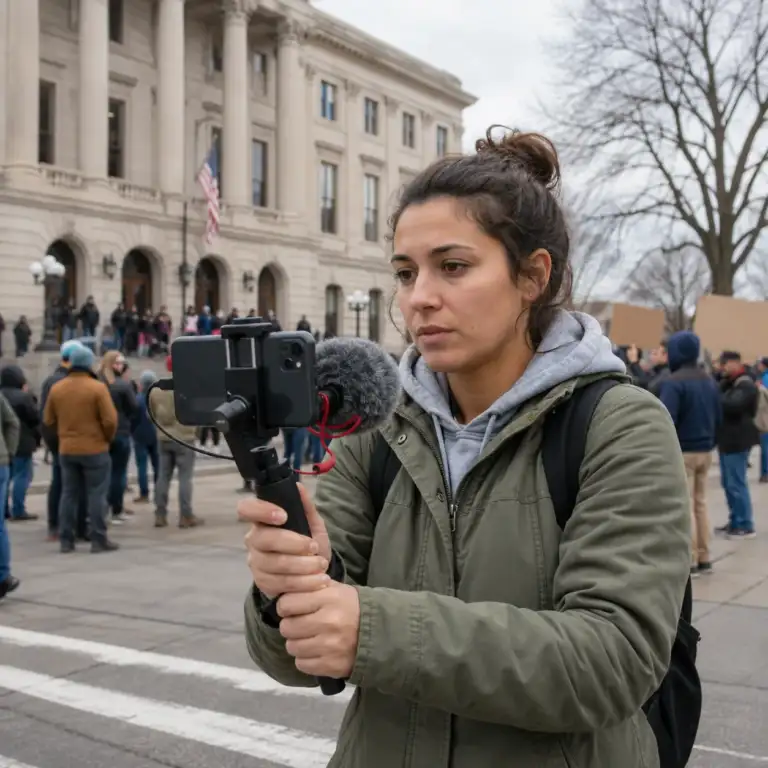
What has changed most dramatically since Holliday’s camcorder is not the underlying instinct but the tools available to act on it. Modern smartphones combine a high-resolution camera, a professional-grade microphone, editing software, and the ability to broadcast live to a global audience instantly, a combination of capabilities that would have required an entire television production truck a generation ago. Media researchers describe the resulting phenomenon in terms of “distributed presence”: because ordinary citizens are already on scene when nearly any newsworthy event unfolds, plane emergencies, sudden severe weather, unexpected public disturbances, a network of potential reporters exists that no single news organization, however well funded, could ever match through paid staff alone. News organizations have adapted around this reality rather than fighting it, actively soliciting user-submitted photos and video during major wildfires, snowstorms, and other large-scale events precisely because a scattered public covering an entire disaster zone can capture a scope and immediacy no single assigned crew ever could.
The Minnesota Daycare Story No Newsroom Broke First
This magazine has already profiled, in detail, the single clearest recent example of citizen journalism producing consequences that outpaced anything the professional press managed on its own. In December 2025, independent creator Nick Shirley released a 42-minute investigation alleging massive fraud in Minnesota’s taxpayer-funded childcare system, built entirely on independent legwork, public payment records, and interviews conducted at daycare centers he visited in person, without the backing of any traditional newsroom. The video reached more than 116 million views on X within days, amplified by figures ranging from Elon Musk to Vice President JD Vance to FBI Director Kash Patel. The consequences that followed were not merely viral attention. The Department of Health and Human Services froze childcare payments to Minnesota pending investigation, the FBI and Department of Homeland Security opened formal inquiries, and by May 2026, a Minneapolis daycare featured directly in Shirley’s investigation was federally charged in a $4.6 million fraud scheme. No assignment editor sent Shirley to those daycares. No newsroom’s budget funded his travel or his review of public records. A single independent citizen, working essentially alone, produced accountability journalism that government auditors and legacy newsrooms had, by every available account, failed to produce on their own for years.
“The mechanism here is distributed presence: ordinary people are already on-scene when events unfold, creating a network of potential reporters that no news organization could match.”
— Media research on the structural advantage underlying citizen journalism
When the Crowd Gets There Before the Cameras Do
Shirley’s story, while the most consequential recent American example, is far from the only instance of this pattern playing out. Citizen documentation has become a genuinely global phenomenon over the past several years, with ordinary people using smartphones to document natural disasters, public safety emergencies, and unfolding news events across radically different political and geographic contexts, from the Arab Spring protests of the early 2010s to countless smaller, hyperlocal stories that never reach national attention at all but matter enormously to the communities where they occur, a neighborhood flooding event, a local safety hazard, a small-town government meeting nobody from the regional paper bothered to cover. The Reuters Institute’s most recent Digital News Report found that more than a quarter of people surveyed worldwide encountered news content specifically from an independent creator, rather than a traditional news organization, in just the past week, a figure that captures how thoroughly this once-niche phenomenon has moved into the mainstream flow of how ordinary people actually get informed about the world around them.
The Real Risks Nobody Should Wave Away
Honesty requires this magazine to weigh the genuine risks embedded in this shift alongside its real accomplishments. Citizen journalism, by its very nature, operates without the editorial oversight, fact-checking infrastructure, and institutional accountability that, whatever its recent failures, professional journalism was originally built to provide. Researchers studying breaking news events have documented misinformation spreading rapidly alongside accurate citizen reporting during exactly the chaotic, fast-moving moments when citizen documentation proves most valuable, and crowdsourced attempts to identify individuals involved in a breaking story have, in several well-documented cases, misidentified innocent people entirely, a genuinely serious cost of collective, unmoderated investigation conducted in public in real time. Some media researchers have gone further still, arguing that the sheer volume of citizen-generated content, mistakes and all, has gradually raised the public’s tolerance for inaccurate reporting generally, training audiences to expect and forgive errors that would once have ended a professional journalist’s career. None of this argues for dismissing citizen journalism as inherently untrustworthy. It argues for the kind of clear-eyed weighing this magazine has tried to apply throughout its own reporting: real accountability achieved through citizen investigation deserves genuine credit, and the absence of editorial guardrails that made that accountability possible deserves equally genuine scrutiny.
Why This Movement and Professional Journalism Need Each Other
The most instructive lesson from Nick Shirley’s Minnesota investigation is not that citizen journalism has simply replaced professional newsrooms, but that the strongest outcomes emerge when citizen-sourced material triggers institutions with actual subpoena power, prosecutorial authority, and investigative resources to follow through. Shirley’s video did not itself convict anyone of fraud. It supplied the raw evidence, the public attention, and the political pressure that pushed federal agencies to open the formal investigations that ultimately did. That pattern, ordinary citizens surfacing what institutions overlooked, followed by institutions with real enforcement power picking up the thread, represents this magazine’s own best-case vision for how citizen journalism and professional accountability structures ought to relate to one another going forward: not as replacements for each other, but as two halves of a system in which neither, working alone, currently produces enough accountability on its own.
The Bottom Line
George Holliday did not set out to change American journalism when he pointed a camcorder off his balcony in 1991. He simply recorded what he saw and made sure other people could see it too. Every citizen journalist working today, from a bystander capturing a wildfire’s advance to an independent investigator like Nick Shirley spending months reviewing public daycare payment records, is operating on that same basic instinct, amplified now by tools Holliday could not have imagined and reaching audiences no single camcorder tape ever could. This magazine believes that shift, for all its genuine and documented risks, represents something this country’s tradition of a free and skeptical press should recognize as a genuine extension of itself rather than a threat to it: more eyes watching, more stories surfacing, and more institutions being forced to answer for what they would rather no one had noticed at all.
References
EBSCO Research Starters, “Citizen journalism”
The Conversation, “Citizen journalism News, Research and Analysis”
Journalism University, “The Rise of Citizen Journalism: A Platform for the Unheard Voices,” April 2026
Journalism University, “The Convergence of Mobile Journalism and Citizen Reporting,” December 2025
Journalism University, “Balancing Act: Citizen Journalism and Professional Journalism,” April 2026
Fiveable, “Citizen Journalism Examples to Know for Media and Democracy”
Global Investigative Journalism Network, “The Digital Switch: Citizen Journalism, Minority Coverage”
Reuters Institute for the Study of Journalism, Digital News Report 2025 and 2026 editions
Fox News, “Sylvester Stallone calls President-elect Trump ‘second George Washington,'” (background reference on independent creator impact, prior magazine reporting)
Prior magazine reporting, “Nick Shirley: A Fighter for America,” profiling the Minnesota childcare fraud investigation and its federal consequences