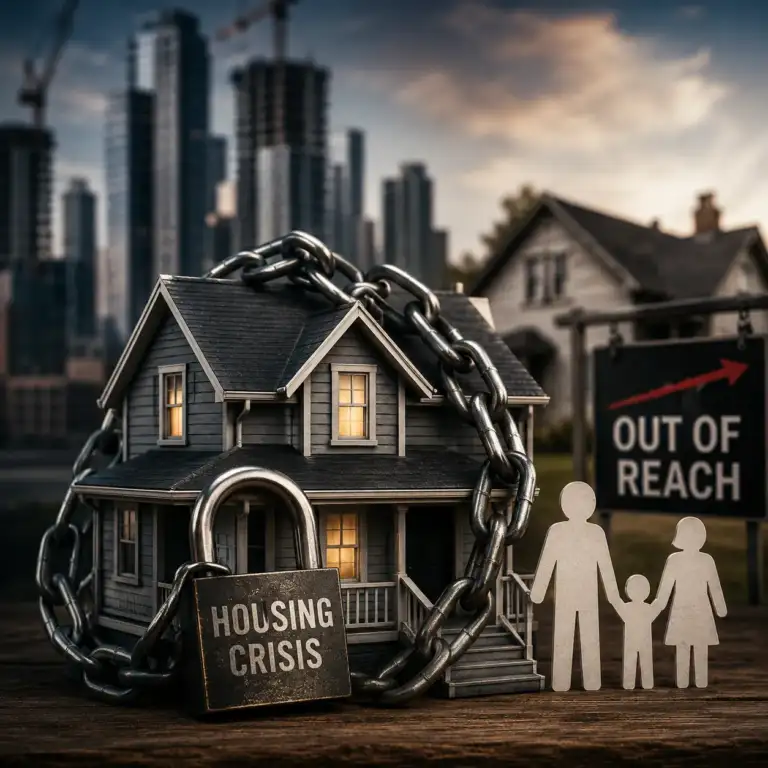
A shortage of roughly four million homes does not sound, at first glance, like a story about marriage, children, church pews, or retirement security. It is exactly that story. Pull on any thread of American family life quietly fraying right now, and the housing market is somewhere near the other end of it.
Americans have spent years discussing the housing shortage as a matter of affordability, mortgage rates, and zoning boards, a real estate story with real estate solutions. That framing misses the actual scale of the damage. Housing is not simply where a family lives. It is the precondition for nearly every major decision a family makes, when to marry, whether to have another child, which congregation to join, whether to stay near aging parents or move for a better job, and how to retire without running out of money. This magazine has documented pieces of this story throughout the past year, marriage becoming a luxury good, the cost of raising a child climbing past $300,000, an entire generation unable to leave their parents’ homes. Laid side by side, those pieces describe a single underlying mechanism. Fix the supply of housing in this country, and a remarkable number of downstream family and community problems begin to loosen on their own. Leave it as it is, and every one of them keeps tightening.
Marriage: Housing as the Price of Admission
This magazine has already reported in detail on the collapse in American marriage rates, from 67 percent of adults ages 25 to 34 married in 1980 to just 37 percent today, and on how directly that collapse tracks the cost of establishing an independent household. Even young newlyweds who do marry increasingly do so as renters rather than owners: as recently as 1960, 83 percent of newlyweds under 35 were renting a year into marriage, a figure that held roughly steady through 1980 and remains a clear majority, 58 percent, today, evidence that the basic financial stability marriage has always required is simply harder to reach than it used to be. A national shortage of roughly four million homes, concentrated most severely at the entry-level price point young couples would traditionally have purchased first, sits directly upstream of that trend. Marriage was never supposed to wait for a mortgage. Increasingly, for a growing share of young Americans, it waits anyway.
Fast Facts
4 million: Estimated national shortage of homes, concentrated at the entry-level price point
37 percent: Share of Americans ages 25 to 34 who are married today, down from 67 percent in 1980
28 states: Where annual childcare costs already exceed public college tuition
1.53: Projected U.S. births per woman by 2036, well below the roughly 2.1 needed to sustain the population without immigration
$2.57 million: What Goldman Sachs projects Americans will need to retire comfortably by 2043, up from $1.75 million projected just a decade earlier
10-year low: Interstate migration rate in 2024, as elevated mortgage rates lock homeowners in place
Fertility: When the Nursery Costs More Than College
This magazine’s recent examination of family formation costs found that raising a single child from birth through age 18 now costs American families roughly $300,000, driven substantially by childcare costs that have climbed 29 percent since 2020 alone. In 28 states, the annual cost of center-based childcare now exceeds the cost of public college tuition, meaning a family welcoming its first child faces a bill larger than a university education before that child ever reaches kindergarten. Housing sits directly inside that calculation too: a family needs not just an apartment but a home large enough for a growing household, in a housing market that has not meaningfully expanded its supply of family-sized units in the areas where young families actually want to live. The consequence shows up plainly in the country’s fertility data. The U.S. birth rate stood at 1.64 births per woman in 2020 and is projected to fall further, to 1.53 by 2036, well below the roughly 2.1 needed to sustain the population without relying on immigration, a trajectory the Congressional Budget Office now expects will leave the country with roughly 8 million fewer people by 2055 than earlier projections assumed.
Church Membership: When the Congregation Can No Longer Afford the Neighborhood
The connection between housing and faith community is less discussed than marriage or fertility, but it is just as direct, and just as visible on the ground. In Portland, Oregon, First A.M.E. Zion Church, the oldest Black congregation in the state, has watched attendance shrink to as few as ten people on a given Sunday, not primarily from a crisis of belief but from a crisis of geography: rising housing costs and gentrification in the historically Black Albina neighborhood pushed the congregation’s own members out of the community the church was built to serve. One longtime member, reflecting on the changes, put it plainly: “We’ve had to move out of the community, because we can’t afford it.” In Boston, researchers at the Emmanuel Gospel Center have documented the same dynamic across the city’s historic neighborhood churches, congregations dispersed not by secularization but by rising rents that pushed longtime members out of Roxbury, Dorchester, and Lower Roxbury entirely. In South Florida, church leaders tracking a recent wave of congregation closures and mergers describe the same underlying pressure in blunt terms: the cost of maintaining housing and stability, one pastor observed, sometimes causes people to simply stop being able to go to church at all.
Gallup’s own long-running tracking shows U.S. church membership falling from 70 percent to 47 percent over the past two decades, a decline this magazine has examined from several angles elsewhere. What the housing-specific case studies above add to that picture is a mechanism too often left out of the broader story: some meaningful share of that decline is not a story about lost faith at all. It is a story about a congregation that stayed in place while the affordable housing around it did not, scattering members to towns and neighborhoods too far to keep showing up on Sunday morning.
Community Stability: Neighbors Who Can No Longer Afford to Stay, or Leave
Housing costs are disrupting community life in two directions at once, and both deserve attention. The first is displacement, the same dynamic emptying church pews in Portland and Boston, playing out across entire neighborhoods as rising costs push longtime residents, and the small businesses, schools, and informal networks built around them, out of communities their families may have called home for generations. The second, less discussed direction is closer to the opposite problem: homeowners who are financially unable to leave a community even when leaving would put them closer to aging parents, adult children, or better opportunities, because doing so means trading a mortgage locked in at a low rate for a new one at a dramatically higher cost. Real estate analysts have taken to calling this the “lock-in effect,” and it has become a genuine structural feature of the current housing market rather than a temporary quirk. Between these two forces, a country that once assumed families would either stay rooted near extended relatives or move freely to be closer to them has increasingly lost the ability to do either on its own terms. Community stability, in other words, is being disrupted not by any single force but by a housing market that simultaneously pushes some families out of the neighborhoods they love and traps others in place, away from the families they’d prefer to be near.
“We’ve had to move out of the community, because we can’t afford it.”
— A longtime member of First A.M.E. Zion Church, Portland, Oregon, on housing costs displacing the congregation
Retirement: A Comfortable Retirement Now Requires $2.57 Million, and a House That Won’t Cooperate
For the generation nearing the end of its working life, housing has become a source of genuine financial anxiety rather than the secure asset it was long assumed to be. Goldman Sachs’ 2025 retirement survey found that Americans may need roughly $2.57 million to retire comfortably by 2043, up sharply from the $1.75 million projected for retirement just a decade earlier, driven substantially by rising housing, healthcare, and living costs. Households headed by someone 65 or older now spend roughly $122,000 annually, more than double the $60,000 such households spent in 2000. A growing share of retirees are approaching that reality with far less housing security than earlier generations: the share of homeowners ages 65 to 79 still carrying a mortgage rose from 24 percent in 1989 to 41 percent in 2022, with median mortgage debt over that period climbing from $21,000 to $110,000, meaning a meaningful share of any home sale proceeds now goes straight to paying off what is still owed rather than funding retirement itself.
The conventional advice, sell the family home, downsize, and bank the difference, has proven far harder to execute in practice than in theory. Data from the National Association of Realtors shows many retirees are not downsizing nearly as much as financial planners expect, often because moving costs, realtor commissions, taxes, and a housing market where even a smaller home now carries a record median price erode much of the expected savings. The result is a genuinely strange paradox: Americans 62 and older now hold a record $14.92 trillion in home equity, one of the largest pools of wealth in the country, and yet Vanguard’s 2025 Retirement Outlook found the typical baby boomer still facing an annual retirement spending shortfall of roughly $9,000, a gap that would close substantially if that equity could be easily converted to cash, but that stays locked in place for exactly the reasons described throughout this piece: nowhere affordable to move to, and a housing market that punishes anyone who tries.
Geographic Mobility: The Great American Stay
Perhaps the clearest single indicator that housing has become a structural drag on American family and economic life is the collapse in how often Americans move at all. Interstate migration hit a ten-year low in 2024, with just 2.1 percent of Americans relocating across state lines, and the long-term trend line, tracked since 1948, shows the overall national relocation rate declining steadily for decades. The reason is not a sudden loss of ambition or a cultural shift away from opportunity. It is, overwhelmingly, the mortgage lock-in effect: millions of homeowners secured historically low interest rates before 2022 and now find that any comparable new home would come with a monthly payment dramatically higher than what they currently pay, even for an equivalent property, making a move that would once have been a simple financial upgrade into a serious financial setback. The consequences extend well beyond individual households. “New job or company transfer,” once the dominant engine of American interstate migration, accounted for 47.6 percent of moves in 2018. By 2025, that figure had fallen to just 25.92 percent, a genuinely dramatic collapse in the country’s basic capacity to match workers with opportunity, a capacity American economic dynamism has depended on for generations.
Why This Adds Up to a Single Crisis, Not Six Separate Ones
Treated separately, these six trends could each be explained away by a different cause: changing values around marriage, rising childcare industry costs, secularization, unrelated neighborhood change, healthcare inflation, remote work reshaping career paths. Treated together, a single connective thread runs through every one of them, and this magazine believes that thread deserves to be named plainly: a persistent, multi-decade shortfall in the supply of American housing, concentrated most severely at exactly the entry-level and mid-size price points young families, displaced congregations, and downsizing retirees all depend on. A country that cannot build enough homes for its people will not simply see higher prices on a real estate listing. It will see fewer marriages, fewer children, emptier pews, disrupted neighborhoods, retirees squeezed by wealth they cannot access, and a workforce too financially immobilized to move toward better opportunity. Every one of those outcomes has been treated, in American political conversation, as its own separate crisis requiring its own separate policy fix. The evidence assembled here suggests they are, in significant part, one crisis wearing six different faces.
The Bottom Line
This magazine has argued throughout the past year that marriage, family formation, faith community, and rootedness in a stable neighborhood are not incidental features of a flourishing society but its actual foundation. None of that argument changes here. What changes is the recognition that a nation genuinely serious about reviving marriage, reversing declining birth rates, keeping congregations intact, and letting both young families and retirees live near the people they love cannot treat housing supply as a side issue for economists to sort out separately from everything else. It is the load-bearing wall underneath all of it. A conservative movement that has rightly made family formation and community stability central to its vision for the country has, in housing policy, one of the clearest and most tractable levers available to actually deliver on that vision, not through another subsidy or tax credit alone, but through the harder, more foundational work of simply letting this country build enough homes again for the families it says it wants more of.
References
Institute for Family Studies, “No Spouse, No House: Marriage Decline and Homeownership Among Young Adults”
Fortune, “‘Almost unmanageable’: Raising a child in the U.S. now costs more than $300,000,” April 2026
Moneywise, “The US is now on track to have 8 million fewer people than earlier projected by 2055,” April 2026
Emmanuel Gospel Center, “What happens when church buildings close?” February 2025
OPB, “As membership declines, Portland churches see money and ministry in affordable housing,” November 2023
Miami Times, “As Black churches close across South Florida, some find new ways to thrive,” December 2025
Counselors of Real Estate, “Transforming Emptying Houses of Worship,” February 2025
HousingWire, “As retirement costs surge, more homeowners turn to their equity,” May 2026
AOL/Vanguard 2025 Retirement Outlook, “Relying on Home Equity for Retirement? You Could Be Facing a Shortfall,” July 2026
National Mortgage News, “Aging-in-place trend props up proprietary reverse surge”
ABC17News/Stacker, “Americans are rethinking the role of home equity in retirement,” July 2026
CRE Daily, “Interstate Migration Slowdown Shifts Moving Trends,” March 2026
StorageCafe, “Interstate Migration Hit 10-Year Low As Affordability Bites,” June 2026
Bank of America Institute, “On the move: Still waiting for the thaw,” September 2025