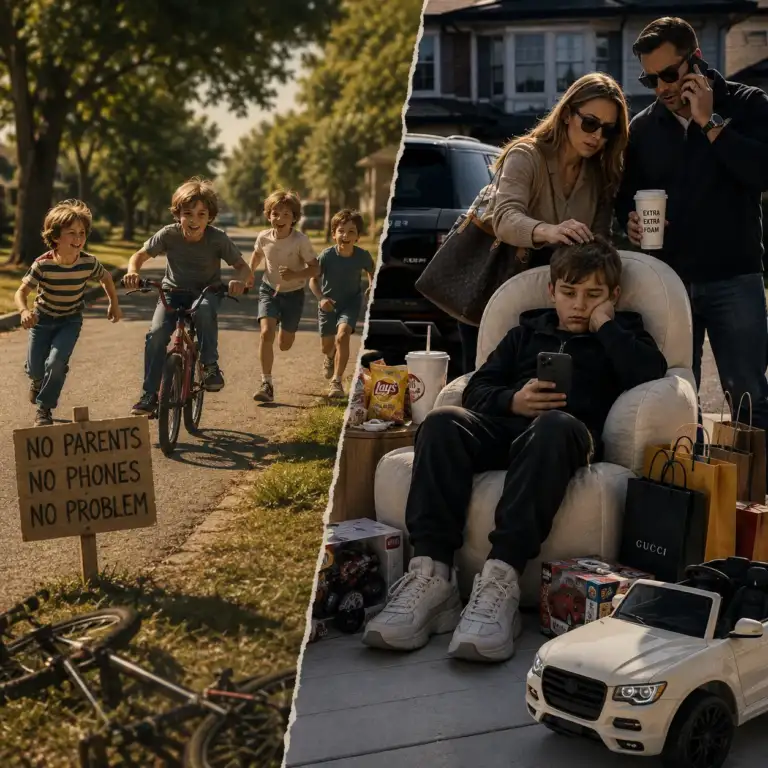
A ten-year-old in 1979 could walk to the corner store, spend an afternoon in the woods with friends, and come home when the streetlights came on, all without a parent knowing exactly where he was for hours at a time. A ten-year-old today is more likely to have never walked to a nearby store alone in his entire life. The objective danger to children has fallen sharply over that same span. The freedom granted to them has fallen even further. Something has gone quietly, deeply wrong in how this country raises its children, and it did not happen by accident.
Ask any American over the age of fifty to describe their childhood afternoons, and a familiar picture emerges: bicycles, unsupervised hours, a rule that amounted to little more than “be home by dark.” Ask a child today the same question, and the picture looks entirely different, scheduled activities, adult supervision at nearly every turn, and a phone that tracks their location in real time even when they are, technically, alone. This shift did not happen because the world became more dangerous. It happened because parents, and the culture surrounding them, quietly redefined what counts as responsible parenting, trading a genuinely rare risk for a genuinely common cost: a generation of children who have had less practice than any before them at navigating the world without an adult standing nearby.
A Childhood Measured in Feet, Not Miles
The data on how far this shift has actually gone is striking. A 2025 Harris Poll commissioned by the nonprofit Let Grow found that 62 percent of children ages 8 to 12 had never walked or biked to a nearby store, park, or school without an adult, and 61 percent had never made plans with friends entirely on their own, without a parent arranging the details first. Pew Research Center found a nearly identical pattern: roughly two-thirds of children in that same age range had never walked or biked to a nearby place unaccompanied. A University of Michigan Health poll found the restriction runs even deeper for younger children: only 24 percent of 5 to 8 year olds regularly order their own food at a restaurant, and just 20 percent regularly prepare their own snack or simple meal. The same poll found that half of parents will not let a 9 to 11 year old walk to a different aisle in a store alone, two-thirds will not let a child that age walk or bike to a friend’s house, and only 15 percent will allow trick-or-treating with friends unsupervised. More than 4 in 10 parents will not leave a child that age home alone for even thirty to sixty minutes.
What makes these numbers more than a simple story about cautious parents is the gap between restriction and desire. That same Harris Poll found that 61 percent of the children surveyed, the very same kids being kept indoors and accompanied everywhere, said they wanted to play with friends in person without an adult present. Children are not, by and large, asking to be supervised this closely. Adults are choosing it for them.
Fast Facts
62 percent: Children ages 8 to 12 who have never walked or biked to a nearby store, park, or school without an adult
61 percent: Children in that same age group who wanted unsupervised time with friends but did not have it
45 percent: Share of parents who describe themselves as overprotective
1 in 720,000: Approximate annual odds of a child being abducted by a stranger, according to Department of Justice data
11 states: Have passed “Reasonable Childhood Independence” laws protecting parents who allow age-appropriate unsupervised activity, since 2018
May 2026: A bipartisan federal bill, the Promoting Childhood Independence and Resilience Act, is introduced in Congress
The Danger That Isn’t There Anymore
The single most important fact in this entire debate is one most parents have never actually seen stated plainly: the specific danger driving so much of this caution, a stranger abducting a child, is extraordinarily rare, and has become rarer over exactly the same decades that supervision has tightened. The Department of Justice’s National Incidence Studies of Missing, Abducted, Runaway, and Thrownaway Children, the most rigorous data source available, consistently puts the number of “stereotypical kidnappings,” meaning abductions by a stranger or slight acquaintance involving transport, ransom demand, or intent to permanently keep the child, at roughly 100 to 115 per year nationwide. With approximately 72 million American children, that works out to odds of roughly 1 in 720,000, closing in on 1 in a million, in any given year. John E. Bischoff III, vice president of the missing children division at the National Center for Missing and Exploited Children, has put the same point more simply: stranger abductions are “much rarer than the fear we were raised with.”
This is not a story of a country that has become more dangerous for children and responded appropriately. It is closer to the opposite. Overall childhood mortality has been cut roughly in half over the past fifty years, from about 6 deaths per 10,000 children to about 2 per 10,000 today, driven by improvements in medicine, car seats, vaccines, and general safety standards. And yet, even as the actual risk to children’s lives has fallen sharply, 45 percent of American parents now describe themselves, in their own words, as overprotective. The fear did not track the danger. It grew even as the danger shrank, fueled less by any change in the world outside the front door than by decades of cable news coverage built around the rarest, most horrifying cases, amplified endlessly by a social media environment that rewards exactly the kind of viral parental panic that makes any single stranger-danger story feel like a daily threat rather than a once-in-a-million tragedy.
What Kids Actually Want
It is worth returning to the gap identified above, because it deserves more weight than a single statistic usually gets. Sixty-one percent of children ages 8 to 12, an age range fully capable of walking to a friend’s house, ordering their own meal, or spending an afternoon unsupervised at a park, told researchers directly that they wanted exactly that kind of independence and were not getting it. This is not a generation of children clamoring to be shielded from the world. It is a generation of children whose own stated preferences are being quietly overridden by adults acting, with genuinely good intentions, on a threat assessment that does not match reality. That mismatch matters because childhood independence is not simply a nice-to-have. Researchers describe unstructured, self-directed play as the primary mechanism through which children learn to assess risk, resolve conflict with peers without an adult intervening to referee, and develop a basic, embodied sense that they are capable, trusted people rather than perpetually monitored ones.
Haidt’s Diagnosis: Overprotected in Real Life, Underprotected Online
Social psychologist Jonathan Haidt, whose work on the collapse of unsupervised childhood has become the intellectual backbone of this entire movement, has summarized the core problem in a single, devastatingly precise sentence: children born since roughly 1995 have suffered from “overprotection in the real world and underprotection in the virtual world.” That inversion is the actual mechanism worth understanding, not two separate problems but one continuous failure. As parents systematically closed off the unsupervised outdoor time that had defined childhood for generations, out of caution against a danger that was actually receding, children did not simply sit quietly at home instead. They went somewhere else entirely, onto phones and social media platforms that offered the independence, social risk-taking, and unsupervised exploration real-world childhood no longer provided, except in an environment engineered by tech companies to maximize engagement rather than genuine growth, and arguably far more dangerous to a developing child’s mental health than the neighborhood streets they were kept off of.
A study from Florida Atlantic University, co-authored by psychology professor David Bjorklund, connected this shift directly to the well-documented rise in youth anxiety, depression, and suicide, arguing that parents today are bombarded with constant warnings about the dangers unsupervised children might face, while hearing almost nothing about the opposite danger: that children denied real, self-directed activity and meaningful independence never develop the internal confidence that comes only from proving to themselves, not being told by an adult, that they can handle the real world.
“Overprotection in the real world and underprotection in the virtual world.”
— Jonathan Haidt, describing the modern inversion of childhood risk
The Legal Backlash: Reasonable Childhood Independence Laws
The good news, and the reason this magazine believes the tide may genuinely be turning, is that a real, bipartisan legislative response has begun to take shape. Since 2018, eleven states have passed some version of a “Reasonable Childhood Independence” law, designed specifically to prevent parents from facing neglect investigations simply for allowing age-appropriate unsupervised activity. Georgia’s version, enacted in the summer of 2025, is a useful model: it replaced the old legal standard, which defined neglect as failing to provide “proper” parental care, a vague phrase open to almost any interpretation, with a considerably higher and more precise bar. Under the new law, a parent must show “blatant disregard” for a child’s safety, meaning placing the child in imminent, obvious danger, before neglect can be found, and the statute explicitly states that letting a reasonably capable child walk to school or a nearby park alone does not, by itself, constitute neglect at all.
That state-level momentum has now reached Congress. In May 2026, Republican Representative Blake Moore, Democratic Representative Jennifer McClellan, and Republican Representative Virginia Foxx jointly introduced the Promoting Childhood Independence and Resilience Act, aimed at protecting parents nationwide who allow children to walk to a nearby park, play outside unsupervised, or run age-appropriate errands alone. The bill remains in the early stages of the legislative process, but its genuinely bipartisan sponsorship, crossing party lines in both directions, reflects something rare in current American politics: a recognition, shared across the aisle, that the pendulum on childhood supervision swung too far, and that the law itself had quietly become part of the problem by treating ordinary childhood independence as a potential crime.
A Word of Caution
Fairness requires acknowledging real complexity here rather than simply declaring every supervising parent guilty of overreach. Not every family has access to the kind of safe, walkable neighborhood that made mid-century childhood independence possible in the first place, and a parent’s caution in a genuinely unsafe area is not the same failure of judgment as blanket overprotection in a quiet suburb. Family abduction, not stranger danger, remains the far more statistically common form of child abduction in America, and traffic accidents remain a real and serious risk to unsupervised children near roads, a concern worth taking seriously on its own terms. Critics of the reasonable-childhood-independence legal movement have also raised a fair question worth sitting with: who exactly decides what counts as “reasonable” for a given child’s age and maturity, and how much room does that standard leave for honest disagreement between neighbors, or between a family and a caseworker who may never meet the specific child in question. None of that undercuts the core finding driving this entire piece, that the specific fear of stranger abduction has been wildly disproportionate to the actual statistical risk for decades. It does mean the correction, like the original overcorrection, deserves to be implemented with genuine care rather than a simple reversal of the old panic into a new, opposite one.
Why This Is a Family Values Issue, Not Just a Safety One
This magazine has written before about how a generation raised without enough unsupervised human connection turned, in growing numbers, to AI companions for friendship and emotional support, and about how distracted, phone-absorbed parenting is quietly shaping the next generation’s own relationship with technology. This piece describes the other half of that same story. A child who is never trusted to walk to a friend’s house, order his own meal, or resolve a playground disagreement without an adult stepping in is a child who has been denied, systematically and with the best of intentions, the very experiences that build resilience, self-reliance, and genuine confidence, virtues this magazine believes are foundational to raising capable, faithful, and independent adults rather than perpetually anxious ones. Restoring reasonable childhood independence is not a project of returning to the past for nostalgia’s sake. It is a recognition that character, like faith, is formed through lived experience and small, earned risks, not through constant supervision, however loving its intent.
The Bottom Line
The statistics assembled here point to an uncomfortable but genuinely hopeful conclusion. The world children are growing up in today is, by nearly every objective measure, safer than the one their parents and grandparents grew up in. What has changed is not the danger. It is the willingness of an entire culture, driven by fear disconnected from evidence, to grant children the independence that danger no longer justifies withholding. Eleven states and a bipartisan coalition in Congress have begun, quietly and without much national fanfare, to correct that mismatch. The work ahead is not complicated, even if it requires real courage from individual parents: letting a capable child walk to the mailbox, the park, or a friend’s house alone, not despite loving them, but because loving them well means trusting them to grow.
References
Psychology Today, “The Adult Takeover of Childhood,” April 2025
SheKnows, “Congress Wants to Protect ‘Free-Range Parenting,’ But What Does That Actually Mean?” May 2026
Christian Science Monitor, “Child’s play is more than just that,” June 2026
Deseret News, “What happened to the free-range parenting movement?” May 2026
Big Think, “The quiet disappearance of the free-range childhood,” April 2026
Florida Atlantic University Newsdesk, “All Work, No Independent Play Cause of Youth Declining Mental Health”
Institute for Family Studies, “Resilient Children, Struggling Parents: Mapping American Parenting”
Let Grow, “Let Grow Takes a Look at Crime Statistics,” May 2026
Let Grow, “What’s the Actual Risk of Your Child Being Kidnapped?”
CoursePivot, “Child Abduction Statistics by Year in the US,” June 2026
Reason, “Enough Stranger Danger! Children Rarely Abducted by Those They Don’t Know”