
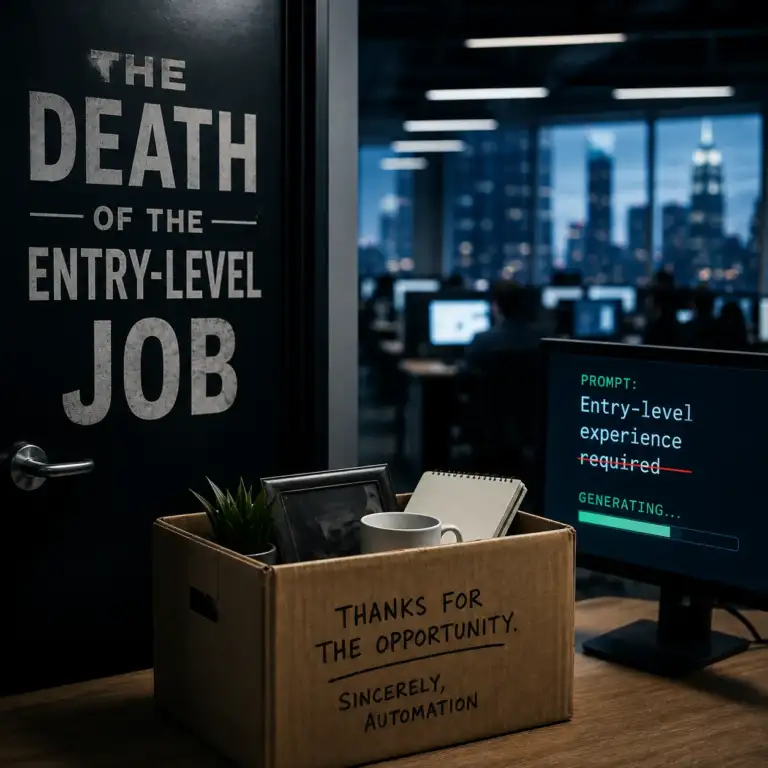
Anthropic’s own CEO, Dario Amodei, predicted in 2025 that artificial intelligence could eliminate roughly half of all white-collar entry-level positions within five years. He was not speaking as a critic of the technology his company builds. He was speaking as someone who understands, better than almost anyone, exactly what it is now capable of automating first. The question this raises is not simply how many jobs disappear. It is whether an entire generation is quietly losing the only path professionals have ever had for learning how to become good at their work in the first place.
Every profession has always had an unglamorous entry point: the research nobody wanted to do, the first drafts a manager would mark up in red ink, the data that needed cleaning before anyone senior would look at it. That work was never simply a hazing ritual junior employees endured on their way to something better. It was, this magazine believes, the actual mechanism by which professional judgment gets built, one corrected mistake at a time, across years of doing the tedious parts of a job before eventually earning the right to do the interesting parts. A growing body of research now suggests that mechanism is being dismantled, not through a single dramatic layoff wave, but through the quiet, steady absorption of exactly that entry-level work by artificial intelligence systems that do it faster, cheaper, and without ever needing to be trained themselves.
The Grunt Work That Built Every Career
New research from McKinsey, led by partner Bryan Hancock and associate partner Charlotte Seiler, names the mechanism directly. For decades, the McKinsey researchers note, junior employees learned their trade specifically by doing the work nobody else wanted, research, documentation, data cleanup, and preliminary analysis, the traditional building blocks of nearly every white-collar career. That grind, tedious as it was, functioned as a genuine training ground, the place where a junior analyst learned to spot a flawed assumption, where a young associate learned what a client actually needed versus what he initially asked for, where instinct got built through repetition and correction rather than through any classroom. McKinsey’s research finds that AI systems are now steadily absorbing precisely those tasks, streamlining or eliminating the very work junior staff have always used to learn the job, not because any single company decided to dismantle its training pipeline on purpose, but because each individual decision to let AI handle the research memo or the first-draft summary looks, in isolation, like simple efficiency.
Fast Facts
50 percent: Share of white-collar entry-level positions Anthropic CEO Dario Amodei predicted AI could eliminate within five years
25 percent: Decline in Big Tech new-graduate hiring from 2023 to 2024, per SignalFire
35 percent: Decline in job openings for the ten most common entry-level titles, including software engineer and data analyst, from 2024 to 2025
16 percent: Relative employment decline for early-career workers in AI-exposed occupations, while employment for experienced workers in the same fields held stable
30 percent: Share of 2025 college graduates who secured an entry-level role in their own field, down from roughly 40 percent the year before
43 percent: Share of graduates ages 22 to 27 who were underemployed as of December 2025
The Numbers Behind the Vanishing Rung
The scale of this shift, once measured directly, is difficult to dismiss as ordinary economic noise. SignalFire’s 2025 tracking of technology hiring found new-graduate hires at major technology companies fell 25 percent between 2023 and 2024 alone. A broader analysis from enterprise software company SAP found the entire early-talent job market down 10 percent since 2021 across all industries, and when isolated specifically to the ten most common entry-level job titles, software engineer, customer support representative, and data analyst prominent among them, job openings fell a striking 35 percent from 2024 to 2025 alone. The pattern shows up just as clearly overseas: entry-level technology graduate roles in the United Kingdom fell 46 percent in 2024, with forecasters projecting a further 53 percent decline by 2026, while separate American data found junior postings specifically in software development and data analysis down by as much as 67 percent. A Harvard study examining 62 million workers across 285,000 firms found junior positions specifically shrinking at companies actively integrating AI into their operations, a direct, firm-level confirmation that the correlation between AI adoption and entry-level hiring cuts is not coincidental.
What This Looks Like for an Actual 22-Year-Old
Behind every one of these statistics sits a young graduate discovering, often for the first time, that the career ladder their parents and professors described to them no longer has a bottom rung in the place it used to be. One 2025 marketing graduate profiled in recent reporting applied to 200 jobs between May and September of that year and secured not a single offer, an experience labor market researchers describe as increasingly common rather than exceptional. Only about 30 percent of 2025 graduates secured an entry-level role in their actual field of study, down from roughly 40 percent the year before, and university career centers report that the average time it takes a graduating student to land a first job has doubled in recent years. As of December 2025, an estimated 43 percent of graduates ages 22 to 27 were underemployed, working in roles that do not require the degree they just spent four years and often significant debt acquiring. This is precisely the population this magazine has already documented struggling to afford independent adulthood at all, and the entry-level hiring collapse described in this piece is one of the clearest, most specific mechanisms behind that broader struggle.
“That grind was never just busywork. It was how instinct got built, one corrected mistake at a time.”
— Summary of McKinsey research on AI’s absorption of traditional junior-employee training tasks
Not Every Sector, and Not Every Story
Fairness requires noting that this trend is not uniform, and this magazine believes the honest picture is more specific than a blanket claim that AI is destroying all entry-level work everywhere. The collapse is concentrated heavily in knowledge economy sectors most directly exposed to generative AI, software development, data analysis, marketing, and general office administration. Sectors requiring physical presence or regulated professional certification have moved in the opposite direction: healthcare, government, and leisure and hospitality together accounted for nearly 75 percent of all jobs added in late 2024 and 2025, and healthcare entry-level postings specifically rose by 13 percentage points even as technology postings collapsed. A separate, older wave of automation, self-checkout and computer vision systems replacing retail cashiers, continues alongside the AI-specific trend rather than being identical to it; Walmart’s self-checkout expansion alone is projected to eliminate roughly 8,000 positions, and Sam’s Club’s AI verification rollout could eliminate another 12,000 cashier jobs, a genuinely separate and longer-running automation story worth distinguishing from the white-collar knowledge-work displacement described above.
The Academic Warning: Pipeline Compression
Beyond the raw hiring numbers, a more subtle and arguably more consequential risk has begun surfacing in serious academic research. Economists Erik Brynjolfsson and colleagues, in 2025 research examining AI-exposed occupations directly, found early-career workers in those fields experiencing a 16 percent relative employment decline while employment among experienced workers in the very same occupations remained essentially stable. Researchers studying this dynamic have coined the term “pipeline compression” to describe the deeper structural risk it implies: even in fields where senior professionals’ judgment continues to be relied upon and their work carefully screened, the experiential path that actually produces that senior judgment in the first place, years of junior-level repetition, correction, and gradually earned responsibility, may be quietly narrowing beneath the surface. That risk is genuinely difficult to see in real time, because senior employment levels look perfectly stable right up until the moment, likely a full decade from now, when the current generation of experienced professionals begins retiring and companies discover there is no comparably trained cohort behind them to take their place, because that cohort was never given the entry-level repetitions needed to develop the judgment now suddenly in short supply.
The Counter-Case: Maybe the Rung Just Moves
This magazine believes the strongest and most honest response to this trend is not blanket alarm, and a genuine counter-case deserves serious consideration. Entry-level work may not be disappearing so much as transforming into something categorically different: instead of junior employees executing routine tasks from scratch, the emerging model asks them to review, triage, and exercise judgment over AI-generated output from their very first day, a shift from task execution to task oversight that, proponents argue, could actually accelerate the development of professional judgment rather than eliminate the opportunity to build it. Under this more optimistic reading, the rung on the career ladder has not vanished. It has simply moved to a different, arguably higher-order position, one that asks a 23-year-old to develop the kind of critical evaluation skills that used to take years of grunt work to earn, compressed instead into the first months of a career built around reviewing and correcting a machine’s first drafts rather than producing them personally. Whether this genuinely produces the same depth of professional instinct the old apprenticeship model built, or merely a superficial familiarity with output a young employee never had to struggle to produce themselves, remains a genuinely open, unresolved question, and this magazine does not believe anyone, including the researchers cited throughout this piece, currently has a confident answer either way.
Why This Matters Beyond Economics
This magazine has written elsewhere about the importance of discipline, effort, and earned struggle in forming genuine character and competence, arguing that the self-esteem movement’s substitution of unconditional affirmation for hard-won achievement produced measurably worse outcomes than the older model of learning through correction and earned progress. The traditional entry-level job embodied exactly that older model in professional form: a young worker given real but low-stakes responsibility, corrected repeatedly by someone more experienced, and gradually trusted with more as competence was actually demonstrated rather than assumed. If artificial intelligence genuinely eliminates that path without replacing it with something equally rigorous, the loss extends well beyond a disappointing job market statistic. It removes one of the last remaining structures in American professional life that reliably taught young adults the difference between believing they are ready for responsibility and actually having earned it.
The Bottom Line
The evidence assembled here does not yet support a confident verdict that entry-level work is disappearing entirely, and this magazine is wary of the most apocalyptic predictions circulating around this trend, including, ironically, some offered by the very AI companies whose products are driving it. What the evidence does support, clearly and across multiple independent data sources, is that the traditional entry point into professional life has genuinely narrowed, concentrated heavily in exactly the fields where AI has advanced fastest, and that the deeper risk, a quiet erosion of the apprenticeship structure that has always produced tomorrow’s senior professionals, will not show up clearly in any single year’s hiring statistics. It will show up a decade from now, in a shortage of experienced judgment nobody thought to protect while there was still time. This magazine believes that risk deserves far more serious attention from employers, educators, and policymakers alike than it has so far received, precisely because, unlike most economic problems, this one will not announce itself until it is already too late to fix quickly.
References
DesignRush, “200+ AI Job Displacement Statistics (2026 Trends),” citing Dario Amodei, SSRN, World Economic Forum, and NBER, May 2026
Rezi.ai, “The Crisis of Entry-Level Labor in the Age of AI (2024–2026),” May 2026
CIO.com, “How AI automation is reshaping the IT leadership pipeline,” citing SAP report, July 2026
DevelopmentAid, “The broken rung: Is AI eradicating entry-level jobs?” June 2026
IBTimes UK, “The Office Apprenticeship That Built Generations of Experts Is Disappearing as AI Absorbs Entry Level Work,” citing McKinsey’s Bryan Hancock and Charlotte Seiler, August 2026
1023 Jack, “The bottom rung. The danger isn’t the lost jobs. It’s the layer that made the seniors,” citing Revelio Labs and a Harvard study of 62 million workers, June 2026
arXiv, “Generative Models Erode Human Temporal Learning Through Market Selection,” citing Brynjolfsson et al. (2025) and SignalFire (2025)