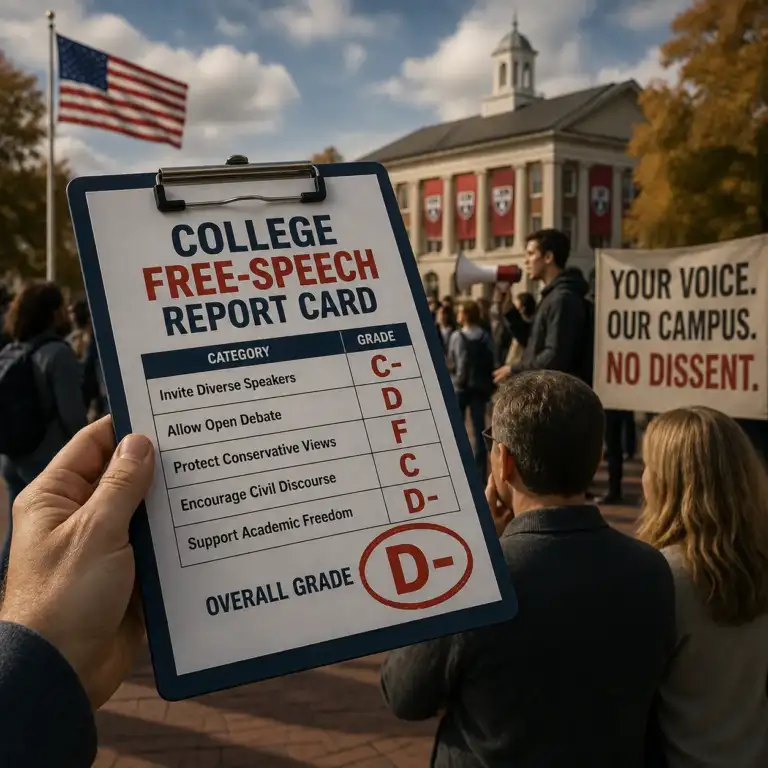
American families now spend more on four years of college than on almost anything else they will ever buy, a house and a wedding included. Almost none of them ever look up the one report that measures whether their child will actually be free to speak, question, and hold onto their convictions once they get there. That report already exists, it is free, and it should be required reading before a single tuition check gets written.
Every fall, millions of American parents pore over acceptance rates, average class size, graduation statistics, and career placement numbers before deciding where to send a child and how much debt to take on doing it. Almost none of them check the one number that may matter more than all the others combined for a Christian or conservative family: whether the campus their child is about to spend four formative years on will let that child actually say what they believe out loud. The Foundation for Individual Rights and Expression, known as FIRE, has been measuring exactly that every year since 2020, surveying tens of thousands of students at hundreds of schools and publishing the results in a free, searchable ranking built specifically, in the organization’s own words, to give “students, parents, alumni, and the media a pulse” of campus expression. The 2026 edition, released this past September, surveyed 68,510 students at 257 colleges and universities, the largest study of its kind ever conducted. The picture it paints is not encouraging, and it is exactly the kind of information a family should have before agreeing to spend a quarter million dollars on an education.
A Report Card Most Parents Have Never Seen
The topline numbers alone justify five minutes of research before any deposit gets sent. Of the 257 schools FIRE surveyed for its 2026 rankings, 166 received an outright failing grade for their campus speech climate, and only 11 schools nationwide earned a C or better. Claremont McKenna College took the top overall spot for the second time, followed by Purdue University, the University of Chicago, Michigan Technological University, and the University of Colorado Boulder. At the other end, Barnard College finished dead last of all 257 schools surveyed, with Columbia University and Indiana University ranked among the very worst as well. The prior year’s rankings told an equally sobering story at the bottom: Harvard finished last for a second consecutive year with a perfect-zero score, tied there by Columbia, with NYU, the University of Pennsylvania, and Barnard rounding out a bottom five FIRE described as having an “Abysmal” or “Very Poor” speech climate. These are not fringe or unknown institutions. Several sit among the most selective, most expensive, and most prestigious names in American higher education, exactly the schools many ambitious families are working hardest to get their children into.
Fast Facts
257: Colleges and universities surveyed in FIRE’s 2026 College Free Speech Rankings
68,510: Student respondents, the largest survey of its kind ever conducted
166 of 257: Schools that received a failing grade for campus speech climate
34 percent: Share of “very conservative” students who say they self-censor on campus very or fairly often, the highest of any political group measured
91 percent: Share of undergraduates who told FIRE they believe “words can be violence,” per a companion December 2025 survey
First time ever, 2026: Not one of the sample controversial speakers tested was one that a majority of students would allow on campus, whether the statement leaned liberal or conservative
Why This Matters More for Christian and Conservative Families Specifically
FIRE’s own data makes clear this is not an evenly distributed problem across the political spectrum, even though the organization is careful to note that self-censorship has been rising among students of every ideological stripe, including liberals. Very conservative students report self-censoring most often of any group, with 34 percent saying they hold back their views very or fairly often, compared with 24 percent of somewhat conservative students and 22 percent of slightly conservative students. That is not a marginal gap. It means the students most likely to hold traditional, faith-informed views on issues like abortion, marriage, and human sexuality are also the students most likely to report sitting silently through classroom discussions rather than risk the social or academic consequences of speaking honestly.
This is not an abstraction. FIRE’s 2026 report documents the case of a professor investigated by his university after administrators suggested that social media posts reflecting his religious convictions might make transgender students feel unsafe on campus; the professor defended his statements as protected religious expression and argued the investigation itself reflected institutional bias against conservative and religious viewpoints. Cases like this are exactly why a family paying six figures for an education has every right to ask, in advance, whether the campus their child is joining treats a sincerely held Christian conviction as a legitimate viewpoint to be debated, or as a violation to be reported and investigated.
How FIRE Actually Grades a School
Understanding what actually goes into these rankings turns them from an intimidating spreadsheet into a genuinely usable tool. FIRE scores each school across several distinct categories: how comfortable students report feeling expressing their views in class and among peers, how often students admit to self-censoring, how tolerant students are of controversial speakers from both the left and the right, how much support campus administrations show for free expression when controversies arise, how open the overall campus culture is to disagreement, and how often speakers get successfully shut down or “deplatformed” once invited. Starting with the 2026 rankings, FIRE also began awarding bonus points to schools that have formally adopted the University of Chicago’s 2014 “Chicago Principles,” a widely cited institutional pledge to broad free expression, and to schools that have adopted a policy of institutional neutrality, meaning the university itself refrains from taking official positions on contested political and social questions rather than pressuring students and faculty to fall in line with an administration-endorsed viewpoint. Both of those are concrete, checkable policy commitments, not vague impressions, and any family can look up in about sixty seconds whether a specific school on their list has adopted either one.
FIRE also maintains a separate, complementary tool worth knowing about: its “Spotlight” database, which rates the actual written speech codes and conduct policies of thousands of American colleges on a green, yellow, or red light scale, entirely apart from the annual student survey. A school with a “red light” rating has at least one policy that, in FIRE’s assessment, clearly and substantially restricts protected speech on paper, regardless of how students say they feel about the climate day to day. Checking both resources together, the survey-based rankings for lived student experience and the Spotlight database for the actual rulebook a student will be bound by, gives a far more complete picture than either one alone.
This Year’s Honor Roll, and This Year’s Warning List
The genuine encouragement in FIRE’s data is that campus climate is not fixed, and some schools are actively moving in the right direction. Dartmouth College and Vanderbilt University were both singled out in the 2026 report as schools that improved their scores substantially after implementing real policy reforms and new programming supporting open discourse. The University of Wisconsin-Madison climbed an extraordinary 126 spots in the rankings between 2024 and 2026, landing at 101st out of 257, even as FIRE’s own researchers cautioned that students there still report meaningful discomfort expressing themselves, a reminder that a rising rank is a genuinely good sign but not yet a guarantee. That is precisely why families should check the current year’s data specifically rather than rely on an older reputation, good or bad. A school your older child attended five years ago, or one you remember from your own reporting on higher education a decade back, may look meaningfully different, for better or worse, in this year’s numbers.
“The College Free Speech Rankings provide students, parents, alumni, and the media a pulse of what’s going on in terms of the climate for students’ abilities to express themselves in the classroom and on campus in general.”
— Sean Stevens, FIRE Chief Research Advisor
The Questions Rankings Alone Can’t Answer
Fairness requires being honest about what a ranking like this can and cannot tell a family. It is built on self-reported student survey data gathered at a specific point in the academic year, which means it captures a genuine, large-scale snapshot of campus mood rather than a guarantee about any single classroom, professor, or department a particular student will actually encounter. A school with a strong overall score can still have individual programs, majors, or professors with a noticeably different climate than the campus-wide average, and a school with a poor overall score may still have specific departments, religious life offices, or student organizations where a conservative or Christian student finds real community and genuine intellectual freedom. The rankings are an excellent starting point for narrowing a list and asking sharper questions. They are not a substitute for actually calling a campus ministry, reaching out to a current student in a relevant Christian fellowship group, or asking an admissions officer directly and specifically how the university handled its most recent free speech controversy, and watching closely how honestly that question gets answered.
A Practical Checklist Before You Sign the Tuition Check
Look up the specific school’s current-year FIRE ranking and letter grade at rankings.fire.org rather than relying on general reputation.
Check whether the school has adopted the Chicago Principles or institutional neutrality, both concrete, verifiable policy commitments now factored directly into the rankings.
Search the school’s rating in FIRE’s separate Spotlight database to see whether its actual written conduct and speech policies carry a green, yellow, or red light rating.
Ask about the campus’s most recent deplatforming or investigation controversy directly, and pay close attention to whether the answer is transparent or evasive.
Talk to a current student in a campus religious or conservative organization before enrollment, since lived experience inside a specific community often reveals more than a campus-wide average score can.
The Bottom Line
A college education remains one of the largest financial commitments most American families will ever make, and this magazine believes it is entirely reasonable to ask what that investment is actually buying beyond a diploma. FIRE’s research shows, in careful, methodologically rigorous detail, that a majority of American colleges and universities are currently failing to protect the basic freedom to speak honestly on campus, and that conservative students in particular are absorbing the sharpest edge of that failure. A family that would never sign a mortgage without reading the inspection report should not sign four years of tuition payments without reading this one. The good news buried in the data is that plenty of strong, rigorous, genuinely open campuses still exist, and they are identifiable, by name, in a free report published every September. The only real mistake a parent can make here is not looking.
References
FIRE (Foundation for Individual Rights and Expression), “2026 College Free Speech Rankings: America’s colleges get an ‘F’ for poor free speech climate,” September 2025
FIRE, “2026 College Free Speech Rankings” full report, rankings.fire.org
FIRE, “2025 College Free Speech Rankings”
FIRE, “2024 College Free Speech Rankings”
Insight Into Academia, “FIRE Survey Finds Majority of Colleges Failing Free Speech Test,” September 2025
The Daily Pennsylvanian, “Penn ranked among the worst universities in the nation for free speech,” 2025
The Madison Federalist, “FIRE Free Speech Ranking Reveals Progress, Problems on Campus,” November 2025
FIRE, “91 percent of undergraduate students believe that words can be violence,” December 2025