
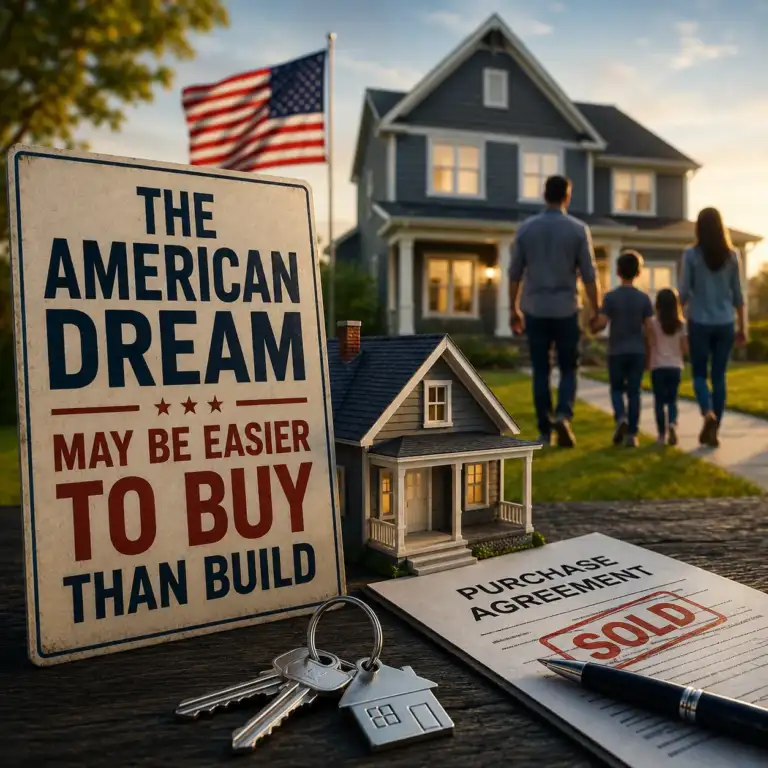
Every founder who has ever pitched an idea has heard the same romantic version of the American Dream: start with nothing, build something the world has never seen, and let the risk be the price of the reward. A quieter, less mythologized version of that same dream is sitting on the balance sheets of millions of aging small business owners across the country right now, and the data increasingly suggests it may be the more reliable path to the exact same destination.
This magazine has written before about the historic wave of small business ownership transitions now underway as baby boomers retire, and about why the survival data so strongly favors acquiring an established business over founding a new one. This piece takes that comparison further, walking through the five dimensions that actually determine whether a prospective business owner ends up secure and independent or exhausted and broke: financing, risk, cash flow, customer acquisition, and the personal freedom the whole endeavor was supposed to buy in the first place.
Financing: The Bank Already Knows Which Bet It Prefers
Start with the clearest, most quantifiable evidence available: how lenders themselves price the two paths. An analysis of every SBA 7(a) loan issued between 2020 and 2025 found that loans financing a business acquisition, formally categorized as a change of ownership, defaulted at just 0.71 percent, compared with 1.99 percent for loans financing an entirely new business, nearly a threefold gap. Banks do not extend credit generously to risky borrowers out of charity; they price risk directly into approval rates, interest rates, and required collateral. The fact that acquisition financing is treated as dramatically safer than startup financing by the institutions with the most direct financial stake in getting the risk assessment right is one of the clearest signals available about which path the market itself considers more dependable. For buyers seeking outside capital and structure, the search fund model, in which an entrepreneur raises money specifically to find and acquire a single established business, has produced an average internal rate of return of 35.1 percent and a 4.5 times return multiple across 681 tracked funds since 1984, a track record that compares favorably against venture capital over the same period, even accounting for the roughly half of searches that never complete a deal at all.
Fast Facts
0.71 percent vs. 1.99 percent: SBA loan default rates for business acquisitions versus new business startups
~50 percent vs. 70 to 80 percent: Five-year survival rates for ground-up startups versus acquired businesses
222 percent: Rise in average customer acquisition cost over the past eight years
72 percent: Entrepreneurs reporting burnout symptoms in the past year
60+ hours: Weekly work hours cited by 70 percent of founders as their primary driver of burnout
35.1 percent: Average internal rate of return across 681 search funds since 1984
Risk: A Coin Flip Versus a Strong Favorite
This magazine has documented this comparison in detail, and it remains the single starkest number in the entire buy-versus-build decision. Roughly 20 to 22 percent of new American businesses close within their first year, and by the five-year mark, survival falls to somewhere near 50 percent, according to Bureau of Labor Statistics and Census Bureau data. Businesses acquired from an existing owner, by contrast, survive at an estimated 70 to 80 percent over that same five-year window, according to industry data compiled from SBA lenders, business brokers, and search fund operators. The gap exists for an intuitive reason: an acquired business has already answered the single hardest question a new venture faces, whether real customers will actually pay for what it offers, while a startup has to answer that question from zero, with real money and real time on the line before anyone knows the answer.
Cash Flow: Day One Versus Month Eighteen
Perhaps the most underappreciated difference between these two paths is what happens to a bank account in the first year. A founder starting a business from nothing typically spends months, often longer, building a product, establishing operations, and acquiring an initial customer base before revenue exceeds expenses, a period commonly described in startup circles as the cash-burn phase, funded entirely by savings, debt, or outside investment with no guarantee it ends before the money runs out. A buyer acquiring an established, profitable business inherits positive cash flow from literally the first day of ownership: existing customers already paying, existing revenue already covering existing expenses, and an existing track record a bank can actually underwrite against rather than a projection built on hope. That single difference, cash flow from day one instead of cash flow as a distant and uncertain milestone, explains much of the gap in both loan default rates and long-term survival described above. It is far easier to keep a business alive that is already breathing on its own than to will one into existence from a standing start.
Customer Acquisition: The Most Expensive Problem You Can Simply Skip
If there is one line item that has quietly become the single largest hidden cost of building a business from scratch, it is the cost of finding customers in the first place. The average cost of acquiring a new customer has surged 222 percent over the past eight years, with a particularly sharp 40 to 60 percent jump in just the 2023 to 2025 window alone, driven by rising digital advertising costs, tightening privacy regulations, and increasingly saturated markets in nearly every category. The spread by industry is genuinely brutal: customer acquisition costs run as low as $21 in arts and entertainment but climb to $1,672 in fintech, with enterprise-focused B2B software companies routinely spending $11,400 to $28,400 to land a single customer through direct sales. Even the most efficient acquisition strategy available, product-led growth, in which a free trial or freemium product drives its own adoption, still costs $200 to $2,000 per customer, a real and rising expense that an acquired business simply does not have to pay. A buyer purchasing an established company with an existing, loyal customer base is not merely inheriting revenue. He is skipping what has become, by a wide and growing margin, the single most expensive and least certain phase of building any company from nothing.
“72% of entrepreneurs report experiencing burnout symptoms in the past year.”
— Aggregate 2026 entrepreneurial burnout research, cross-referencing UC San Francisco and multiple independent founder surveys
Personal Freedom: The Dream the Startup Path Often Fails to Deliver
The single most seductive promise of founding a company from scratch is personal freedom, the idea that building something entirely your own frees a person from someone else’s schedule, someone else’s priorities, someone else’s rules. The actual data on founder wellbeing tells a considerably harder story. Multiple independent surveys converging across 2025 and 2026 found that 72 percent of entrepreneurs report experiencing burnout symptoms within the past year, and research affiliated with UC San Francisco found that entrepreneurs are 50 percent more likely than the general population to report a mental health condition, with elevated rates of anxiety, depression, and attention disorders. A striking 87.7 percent of entrepreneurs report struggling with at least one mental health issue, whether anxiety, chronic stress, financial worry, burnout, or impostor syndrome, yet only 23 percent seek professional psychological support, many citing a genuine and rational fear that a therapy record could surface during a future funding round or acquisition due diligence process. Seventy percent of founders point to sustained 60-plus-hour work weeks as the primary driver of that burnout, and 45 percent say their workload actively prevents them from maintaining personal relationships. The consequences extend beyond the founder’s own wellbeing directly into the business itself: 65 percent of startup failures involve internal conflict or founder burnout as a contributing factor, and companies that lose a founder to burnout-driven exit see valuations fall by 40 to 60 percent, because investors price founder-dependent companies heavily on that founder’s continued presence and stamina.
A buyer stepping into an already-functioning business is not exempt from real work or real stress; running any company, acquired or founded, is genuinely demanding, and this magazine has no interest in pretending otherwise. But the specific kind of stress differs meaningfully in character. A business buyer inherits existing systems, an existing team, and existing processes to manage and improve, a fundamentally different daily reality than a founder simultaneously solving product-market fit, managing a shrinking cash runway, and building every operational system from a blank page, often alone, at the same time. The freedom the American Dream has always promised, control over one’s own time and work, appears, according to the data, considerably more achievable running a business that already works than building one that might never get the chance to.
What Building Still Offers That Buying Doesn’t
Fairness requires this magazine to be honest about what the acquisition path genuinely cannot offer. Buying an existing business means inheriting someone else’s decisions, someone else’s culture, and sometimes someone else’s hidden problems, an underperforming employee nobody wanted to fire, a customer relationship built entirely on the departing owner’s personal rapport, equipment quietly nearing the end of its useful life. It offers no path to building something genuinely new, no chance at the outsized, category-defining outcome a small number of true startups occasionally produce, and no experience of shaping an organization’s identity from its very first hire. For an entrepreneur whose actual ambition is innovation itself, not simply ownership and financial security, founding a company remains the only path that leads where he actually wants to go, whatever the survival odds along the way.
The Bottom Line
For the founder chasing a genuinely novel idea, building from scratch remains, and should remain, a legitimate and sometimes necessary path, whatever its steeper odds. But for the far larger number of Americans whose actual goal is the traditional heart of the American Dream itself, financial independence, ownership of something real, and a measure of control over their own working life, the evidence assembled across financing, risk, cash flow, customer acquisition, and personal wellbeing points in a remarkably consistent direction. The safer loan, the higher survival rate, the immediate cash flow, the customer base that doesn’t have to be built from zero at ever-rising cost, and very possibly the healthier and more sustainable daily life, all favor the entrepreneur willing to buy something that already works over the one determined to build everything from nothing. That is not a smaller dream. Given what the data now shows about the actual cost, in dollars and in mental health, of building from scratch, it may simply be the more honest one.
References
GoSBA Loans, “SBA Loan Default Rates: Startups vs Acquisitions vs Working Capital,” June 2026
Angora, “Startup Failure Rate: What the Data Actually Shows (And Why Acquisitions Succeed at 2x the Rate),” April 2026
BizScout, “The Great Business Handoff,” citing search fund industry tracking data
Culta.ai, “Customer Acquisition Cost Benchmarks for Startups: 2026 Data by Channel and Stage,” citing SimplicityDX and Phoenix Strategy Group, April 2026
Mean.ceo/Startup Edition, “Customer acquisition cost benchmarks by industry statistics (2026)”
Amra and Elma, “Top 20 Customer Acquisition Cost Statistics 2026,” citing CB Insights Fintech Customer Economics Report, May 2026
StealthAgents, “Founder Burnout Statistics 2026,” citing ZipDo, Octopus Ventures, and CB Insights, 2026
Cerevity, “Tech Founder Burnout Statistics 2025,” citing UC San Francisco research, December 2025
ZipDo, “70+ Entrepreneur Burnout Statistics: 2026 Report,” citing Inc.com, Sleep Foundation, and Mayo Clinic surveys, February 2026