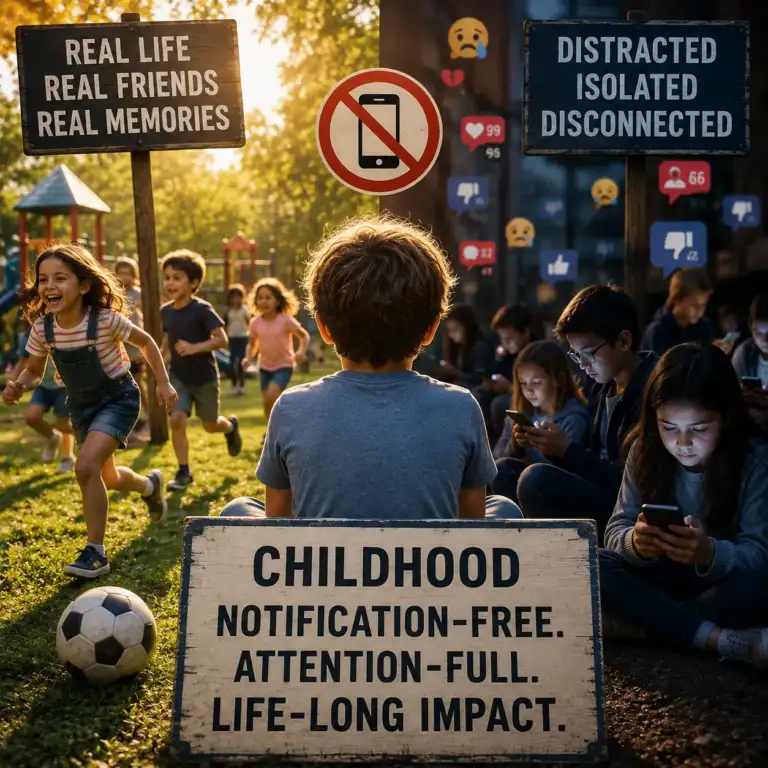
Should Every Child Have a Right to a Phone-Free Childhood?
Two years ago, a psychology professor published a book arguing that smartphones had quietly stolen something essential from an entire generation of children. Today, thirty-five American states restrict phones in schools, an entire nation has banned social media for anyone under sixteen, and grassroots parent movements spanning sixty countries are pushing lawmakers to do formally what individual families discovered they could not do alone. The question this movement is really asking is bigger than screen time limits. It is whether childhood itself deserves legal protection from a technology industry that was never built with children’s wellbeing in mind.
In 2024, NYU social psychologist Jonathan Haidt published “The Anxious Generation,” a book arguing that the simultaneous arrival of smartphones and social media in children’s pockets, combined with a collapse in unsupervised outdoor play, had produced what he called an epidemic of teenage mental illness. The book has since sold more than two million copies and become something rarer still for a work of academic psychology: a direct catalyst for national law. Within seven months of an Australian mother finishing the book and telling her husband, a state premier, “you better do something about this,” Australia had become the first country on earth to ban social media outright for anyone under sixteen. In the United States, thirty-five states have now restricted or banned phones in K-12 schools, with more state laws passed in 2025 alone than in the entire previous decade combined. This magazine believes the question underneath all of this legislative momentum deserves to be asked plainly: should a phone-free childhood be treated not as a lucky accident of good parenting, but as something every child has a right to expect, protected by law when individual families cannot secure it alone?
A Book That Started a Global Movement
Haidt’s core argument is that four specific norms, if restored, would substantially reverse the youth mental health crisis he documents: no smartphones before age fourteen, no social media accounts before sixteen, phone-free schools enforced by policy rather than left to individual teachers, and a deliberate return to childhood independence and unsupervised play. What made the book different from countless prior warnings about screen time was Haidt’s insistence that none of these norms can be restored by individual families acting alone. “When we face this as individuals, we’re trapped,” Haidt told an audience at the World Economic Forum, describing the exact bind so many parents already know from experience: a mother who refuses to give her twelve-year-old a smartphone quickly hears the same protest from her own child that every other parent hears, that she is the only kid in her grade without one, socially exiled by a device everyone else already carries. Haidt’s argument, in other words, was not really about individual willpower. It was about a collective action problem that only collective solutions, schools, platforms, and governments acting together, could actually solve. That framing is precisely why his book produced legislation rather than just another wave of parental guilt.
Fast Facts
2 million+: Copies sold of Jonathan Haidt’s “The Anxious Generation” since its 2024 publication
35: U.S. states that now restrict or ban student cellphone use in K-12 schools, as of late 2025
22 to 28: Of those state laws passed in 2025 alone, more than the entire previous decade combined
December 2025: Australia’s ban on social media for anyone under 16 takes effect, the first national law of its kind
77 percent: Share of Australians who supported the under-16 ban once it was formally announced, up from 61 percent beforehand
500,000+: Under-16 accounts Meta reported blocking in Australia in the ban’s first weeks
The State-by-State Revolution No One Fully Noticed
The scale of the American school phone ban wave has genuinely outrun public awareness of it. Florida became the first state to legislate a classroom cellphone ban in May 2023 under Governor Ron DeSantis, passed unanimously by both chambers of its legislature. What followed was slower at first and then suddenly, remarkably fast: by December 2025, thirty-five states plus Washington, D.C. had enacted some form of restriction, with twenty-two to twenty-eight of those laws, depending on the tracking organization, passed in 2025 alone. New York became the largest state in the nation to require full “bell-to-bell” restrictions, banning phones for the entire school day rather than just during instructional periods, a policy Governor Kathy Hochul secured as part of the state’s 2026 budget and paired with an earlier, first-in-the-nation law restricting addictive social media feeds for minors statewide. Texas, Virginia, Louisiana, Alabama, and Nebraska have adopted similarly strict bell-to-bell standards. Enforcement has become a genuine industry of its own: many districts now contract for Yondr pouches, magnetically locking fabric cases students place their phones inside at the start of the school day, with contracts ranging from a few thousand dollars for small districts to more than five million dollars for the largest ones. Even the National Association of School Resource Officers, whose members are directly responsible for school safety, has formally endorsed bell-to-bell bans as the safer option, cutting against the common parental objection that a locked-away phone leaves a child less safe in an emergency.
When a Nation Decided Sixteen Was the Line
Australia’s national ban remains the single most consequential policy this movement has produced anywhere in the world, and its origin story is worth telling in full because it illustrates exactly how quickly this issue has moved from private parental anxiety to binding law. South Australia Premier Peter Malinauskas has described the night his wife finished reading Haidt’s book, set it down, and told him plainly he needed to act. What began as a proposal in a state representing just seven percent of Australia’s population escalated to a full national law within roughly seven months, ultimately winning the backing of Prime Minister Anthony Albanese. Public support followed the same trajectory: a survey found 77 percent of Australians backed the ban once it was formally announced, up from 61 percent before the government’s announcement, the kind of rapid consolidation of opinion that typically only follows a policy voters were already primed to want. The law took effect in December 2025, and within its first weeks, Meta reported blocking more than 500,000 under-16 accounts across its platforms in the country, a scale that gives some real sense of how many Australian children under sixteen had social media accounts in the first place. Meta has publicly urged the government to reconsider the policy. The government has shown no sign of doing so. The United Kingdom’s health leadership has since invited Haidt directly to advise officials on a similar law, and France is debating its own version for children under fifteen, championed personally by President Emmanuel Macron.
The Grassroots Army Behind the Laws
None of this legislative momentum happened through elite policy circles alone. It was built, in large part, by parents organizing directly with one another, often starting from nothing more than a shared sense of powerlessness. The UK-based Smartphone Free Childhood movement, founded in February 2024 by two parents who began simply as a WhatsApp group in Suffolk, has grown to more than 350,000 self-reported members, with over 140,000 parents across 13,500 schools signing formal pacts to delay giving their own children smartphones together, precisely the kind of coordinated action Haidt argued individual families could never manage alone. The movement now has affiliated organizations in more than 40 countries, from Wait Until 8th in Austin, Texas, to Unplugged in Canada, No Es Momento in Mexico, and the Heads Up Alliance in Australia. Brooke Shannon, Wait Until 8th’s founder, described the reaction to Australia’s ban in terms that capture the entire movement’s underlying sentiment: “Parents were waiting for something like this: a simple and collective way to push back against a cultural current that felt too strong to face alone.”
“No smartphones before 14. No social media until 16. Phone-free schools. More free play, responsibility, and independence.”
— Jonathan Haidt, describing the four norms at the center of his movement
Is the Science as Settled as the Politics?
Fairness requires acknowledging that Haidt’s underlying scientific claims remain genuinely contested among researchers, even as his policy prescriptions have moved with startling speed through legislatures. Canadian psychologist Candice Odgers, reviewing “The Anxious Generation,” wrote bluntly that the “scary story” Haidt tells is “not supported by science” in the way the book’s confident tone implies, pointing to a body of research showing correlations between social media use and teen mental health that are real but consistently modest in size, not the dramatic, singular cause Haidt often describes. Other researchers have pushed back on that skepticism in turn; Michael Noetel, a University of Queensland researcher, has argued that “small effects across billions of users add up,” and that demanding an unrealistic threshold of proof before acting on a plausible, mounting harm is itself a kind of policy failure. This magazine does not believe that ongoing scientific debate about effect sizes should be read as evidence the underlying concern is manufactured. It should be read as a reminder that good policy in this area needs to rest on the parts of the evidence that are genuinely well established, rising teen anxiety and depression rates, sleep disruption, and the documented collective action problem parents face, rather than on the most dramatic version of the causal story alone.
The Equity Question Nobody Wants to Answer
There is a sharper critique of this movement worth taking seriously, one that Haidt himself has acknowledged directly. Speaking about who is actually able to implement his four norms in practice, Haidt has conceded a genuinely uncomfortable truth: the families most able to raise an “analogue childhood,” free play, delayed smartphones, hired help to manage a phone-free household, tend to be exactly the educated, married, two-parent families with the resources to pull it off, while single parents and lower-income households, who need a phone to reach a child after school or to manage logistics no second adult is available to handle, often cannot replicate the same choices no matter how much they might want to. That is precisely the class divergence this magazine warned about in its own recent examination of how marriage has become a luxury good increasingly available only to the affluent, and it is worth naming directly here rather than pretending it does not exist: left purely to individual family choice, a phone-free childhood risks becoming another marker of privilege, available to those with the resources to enforce it and unavailable to everyone else.
That critique, rather than undermining the case for legal protection, is this magazine’s strongest argument for it. A voluntary norm that only the affluent can actually sustain is not a real solution to a collective action problem. A legal one, a school policy that applies to every student regardless of household income, a national age verification standard that applies to every platform regardless of which families can afford alternatives, is the only version of this movement that does not simply widen the gap between children whose parents have resources and children whose parents do not.
What “A Right to a Phone-Free Childhood” Would Actually Require
Answering this magazine’s original question honestly means being specific about what a genuine right would actually look like in practice, rather than leaving it as an aspiration. It would mean treating bell-to-bell school phone policies, now law in thirty-five states, as a floor rather than an aspiration, extended to every remaining state rather than left to local discretion. It would mean following Australia’s lead on platform-level age verification rather than leaving enforcement entirely to individual parental vigilance against algorithms explicitly engineered to defeat it. And it would mean recognizing, as Haidt’s own framing insists, that this cannot be solved by telling parents to simply try harder. The entire reason this movement produced legislation instead of just another self-help book is that its founders correctly identified something conservatives should recognize instinctively: some problems are structural, not personal, and pretending otherwise leaves only the families with the most resources able to protect their own children while everyone else’s kids remain unprotected by default.
The Bottom Line
Two years ago, this was a book. Today it is law in thirty-five American states and an entire Australian federal statute, driven not by distant bureaucrats but by parents who organized because they had run out of other options. That speed of change reflects something real: a broad, cross-partisan recognition that the current arrangement, in which a handful of technology companies design products explicitly to capture children’s attention for as many hours as possible, and individual families are left alone to fight that design with nothing but willpower, was never a fair fight to begin with. A child does not choose the algorithm built to exploit her developing brain, and a family without the resources of the most privileged households should not be the only ones left unable to protect their own. This magazine believes the honest answer to the question in this piece’s title is yes: a phone-free childhood should be treated as something every child is entitled to, secured through schools, platforms, and law working together, not as a private luxury available only to the families lucky enough to afford it.
References
The Conversation, “School smartphone bans reflect growing concern over youth mental health and academic performance,” September 2025
KFF, “A Look at State Efforts to Ban Cellphones in Schools and Implications for Youth Mental Health,” September 2025
Phone-Free Schools State Report Card, distractionfreeschools.com
Office of Governor Kathy Hochul, “Distraction-Free Schools: New York to Become Largest State With Bell-to-Bell Restrictions”
Campus Safety Magazine, “Which States Have Banned Cell Phones in Schools?”
Ballotpedia, “State policies on cellphone use in K-12 public schools”
Civic IQ, “26 States Now Require School Cell Phone Bans: 2026 K-12 Policy Tracker”
ExcelinEd In Action, “Top 2025 Policy Trend: 28 States Commit to Phone-Free Classrooms and Schools,” January 2026
Wikipedia, “Smartphone Free Childhood”
CNBC, “Meta urges Australia to rethink under-16 social media ban after blocking over 500,000 accounts,” January 2026
CNBC, “Jonathan Haidt on smartphone free childhood: Key is enforcing 4 norms,” February 2025
Christian Science Monitor, “Australia banned social media for teens under 16. Will other countries follow?” December 2025
CBS News, “Australia’s new social media ban for kids started with a mom saying, ‘Do something!'”
PhoneArena, “This book inspired the Australian ban on social media for kids under 16”
Gulf News, “UK, France mull social media bans for youth as debate rages”
John Menadue’s Pearls and Irritations, “Banning social media for kids is not the answer. Jonathan Haidt is wrong”