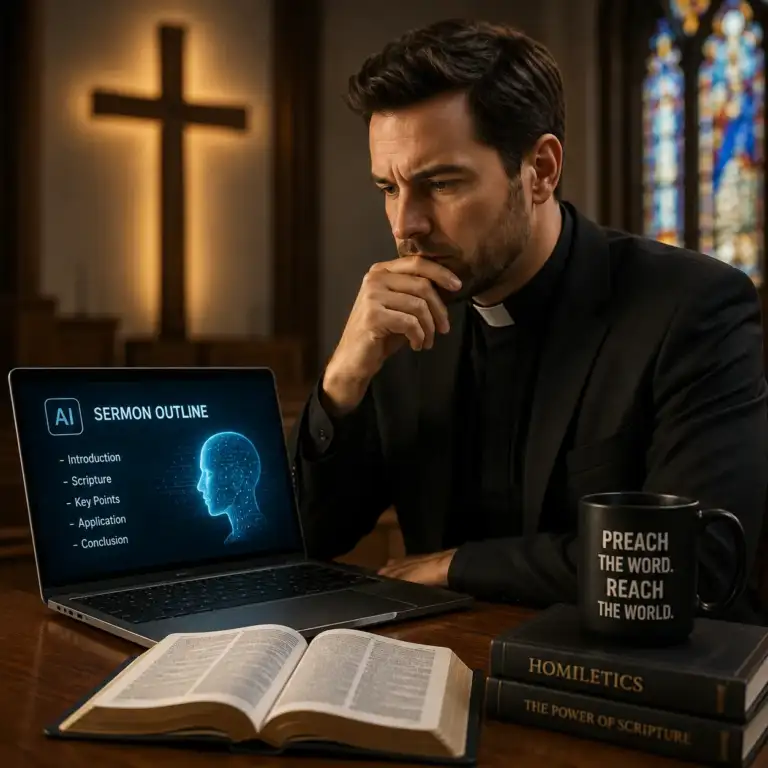
For most of Christian history, sermon preparation looked essentially the same: a pastor alone with Scripture, commentaries, prayer, and whatever wisdom years of shepherding a congregation had taught him. That picture has changed faster than almost anyone in ministry expected. According to Barna Group’s 2026 State of the Church research, conducted in partnership with Gloo, only 13 percent of Protestant pastors say they don’t use AI at all in their work. The rest are drawing on it for brainstorming, research, graphics, discussion questions, and increasingly, the sermon itself. A separate survey from AiForChurchLeaders.com found 61 percent of pastors now using AI weekly or daily, up from 43 percent just two years earlier, with nearly two-thirds of those who prepare sermons saying AI is now part of that process in some form. This is not a hypothetical debate for some future church. It is happening in pulpits across the country right now, and it deserves a more careful answer than either blanket enthusiasm or blanket suspicion.
A Question No Pastor Can Avoid Anymore
The honest starting point is acknowledging how quickly this shift has occurred. In early 2024, just 12 percent of pastors said they were even comfortable with the idea of using AI to help write a sermon. By late 2025, Barna found that number had doubled to 24 percent of pastors actually doing it, not merely open to it. Pastor Darrell Stetler II of Oklahoma City, profiled by the Wall Street Journal as representative of this new generation of tech-comfortable ministry leaders, is one of a growing number of preachers treating AI tools as a normal part of weekly preparation rather than a novelty or a shortcut. At the same time, this rapid adoption has not come with rapid comfort. Barna found that 71 percent of pastors describe feeling cautious about AI, and 40 percent say they feel genuinely conflicted about the technology even as they use it. That tension, using a tool while feeling uneasy about it, is exactly the space this magazine believes deserves a clear, biblically grounded answer rather than silence.
Fast Facts
87 percent: Share of U.S. Protestant pastors who use AI in some part of their ministry work
24 percent: Share of pastors who now use AI to help write or edit sermons, up from just 12 percent in early 2024
29 percent: Share of pastors who name theological misalignment as their top ethical concern about AI
79 percent: Share of pastors who worry about AI functioning as a replacement for God in people’s spiritual lives
30 percent: Share of U.S. adults who already consider AI spiritual advice as trustworthy as a pastor’s, rising to 39 percent of Gen Z and 40 percent of Millennials
44 to 43 percent: How churchgoers split on whether AI-assisted sermon prep is acceptable, according to Lifeway Research
Where AI Earns Its Place: Research, Outlines, and the Unglamorous Work
Not every use of AI in ministry raises the same concerns, and treating them all identically would be a mistake. Barna’s research shows pastors primarily reaching for AI as a brainstorming partner (50 percent), a graphic design assistant (37 percent), a research aid for biblical or theological questions (36 percent), a generator of small group discussion questions (34 percent), and a helper with routine administrative tasks like scheduling and email (34 percent). Barna’s Vice President of Research, Daniel Copeland, described this pattern precisely: “Pastors are predominantly using AI for behind-the-scenes work, as a thought partner, a visual aid. They’re using it to prepare for ministry, not to replace what happens when they’re actually with people.” That is a meaningful and, this magazine believes, defensible distinction. A pastor pulling up cross-references, checking a Greek word’s range of meaning, drafting a first-pass outline to react against, or building a slide deck is not doing anything categorically different from consulting a concordance, a commentary, or a seminary-trained research assistant, tools the church has used without controversy for generations. The tool is new. The underlying activity, gathering information to be prayerfully weighed and shaped by the pastor’s own study, is not.
Where the picture changes is when AI stops assisting the process and starts producing the product.
The Line Nobody Should Cross: Full Sermon Generation
This is precisely the distinction the Southern Baptist Convention drew in 2025, when messengers at its annual meeting in Dallas adopted a resolution titled “Restoring Integrity to the Pulpit,” aimed squarely at pastoral plagiarism and, explicitly, at AI-generated preaching. The resolution states plainly that Southern Baptists “exhort pastors not to rely on artificial intelligence platforms in the development of their sermons or in shaping their preaching content, but rather to use AI only as a secondary tool for research, never as a substitute for the pastor’s personal study and preparation to faithfully deliver God’s Word to God’s people.” The same resolution goes further, denouncing pastors who buy, sell, or re-preach sermons written by someone else without disclosure, treating AI-generated sermons as simply the newest version of a much older integrity problem the church has always had to guard against.
The SBC’s Ethics and Religious Liberty Commission expanded on this reasoning in a 2025 guide titled “The Work of Our Hands: Christian Ministry in the Age of Artificial Intelligence,” arguing that sermon development is not merely a task to be completed efficiently but a sacred process that refines and renews the preacher’s own heart in the course of wrestling with the text. Replacing that wrestling with an AI-generated draft, the ERLC argues, produces a loss of genuine engagement with Scripture, regardless of how polished the final product sounds from the pulpit. This magazine finds that reasoning compelling, and not merely as a matter of denominational policy. A sermon is not simply information transfer. It is the fruit of a specific person’s study, prayer, and personal encounter with a text, delivered to a specific congregation that person actually knows, and a great deal of what makes preaching spiritually effective is inseparable from that personal, prayed-over process. An AI system has never sat with a grieving widow in that congregation, never wrestled with its own sin in light of the passage being preached, and never prayed through a sleepless night over how to say a hard truth with love. A sermon assembled without any of that is missing something no amount of eloquent AI-generated prose can supply.
Why Accountability and Discernment Matter Here Specifically
The concerns pastors themselves raise about AI reinforce why this distinction matters so much. When asked to name their top ethical concern, 29 percent of pastors cited theological misalignment, the risk that an AI system trained on a broad, denominationally neutral dataset will subtly flatten or distort doctrine in ways a pastor might not catch if he isn’t reading every line with a critical eye. Researchers studying this phenomenon have documented what they call “doctrinal flattening,” a tendency for AI-generated theological content to default toward generic, broadly inoffensive spiritual language that avoids the specific convictions, denominational distinctives, and hard biblical truths a faithful pastor is called to proclaim even when they are unpopular. When asked to identify the single most significant risk of AI in ministry overall, 41 percent of pastors pointed to misinformation, the danger of an AI system confidently generating a scriptural reference, a historical claim, or a theological argument that sounds authoritative and is simply wrong. A pastor who has done the work of seminary training and years of study is equipped to catch that error. A pastor leaning heavily on AI-generated content without rigorous verification may not be, and the congregation sitting in the pews has no way of knowing the difference.
This is precisely why accountability cannot be an afterthought. Every theological claim an AI tool produces must be checked against Scripture and sound doctrine before it ever reaches a congregation, not glanced at for plausibility but actually verified, the same discipline a faithful pastor would apply to any secondary source. The tool does not carry the pastor’s ordination, his accountability to his elders or bishop, or his answerability to God for what he teaches. That responsibility cannot be delegated to software, no matter how convincingly it writes.
The Deeper Fear: Confusing the Tool for the Shepherd
Beneath the practical concerns about accuracy and doctrine sits a deeper unease that pastors themselves are naming directly. A striking 79 percent of pastors surveyed by Barna say they worry about AI functioning as an outright replacement for God in people’s spiritual lives, and 63 percent worry specifically about AI replacing pastors or spiritual leaders altogether. Those numbers might sound overstated until set beside a companion finding from the same research: 30 percent of American adults already say they consider spiritual advice from AI as trustworthy as advice from a pastor, a figure that climbs to 39 percent among Gen Z and 40 percent among Millennials. This magazine has written before about how young people are increasingly turning to AI companions for friendship, emotional support, and even romantic connection in place of real human relationships. The same pattern is now reaching into the most sacred relationship a congregation has, the relationship between a shepherd and the flock entrusted to his care, and the numbers suggest it is happening fastest among exactly the generations the church can least afford to lose.
“The problem is not whether AI can produce a sermon. It’s whether it can shepherd the person listening to it.”
— Reasoning drawn from the ERLC’s 2025 guidance, “The Work of Our Hands”
What Congregations Actually Think, and Why Disclosure Matters
Congregations are not naive about any of this, and pastors weighing whether or how to use AI should take their view seriously. Lifeway Research’s September 2025 survey of Protestant churchgoers found the pews genuinely split: 44 percent see nothing wrong with a pastor using AI in sermon preparation, while 43 percent object, including 24 percent who object strongly. More tellingly, 61 percent of churchgoers say they are concerned about AI’s broader influence on Christianity itself, a discomfort that runs well beyond any single pastor’s sermon-writing habits and reflects real anxiety about what this technology is doing to the faith as a whole. A congregation that is this evenly divided, and this broadly uneasy, has every right to know how its own pastor is actually using these tools.
That is why disclosure is not an optional courtesy but a matter of basic pastoral integrity. The 2023 SBC resolution on AI called on believers to use these tools in ways that are “honest, transparent, and Christlike,” language that applies with particular force to preaching, since a congregation trusts that the message it receives has been genuinely prayed over and personally prepared by the person delivering it. A pastor is under no obligation to announce every commentary he consulted that week. He is under a real obligation not to let his congregation believe a sermon reflects his own study and conviction when substantial portions of it were, in fact, generated by a machine. Silence in that specific circumstance is not neutral. It is a small deception, and small deceptions from the pulpit have a way of becoming large ones.
A Faithful Way Forward
None of this requires rejecting AI outright, and this magazine is not calling for that. Used as what it actually is, a research assistant, an organizational aid, a tool for catching blind spots or generating a rough outline to argue with, AI can genuinely serve a pastor’s preparation the same way a good study Bible or a well-stocked seminary library always has. What it cannot do, and should never be asked to do, is replace the personal, prayerful, Spirit-led process by which a specific shepherd wrestles with a text on behalf of a specific flock he actually knows and loves. Every AI-assisted theological claim needs to be checked, not trusted. Every AI-assisted sermon needs to still be, in every meaningful sense, the pastor’s own, shaped by his study and his prayer rather than merely his editing pass. And every congregation deserves honesty about which parts of that process a machine touched, because trust in the pulpit, once spent carelessly, is not easily rebuilt.
The Bottom Line
The church has adapted to new tools before, the printing press, radio, television, recorded sermons streamed to phones, without losing what actually makes preaching preaching. AI can likely be added to that list, but only if pastors are honest with themselves, and with their congregations, about the difference between a tool that helps a shepherd prepare and a tool that quietly starts doing the shepherding itself. The data shows most pastors already sense that line intuitively, even as they experiment with where exactly it sits. This magazine’s answer is the same one the Southern Baptist Convention and its Ethics and Religious Liberty Commission have already reached: let AI carry the research, the outlines, the administrative weight ministry has always demanded. Do not let it carry the sermon. That work, the wrestling, the praying, the personal encounter with God’s Word that produces a message worth hearing, was never meant to be automated, and a church that forgets why will eventually discover its pulpit has gone quiet in every way that actually matters.
References
Barna Group, “Majority of Pastors Use AI in Ministry Amid Concerns and Caution,” June 2026, via Gloo and Business Wire
Washington Times, “Barna survey finds pastors increasingly using AI in ministry, sermon prep,” July 2026
Movieguide, “Most Pastors Are Already Using AI — Just Not in the Pulpit,” June 2026
AiForChurchLeaders.com and Exponential AI NEXT, “The 2025 State of AI in the Church Survey Report,” via PR Newswire, December 2025
Christian Post, “Majority of pastors now using AI to prepare sermons amid rapid embrace of technology,” December 2025
Lifeway Research, “Pastors, Churchgoers See AI as Concerning and Confusing,” April 2026
ChurchTechToday, “AI For Pastors: Why Generic ChatGPT Falls Short On Doctrine”
Christ Over All, “Restoring Integrity to the Pulpit: An SBC Resolution to Fight Pastoral Plagiarism,” May 2025
Faith on View, “New ERLC guide urges faithful, cautious approach to Artificial Intelligence,” October 2025
Baptist Standard, “SBC adopts resolution on AI and emerging technologies,” 2023
Breitbart, “Christian Pastors Are Using AI to Write Sermons Sparking Debate in Congregations,” July 2026, citing The Wall Street Journal