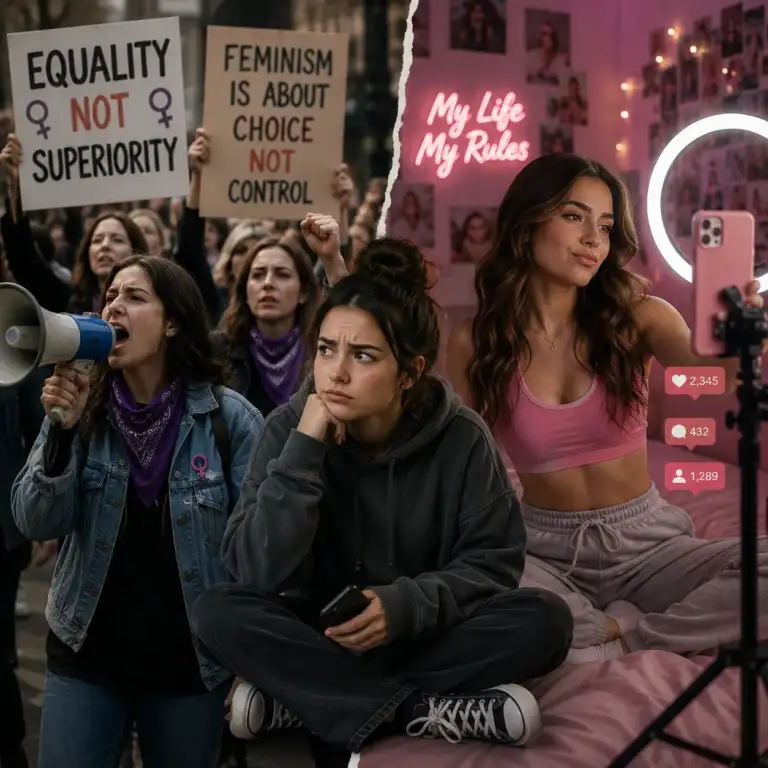
A Juilliard-trained ballerina who married into a family that founded a major airline bakes sourdough in a floor-length dress for millions of followers, and the internet spends a week arguing about what her life actually proves. That fight, repeated across dozens of smaller accounts every week, is really three or four different arguments wearing the same gingham apron: a genuine question about what women actually want, a business model dressed up as a lifestyle, and a nostalgia for a decade almost none of its admirers actually lived through. Untangling those threads matters more than picking a side in the argument itself.
The word “tradwife” gets used today to describe an enormous range of things that do not actually belong in the same category, and that conflation is doing real damage to an honest conversation this magazine believes is worth having. A woman who quietly decided, without a single follower, to leave her job and raise her children full time is doing something categorically different from a content creator with twelve million TikTok followers filming herself making bubblegum from scratch in a designer kitchen. A devout Christian woman structuring her marriage around Ephesians 5 is making a theological choice distinct from a brand account monetizing 1950s aesthetics for ad revenue. This piece exists to separate those threads rather than collapse them, because this magazine believes the genuine version of this choice deserves real respect, and respecting it requires being honest about how much of what circulates under its name is something else entirely.
What the Research Actually Says Women Want
Start with the most rigorous data available, because it complicates the popular narrative in a useful direction. Researchers at King’s College London analyzed nearly four decades of the British Social Attitudes Survey, from 1984 to 2022, alongside the Genders and Generation Survey and a focused study of 1,000 women ages 18 to 34, and reached a conclusion that neither side of the online tradwife debate particularly wants to hear: what draws most young women to this content is not actually a desire to replicate the male-breadwinner, female-homemaker model at all. It is the aesthetic of simplicity, leisure, and escape from a labor market that demands total commitment from workers while offering little accommodation for family life. Between 70 and 80 percent of young people surveyed in the underlying research still believe both men and women should contribute to household income, a figure sharply at odds with the pure homemaker ideal the most viral content depicts. The researchers’ own framing is worth repeating plainly: this is less a genuine embrace of 1950s gender roles than “a plea for balance” from a generation exhausted by high childcare costs and an “ideal worker” standard that assumes no one has a family to raise at all.
That finding matters enormously for how this magazine wants readers to understand the broader phenomenon. It does not mean the desire to prioritize home and family is fake. It means the desire being expressed, for most consumers of this content, is genuinely about relief from overwork and a longing for a slower, more present family life, a desire this magazine takes seriously and has written about approvingly elsewhere, rather than a literal referendum on whether married women should hold jobs at all.
Fast Facts
70 to 80 percent: Share of young people surveyed who believe both spouses should contribute to household income, even among those drawn to tradwife content
57.3 percent: Share of working-age American women employed in 2025, compared with 35.7 percent in 1955
12.4 million: TikTok followers for tradwife influencer Nara Smith, one of the trend’s most visible figures
2024: Hannah Neeleman, known as “Ballerina Farm,” publicly disputes a Sunday Times profile she says portrayed her as oppressed
2026: Online commentary increasingly describes widespread “tradwife fatigue” amid growing scrutiny of the wealth behind the aesthetic
The Business Model Behind “Simple Living”
No single figure illustrates the gap between content and reality more clearly than Hannah Neeleman, the Juilliard-trained ballerina and former beauty queen who built an audience of nearly nine million on Instagram and seven million on TikTok chronicling her life as a homesteader and mother of eight on a Utah farm known as Ballerina Farm. Neeleman married into the family behind JetBlue Airways, a detail her critics have repeatedly noted provides resources far beyond what the “simple living” framing of her content suggests. In July 2024, a Sunday Times profile crowning her “the queen of the trad wives” sparked weeks of heated online debate, after which Neeleman took to social media to say the piece was “an attack on our family and my marriage,” insisting she was not, as she believed the article implied, an oppressed woman controlled by her husband. Months later, a separate controversy erupted after Neeleman competed in the Mrs. World pageant roughly two weeks after giving birth to her eighth child, posting “postpartum pageant prep” content that critics argued set an unrealistic and potentially harmful standard for ordinary women navigating a genuinely exhausting stage of life, a standard her defenders in turn framed as an attack on her right to make her own choices.
Beyond any single controversy, the structural critique of this genre of content has only sharpened. Observers have pointed out that the farm equipment, expansive kitchens, land, and childcare support required to produce this kind of “simple living” footage are themselves expensive markers of privilege rarely acknowledged on camera, and that the vintage dresses and aprons worn while performing physical farm labor function, as more than one critic has put it, closer to costume than practical workwear. There is also a more direct irony worth stating plainly: many of the most prominent tradwife accounts are, functionally, businesses, with their creators operating as CEOs of content and merchandise brands built around portraying a life explicitly defined by the absence of paid work outside the home. That tension, being professionally successful by performing the aesthetics of not working, is not automatically dishonest, but it is a genuinely different phenomenon than the quiet, undocumented choice a woman without an audience makes when she leaves her job to raise her own children, and treating the two as interchangeable flattens something that deserves to stay distinct.
“We were taken aback when we saw the printed article, which shocked us and shocked the world by being an attack on our family and my marriage.”
— Hannah Neeleman, “Ballerina Farm,” responding to a 2024 profile
A Taxonomy of the Trend
Recent academic research has begun mapping this space with more precision than the blanket term “tradwife” allows, and the resulting taxonomy is genuinely useful for readers trying to make sense of what they are actually looking at online. One framework, published in early 2026, identifies three distinct repertoires operating under the same broad label. The first, which researchers term “aesthetic wifehood,” involves content that is purely visual and largely apolitical, elaborate cooking and homemaking performances with no explicit ideological framing, even as critics note the content still implicitly normalizes a wife’s submission and prioritization of her husband’s career over her own. The second, “missionary domesticity,” blends the same domestic content with overt religious and political conservatism, explicitly framing a woman’s role in biblical or ideological terms. A third, smaller but genuinely concerning tier shades into overt activism, and researchers studying this corner of the internet have found some accounts within it promoting explicitly anti-feminist, misogynistic, and in isolated cases far-right or conspiratorial content alongside the domestic aesthetic. Collapsing all three into a single “tradwife movement” does a disservice to the large majority of women in the first two categories, who are sharing an aesthetic or a sincere faith commitment, by association with the much smaller and more troubling third.
The Political Edge Worth Naming Honestly
This magazine believes intellectual honesty requires naming that third category plainly rather than pretending it does not exist simply because doing so is uncomfortable. Britannica’s own summary of the trend notes it is “strongly correlated with political conservatism,” and that some tradwife content, a minority but a real one, does traffic in genuinely extremist material rather than the sincere faith and family values this magazine actually champions. A woman choosing to homeschool her children and prioritize her marriage is making a choice this magazine respects without reservation. An account using that same aesthetic as a vector for conspiracy theories or genuine misogyny is doing something else, and readers deserve a publication willing to draw that line clearly rather than defending the entire category out of tribal loyalty. The overwhelming majority of women drawn to this content, per the King’s College London research cited above, are not seeking that ideological extreme at all. They are seeking rest.
What’s Real Underneath the Performance
Here is where this magazine wants to land, and it is not a cynical conclusion. The workforce data tells its own quiet, unglamorous story: 57.3 percent of American working-age women were employed in 2025, compared with 35.7 percent in 1955, the decade the tradwife aesthetic borrows its visual vocabulary from. That gap has not meaningfully closed despite years of viral tradwife content, which means the actual lived choice to leave paid work entirely for full-time homemaking remains, today as it has for decades, a minority path among American women, chosen by some for reasons ranging from genuine religious conviction to simple family circumstance, not a mass movement reversing course on female employment. What has changed is not how many women are making that choice. What has changed is how visible, aestheticized, and commercially rewarding it has become to perform that choice for an audience, whether or not the performer’s actual daily life resembles the version she films.
That distinction is the entire point of this piece. The real rebellion, if one exists at all, is smaller, quieter, and considerably less photogenic than anything trending on TikTok: it is the woman who, without sponsorship or a single follower, decided that her family’s stability mattered more to her than a second income, and who will never be profiled, praised, or picked apart by a national newspaper for that choice. She deserves this magazine’s full respect. The influencer economy built around performing her life, for profit, on camera, deserves something closer to scrutiny, not because the underlying desire it markets is fake, but because commercializing an aesthetic of domestic simplicity is, almost by definition, a different act than actually living it.
The Bottom Line
Neither the feminist critics dismissing every trace of this trend as false consciousness nor the online defenders treating every criticism of it as an attack on womanhood itself are fully right. The desire underneath the tradwife aesthetic, for a slower pace, a more present family life, and relief from a work culture that asks everything and gives back little, is genuine, widely shared, and worth this magazine’s continued sympathy. The specific content built to monetize that desire, curated, often extraordinarily well-resourced, and occasionally shading into genuinely troubling politics, is a separate phenomenon that deserves separate judgment. The task for any honest reader, and any honest magazine, is refusing to let the second thing borrow the moral credibility of the first simply because they happen to be wearing the same apron.
References
Current Affairs, “Why The Internet Can’t Stop Talking About Ballerina Farm?” May 2026
IBTimes UK, “Ballerina Farm Exposed? Famous TikTok Influencer Allegedly Lives in a Ski Town,” December 2025
AOL/USA Today Network, “Ballerina Farm influencer slams ‘attack’ on family. What to know about ‘tradwife’ controversy”
Axios, “Utah’s Ballerina Farm influencer controversies churn amid tradwife scrutiny”
Newsweek, “There’s a Reason Women Want To Be Tradwives — It’s Not Old-Fashioned Values,” October 2025
King’s College London, “The tradwife phenomenon isn’t a return to tradition, it’s a plea for balance,” October 2025
Britannica, “Tradwife,” June 2026
ScienceDirect, “From ‘I’ve Always Wanted to be a Homemaker’ to ‘Feminism is Cancer’: Performing tradwife identity in Instagram Reels,” February 2026
Vice, “Gen Z Women Are Obsessed With Becoming Trad Wives,” March 2026
Reason, “Tradwives Are Fighting the Cultural Stigma Around Being a Homemaker. That Makes Them Good Feminists.”