
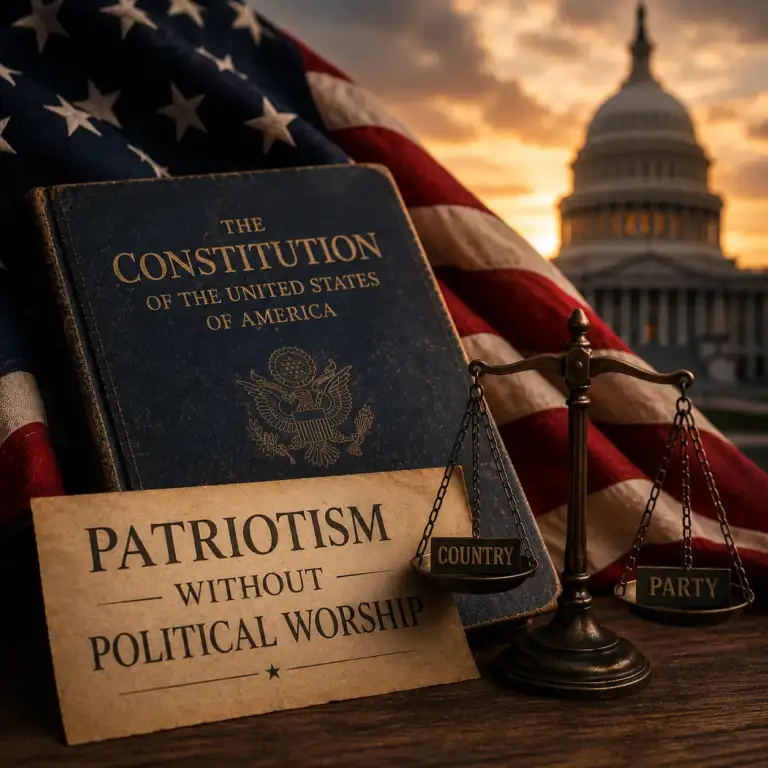
In 1816, a celebrated American naval hero raised his glass and toasted “our country, right or wrong.” Fifty-six years later, a senator who had fled political tyranny in Europe to become an American citizen stood on the floor of the United States Senate and corrected him: “if right, to be kept right; if wrong, to be set right.” That argument between two genuine patriots has never actually been settled in American life, and this magazine believes it needs to be settled again, deliberately, by every generation that inherits this republic.
Every healthy love asks something of the person who holds it, and love of country is no exception. The question is what, exactly, that love should demand. Should a patriot defend his country and its leaders unconditionally, the way a soldier defends a comrade under fire, no questions asked in the moment? Or does genuine patriotism require something harder: loyalty to the principles a country claims to stand for, even when that loyalty means holding the country’s own leaders, parties, and momentary passions up to the same standard it demands of everyone else? This magazine believes the second answer is the only one consistent with what America’s founders actually built, and that confusing love of country with unconditional deference to whoever currently leads it is not patriotism at all. It is something considerably smaller, and considerably more fragile.
A Debate as Old as the Republic Itself
The tension is not a modern invention. In 1816, Commodore Stephen Decatur, celebrating the end of the Second Barbary War, offered a toast that has echoed through American political rhetoric ever since: “Our country! In her intercourse with foreign nations may she always be in the right; but our country, right or wrong.” It is a stirring line, and it captures something real about the instinct to defend one’s own nation against outside criticism. But the version of that sentiment that survived in popular memory, stripped of its qualifying first half, hardened into something closer to a demand for unconditional loyalty than a statement of national pride.
Carl Schurz, a German immigrant who had fled political persecution in his homeland, fought as a Union general in the Civil War, and later served as a United States Senator from Missouri, offered the correction that this magazine believes gets closer to the truth of what patriotism actually requires. Addressing the Senate directly in 1872, and again in a widely quoted 1899 speech warning against what he called “mock patriotism,” Schurz reframed Decatur’s toast entirely: “Our country, right or wrong; when right, to be kept right; when wrong, to be put right.” The difference between those two formulations is not a matter of degree. It is the entire argument this piece exists to make. Decatur’s toast asks for loyalty regardless of conduct. Schurz’s correction asks for loyalty to a standard, one high enough that a patriot’s job is never finished, because keeping the country right, or setting it right when it strays, is itself the patriotic act.
Fast Facts
1816: Stephen Decatur toasts “our country, right or wrong,” a phrase later stripped of its original context
1872 and 1899: Senator Carl Schurz, a former refugee from European political persecution, publicly corrects the sentiment: “when right, to be kept right; when wrong, to be put right”
1783 and 1797: George Washington voluntarily relinquishes power twice, first as commanding general, later as president, rather than accept the crown some urged him to take
1787: The Constitutional Convention builds an oath of office sworn to the Constitution itself, not to any individual officeholder
1945: George Orwell distinguishes patriotism, devotion to a place and way of life with no wish to impose it on others, from nationalism, the placing of a nation or leader beyond moral judgment
Why Washington Refused to Be King
No episode in American history illustrates the difference between patriotism and personality worship more powerfully than George Washington’s own repeated refusal of exactly the kind of loyalty many of his contemporaries were eager to hand him. After leading the Continental Army to victory, Washington held more raw popular devotion than any other American of his generation, devotion so strong that some officers seriously floated the idea of installing him as a monarch. He declined immediately and unambiguously, voluntarily surrendering his military command to Congress in 1783 in a ceremony so unprecedented for a victorious general that King George III himself reportedly said that if Washington actually gave up power rather than seizing it, he would be “the greatest man in the world.” Washington did it again as president, declining to seek a third term in 1797 despite near-certain reelection, establishing a peaceful precedent of voluntary transfer that held for a century and a half before it was ever codified into constitutional law.
Washington’s genius, in this specific sense, was not military or political. It was that he understood, more clearly than almost anyone else in the founding generation, that a republic asking its citizens to worship a person rather than a principle was a republic already halfway back to the monarchy it had just fought a war to escape. He built his entire legacy around demonstrating, through his own repeated example, that the object of American loyalty was meant to be the system itself, not the man temporarily entrusted to run it.
A Constitution Is a Covenant With Principles, Not a Person
That founding instinct was written directly into the structure of American government, and it remains one of the most distinctive features of the American constitutional order. Every officer of the United States, from the president down to the newest enlisted service member, swears an oath to support and defend the Constitution, not an oath of personal loyalty to whoever happens to occupy the presidency at the time. That is not a small technical detail. It is the entire design principle James Madison articulated in Federalist 51, writing that if men were angels, no government would be necessary, and that because they are not, a system of checks, balances, and divided power was required precisely because no single officeholder, however popular or well-intentioned, could be trusted with unchecked loyalty from the citizens he governed. The founders built a government designed to survive the failure, incompetence, or corruption of any individual who might occupy it, because they assumed, correctly, that eventually one would.
This is precisely why peaceful transfers of power function as the great, quiet miracle of American political life, rehearsed successfully dozens of times across two and a half centuries with remarkably few exceptions. A citizenry whose loyalty was actually attached to individual leaders rather than to the constitutional system itself would have no principled reason to accept an election loss. A citizenry whose loyalty is attached to the system survives every individual leader’s rise and departure without its underlying love of country ever wavering.
The Difference Between Patriotism and Nationalism
George Orwell drew the sharpest version of this distinction in his 1945 essay “Notes on Nationalism,” written in the shadow of the century’s great totalitarian movements. Orwell defined patriotism as devotion to a particular place and a particular way of life that a person believes, genuinely and without arrogance, to be the best in the world, but which he has no desire to force on anyone else. Nationalism, in Orwell’s formulation, is something categorically different: the habit of identifying so completely with a nation, a movement, or a leader that the object of that identification is placed beyond the reach of ordinary moral judgment entirely, with no duty recognized except advancing its interests and prestige, right or wrong. Patriotism, in Orwell’s account, is defensive by nature. Nationalism is possessive, and it treats disagreement not as a difference of political opinion but as betrayal.
That distinction maps almost exactly onto the difference this piece is drawing between loyalty to principle and loyalty to party or personality. A patriot can love his country enough to be genuinely embarrassed by a specific policy, a specific scandal, or a specific leader’s specific failure, without that embarrassment diminishing his underlying devotion to the nation and its founding ideals in the slightest. Political worship cannot absorb that same criticism without feeling like a personal wound, because it has fused the object of loyalty, the leader or the party, with the nation itself, so that any critique of the former reads automatically as an attack on the latter.
“Our country, right or wrong; when right, to be kept right; when wrong, to be put right.”
— Carl Schurz, addressing the United States Senate, 1872
When Loyalty to a Person Replaces Loyalty to a Principle
History offers no shortage of warnings about what happens when a nation’s citizens transfer their loyalty from principle to person, and the warning is not confined to any single country, era, or political direction. Every genuinely authoritarian regime of the modern era, regardless of its stated ideology, has depended on precisely this substitution: convincing citizens that loyalty to the leader and loyalty to the nation are the same thing, so that criticizing the former becomes, by definition, an act of disloyalty to the latter. That is precisely why healthy republics build institutional friction against it, term limits, independent courts, a free press, an oath sworn to a document rather than a person, and why every erosion of those structures anywhere in the world tends to travel in the same direction: toward a leader who claims to embody the nation so completely that the two can no longer be meaningfully distinguished. This magazine has written elsewhere this year about how political identity has, for a growing number of Americans across the spectrum, begun quietly filling the role religion once occupied, complete with its own certainties, its own rituals, and its own excommunications for heresy. Political worship of a leader or party is simply that same substitution applied to an individual rather than to a movement, and it deserves the same wariness from every reader of this magazine, regardless of which party’s leader happens to be standing in the position of honor at any given moment.
What Principled Patriotism Actually Asks of Us
Carl Schurz’s own biography offers a useful model for what the alternative actually looks like in practice, because he was no cynic or half-hearted citizen. He had risked his life fleeing an autocratic government in Prussia, fought and nearly died for the Union cause, and spent decades of public service devoted explicitly to American reconciliation and reform. His insistence on correcting Decatur’s toast did not come from lesser love of country. It came from greater love of it, a conviction that a nation worth that much sacrifice deserved citizens willing to hold it to its own highest standard rather than simply cheering whatever it happened to do. That is the model this magazine believes principled patriotism actually requires: love substantial enough to demand improvement, not love so fragile it can only survive by refusing to look honestly at failure.
Practically, that means a patriot can support a party’s platform on the merits while still saying plainly when a specific leader within that party violates the principles the platform claims to stand for. It means a citizen can defend his country’s founding ideals passionately against outside critics while still insisting, just as passionately, that his own country has not always lived up to them and owes its citizens the ongoing work of getting closer. It means treating the Constitution, not any individual officeholder, as the actual object of an oath, a habit of mind the founders built into the very ceremony of American public office for exactly this reason.
This Is Not Weakness, It Is the Whole Point
Some readers will hear all of this and worry it amounts to a call for divided loyalty, a weaker, more conditional form of patriotism than the unconditional devotion the word usually implies. This magazine believes the opposite is true. Unconditional loyalty to a fallible human being is actually the more fragile arrangement of the two, because it depends entirely on that individual continuing to deserve it, and collapses, often bitterly, the moment he fails to. Loyalty to a set of enduring principles, by contrast, can survive any single leader’s worst day, any single party’s worst decade, because the object of that loyalty was never a person to begin with. It was an idea large enough to outlast every single human being who has ever tried to represent it, including George Washington himself, who understood that truth well enough to hand back the power he could easily have kept.
The Bottom Line
America was not founded on the premise that its citizens would love whoever happened to be leading it. It was founded on the far more demanding premise that citizens would love the country enough to hold it, and everyone entrusted to lead it, accountable to principles that predate and outlast any single administration. Carl Schurz understood that distinction because he had lived under a government that demanded the opposite kind of loyalty and found it wanting. George Washington understood it well enough to walk away from power twice rather than let his own popularity calcify into something the republic could not survive. This magazine believes that same understanding is worth recovering deliberately today: not less patriotism, but a truer version of it, loyal enough to the actual principles of this country to say, plainly and without contradiction, when it is right, and when it needs, once again, to be set right.
References
Flickr/Public Domain Review, “‘My country, right or wrong!’ Common misquote of Stephen Decatur”
River Falls Journal, “On chauvinism,” July 2024
Goodreads, Stephen Decatur, “Correspondence, between the late Commodore Stephen Decatur and Commodore James Barron”
Patch, “Carl Schurz, US Senator from Wisconsin, Feb. 29, 1872 on the US Senate floor”
Wisconsin Historical Society Digital Collections, “Carl Schurz,” from Wisconsin Authors and Their Works, 1918
National Archives, “The Constitution of the United States: A Transcription”
George Orwell, “Notes on Nationalism,” 1945
Mount Vernon, George Washington’s Resignation as Commander-in-Chief, 1783