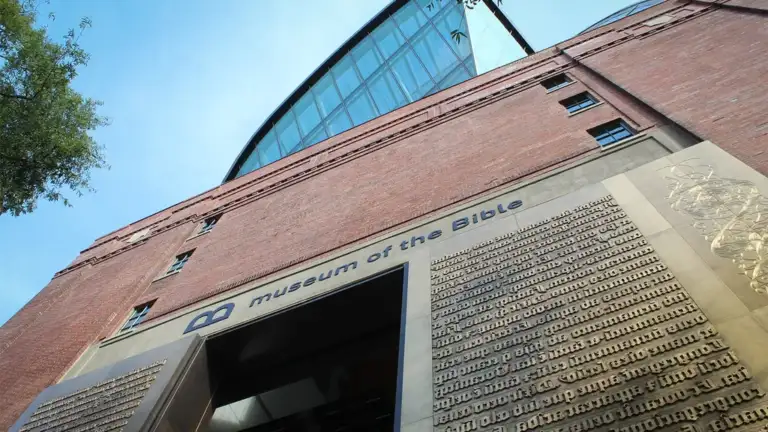
Three blocks from the United States Capitol, where the marble monuments of American democracy rise against the sky, stands a building unlike anything else in Washington, D.C. Behind forty-foot bronze doors cast with lines from the Gutenberg Bible lies 430,000 square feet dedicated entirely to the book that shaped Western civilization more than any other. This is the Museum of the Bible, and if you have not yet walked through those doors, you are missing one of the most important cultural achievements of our generation.
I have visited museums across this country and abroad — the great halls of the Smithsonian, the solemn corridors of the National 9/11 Museum, the storied exhibits of the Vatican. None of them left me with quite the sense of purpose and reverence I felt walking into the Museum of the Bible. This is not a dusty repository of old books. It is a living, breathing testament to the fact that the Bible is not merely a religious artifact but the foundation stone of law, art, language, and liberty as we know them.
A Bold Vision, Faithfully Built
The museum opened its doors on November 17, 2017, the fruit of a vision cast nearly a decade earlier by the Green family, the devout evangelical Christians behind the Hobby Lobby craft store empire. What began as a private collection of biblical artifacts grew into a nonprofit institution dedicated to telling the story of Scripture on a scale worthy of its subject. Today, under the leadership of CEO Carlos A. Campo, the museum houses roughly 1,500 objects and artifacts spanning some 4,000 years of history, and it has welcomed more than three million guests through its doors since opening.
Skeptics in the secular press love to point out that the museum’s founders hold to a statement of faith affirming the truth of Scripture. To that, this editor says: so what? Every institution reflects the convictions of those who built it. What matters is whether the museum delivers an honest, rigorous, and moving account of the Bible’s history and influence — and on that score, it succeeds magnificently. The museum has always maintained that it is nonsectarian, welcoming visitors of every faith and no faith at all to encounter the evidence and decide for themselves.
Walking Through History
The moment you step inside, you understand you are somewhere different. The grand lobby stretches out beneath a massive digital ceiling display that shifts through radiant imagery throughout the day, setting a tone of wonder before you have even reached the first gallery. From there, the museum unfolds across six floors, each one a fresh encounter with the story of the Book of Books.
The fourth floor’s History of the Bible galleries are the heart of the collection — eleven galleries housing more than 600 artifacts, tracing Scripture’s journey from ancient scrolls copied by hand to the countless translations that now carry God’s Word into nearly every language on earth. Interactive touch tables and short films help visitors, especially younger ones, absorb centuries of scholarship without ever feeling like a classroom lecture.
For those who want to feel the Bible rather than simply read about it, the Hebrew Bible Experience is an immersive walk-through journey bringing the Old Testament’s greatest moments to life — Noah’s ark, the burning bush, the parting of the Red Sea — in a way that engages the whole family. Nearby, a meticulously reconstructed first-century Galilean village invites guests to step into a home, a synagogue, and a mikvah much like the ones Jesus himself would have known, offering a tactile sense of the world into which the Messiah was born.
Then there is Washington Revelations, a flyover ride that soars visitors over the monuments of the nation’s capital while pointing out the biblical inscriptions and Scripture references woven into the very fabric of American civic architecture — a not-so-subtle but entirely accurate reminder that this nation’s founders built their institutions on a bedrock of biblical conviction, whatever the revisionists in academia might wish were otherwise.
Treasures Rarely Seen Elsewhere
The manuscript collection alone justifies the price of admission. Visitors can view pages from a Gutenberg Bible, one of the first books ever printed on a movable-type press and a landmark in the democratization of Scripture. The collection also includes the Washington Pentateuch, dating to around the year 1000, a Wycliffite New Testament from the fifteenth century, and one of the Dishna Papers, fragments reaching back to the third or fourth century after Christ.
Since 2024, the museum has hosted a true archaeological marvel: the Megiddo Mosaic, on loan in partnership with the Israel Antiquities Authority. This third-century mosaic floor, unearthed in northern Israel, is believed to mark one of the earliest known sites of Christian worship and bears what may be the oldest surviving inscription identifying Jesus as God. Standing before it, one senses the unbroken thread connecting today’s believers to that first small community of the faithful, worshiping in secret under Roman rule, dedicating their gathering place to “God Jesus Christ.” Currently the exhibit sits on the museum’s Grand Hall, which the museum has generously opened to the public completely free of charge, alongside the Milk + Honey Café and the Vatican Gallery.
A Gathering Place for the Faithful
The Museum of the Bible has become more than an exhibit hall; it has become a genuine hub for the Christian community in the nation’s capital. This spring, as the country prepares to mark its 250th birthday, the museum is hosting “America Reads the Bible,” bringing together more than 475 national leaders and 115 ministries for what organizers believe will be the largest public Bible reading in American history — 84 hours over seven full days, livestreamed to homes across the country. It is precisely the kind of unifying, faith-affirming national moment too rarely seen on the public stage these days, and it is fitting that Washington’s own Museum of the Bible would be the one to host it.
The museum’s magazine likewise offers a steady stream of substantive content from its curatorial staff — reflections tied to Holy Week, deep dives into the art history of Scripture, and essays connecting the Bible to America’s founding as the nation approaches its semiquincentennial. This is an institution that takes seriously its role not just as a tourist attraction but as a teacher of the faith and of the nation’s heritage.
Built for Families, Beloved by Visitors
Practically speaking, the museum has made itself remarkably accessible. General admission runs $34.99 for adults and $14.99 for youth, seniors, and military — modest by Washington museum standards — with free admission to the Grand Hall’s first floor every single day and free general admission on select Tuesdays each month. Families homeschooling their children have particularly embraced the museum as a resource, and it shows in the reviews: visitor satisfaction runs remarkably high, with guests routinely describing five-hour visits that still left exhibits unseen. Parents traveling with grandchildren rave about the World Stage Theater’s live productions, including a recent staging of “The Lion, the Witch and the Wardrobe,” and children receive their own interactive badge and lanyard at the door, turning a museum visit into an adventure rather than a chore.
TripAdvisor ranks the Museum of the Bible among the top 10 percent of attractions worldwide, a remarkable distinction for an institution barely a decade old, competing against the entrenched giants of the Smithsonian a short walk away. That is not the result of clever marketing. It is the result of a museum that delivers exactly what it promises: an honest, immersive, world-class encounter with the most influential book ever written.
A Testament Worth Defending
It has become fashionable in certain corners of the media to view any institution built on unapologetic Christian conviction with suspicion, and the Museum of the Bible has weathered its share of such scrutiny over provenance questions in its early years — questions the museum has worked diligently to resolve through cooperation with federal authorities and source nations. What deserves more attention is what the museum has built since: a rigorous, respectful, and deeply moving institution that treats the Bible with the seriousness it deserves, neither reducing it to mere literature nor hiding it away from honest historical inquiry.
At a moment when so much of American public life seems intent on scrubbing faith from the public square, the Museum of the Bible stands as a quiet, dignified rebuttal — a reminder, delivered not through argument but through artifact and experience, that the Bible remains what it has always been: the single most consequential book in human history, and the wellspring from which so much of what we cherish about this nation first flowed.
If you find yourself in Washington, skip another lap around the usual monuments and walk instead through those forty-foot bronze doors. Bring your children. Bring your Bible study group. You will leave, as this editor did, with a renewed sense that the story contained in that ancient book is very much still being written — and that its next chapter, in some small way, includes you.
The Museum of the Bible is located at 400 4th Street SW, Washington, D.C., a short walk from the Federal Center SW Metro station. The museum is open daily from 9 a.m. to 5 p.m., 10 a.m. on Sundays, and is closed on Thanksgiving, Christmas, and New Year’s Day.