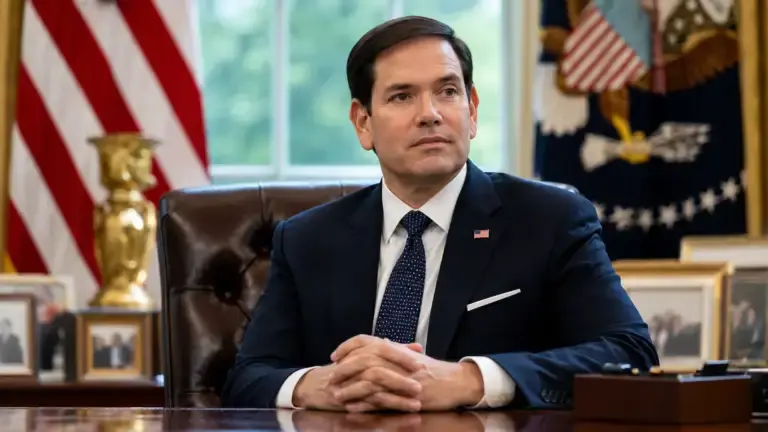
From a bartender’s son in Miami to the seventh floor of the State Department, America’s chief diplomat has spent a career proving that faith, family, and an unshakable love of country are still the surest path to greatness.
There are leaders who arrive in Washington chasing a title, and there are leaders who arrive carrying a debt they intend to repay. Marco Rubio has always belonged to the second kind. The son of Cuban immigrants who fled Fidel Castro’s communism with nothing but the clothes on their backs and a belief in the American Dream, Rubio has spent twenty five years in public life turning his parents’ sacrifice into a case study of what this country still makes possible. Today, as the 72nd Secretary of State and the first Latino ever to hold the post, he stands as one of the most consequential and most authentically American leaders in a generation, a man whose entire career has been an argument for the country his parents chose over the one they left behind.
From a Miami Bartender’s Son to the Cabinet Table
Rubio was born in Miami on May 28, 1971, to parents who had arrived from Cuba years earlier in search of steadier work and a future for their children. His father worked as a banquet bartender. His mother split her time as a housekeeper and a stay at home mom. It was, by any measure, a working class household, but it was rich in the things that actually matter: faith, family, and an unrelenting work ethic that Rubio has carried into every office he has held since. His grandfather, who had lived through communism’s slow theft of Cuban liberty firsthand, spent hours talking with young Marco about what had been lost, conversations Rubio has credited as the spark that first drew him toward public service. It is not every leader who can trace his entire worldview back to his grandfather’s kitchen table, but Rubio can, and it shows in everything he has done since.
His political rise reads like something out of an American civics textbook. Elected to the West Miami City Commission fresh out of law school, Rubio went on to serve in the Florida House of Representatives, becoming majority leader and then Speaker in 2006, where he pushed through his “100 Innovative Ideas for Florida’s Future,” a legislative blueprint built on conservative economic principles that became a hallmark of his leadership style: ambitious, detail oriented, and unapologetically conservative. In 2010, facing a Republican establishment that had lined up behind a sitting governor, Rubio won a landslide election to the United States Senate anyway, becoming one of the most prominent voices of a new conservative generation and, in 2013, the first politician in American history to deliver the Republican response to the State of the Union in both English and Spanish.
His 2016 presidential campaign, though it fell short after a difficult Florida primary loss, only sharpened him. The nickname his rival hung on him during that race, “Little Marco,” has aged into something closer to a badge of honor: the same man once mocked in a primary fight went on to win reelection to the Senate twice, in 2016 and again in 2022, then earned a wholehearted endorsement from that same rival eight years later over his own state’s sitting governor, and then received a 99 to 0 unanimous Senate confirmation to become America’s top diplomat. Few political comeback stories in modern American history are as complete, and fewer still are built on so little bitterness. Rubio simply outworked the doubt.
Fast Facts
Born: May 28, 1971, in Miami, Florida, to Cuban immigrant parents
Political rise: Florida House Speaker (2006 to 2008), U.S. Senator from Florida (2011 to 2025)
Confirmed: 72nd U.S. Secretary of State, January 21, 2025, by a unanimous 99 to 0 Senate vote
Historic first: First Latino Secretary of State and the highest ranking Hispanic American official in U.S. history
Dual role: Also serves as National Security Advisor, the first person to hold both posts simultaneously since Henry Kissinger
Family: Married to Jeanette Dousdebes Rubio since 1998; the couple has four children
A Senate Record Built on Conviction, Not Convenience
Long before he sat at the Cabinet table, Rubio built a Senate record that conservatives could actually point to. The National Taxpayers Union, which tracks votes on taxes, spending, debt, and regulation, gave him an 87 percent rating, the mark of a lawmaker who treated fiscal restraint as a genuine principle rather than a talking point trotted out at election time. He became the longest serving Republican senator in Florida’s history, a testament to a state that kept sending him back because his priorities never wavered: a strong national defense, secure borders, tax reform that let families and small businesses keep more of what they earned, and a foreign policy clear eyed about the threats posed by China, Iran, and the authoritarian regimes of Latin America.
It was on that last point, foreign policy, that Rubio distinguished himself most. Long before Washington’s foreign policy establishment caught up to the danger posed by the Chinese Communist Party, Rubio was already sounding the alarm from the Senate Foreign Relations Committee. He was a fierce, consistent voice against Nicolás Maduro’s narco regime in Venezuela, a champion of the Cuban people against the dictatorship that had driven his own parents from their homeland, and one of the earliest senators to treat the persecution of religious and ethnic minorities abroad, from the Rohingya in Myanmar to dissidents in Turkey, as a matter demanding real American leadership rather than polite statements. That record was not an accident. It was the direct expression of a worldview forged by a family that knew exactly what happens to nations when the free world looks away.
A Diplomat Who Finally Puts America First
Rubio’s tenure at the State Department has been defined by exactly what his critics once doubted he had: results. He was the first cabinet member confirmed in the second Trump administration, and Washington did not have to wait long to see why the Senate trusted him so completely. In May 2025, he was asked to add the role of National Security Advisor to his portfolio, a dual assignment last held more than fifty years ago by Henry Kissinger, and one that reflects a level of trust rarely extended to any single official in modern government. For several months, he also stepped in as acting administrator of USAID and acting Archivist of the United States, a workload that would have buried a lesser public servant and that Rubio carried without complaint, because that is simply what serving your country during a demanding hour requires.
Under Rubio, the State Department has stopped treating America’s adversaries with the deference of prior administrations. He has tightened the screws on the Maduro regime in Venezuela and on Havana’s Communist rulers, announcing fresh sanctions this year on the Cuban military conglomerate GAESA, the financial backbone of the very regime his own parents fled decades ago, a policy that carries the unmistakable weight of personal conviction behind it. When asked why he chose to be photographed in front of a map of Cuba during a visit to Southern Command, Rubio did not dodge the symbolism. Cuba, he noted plainly, sits closer to American shores than almost anywhere else in the hemisphere, and it deserves exactly that level of attention. He has pushed for accountability from China while still keeping the door open to cooperation on America’s terms rather than Beijing’s, striking the kind of balance between strength and pragmatism that too many of his predecessors never found.
He has also thrown himself into the hardest diplomatic puzzle of the moment: Iran. As the regime’s nuclear ambitions and its brutal crackdown on its own people pushed the region toward war, Rubio’s State Department worked around the clock alongside Vice President Vance to secure a framework that returned international inspectors to Iranian soil and reopened the Strait of Hormuz to global commerce, a genuine diplomatic achievement won only because American and allied military strength had already made clear the cost of continued defiance. In a separate and equally significant breakthrough, Rubio announced in June 2026 that Israel and Lebanon had signed a framework agreement with the United States, calling it a first step toward a lasting peace, the kind of quiet, substantive progress that rarely makes a splashy headline but genuinely moves the needle in one of the world’s most dangerous regions.
He has also shown he is not afraid to make hard, America First calls even when they draw fire from the international chattering class. He has launched a campaign to rein in the overreach of the International Criminal Court, an unaccountable body that has too often targeted American service members and allies while giving genuine tyrants a pass. He has worked to enlist allied nations in confronting the organized political violence of groups like Antifa, recognizing correctly that domestic unrest and extremism abroad are connected threats that deserve a coordinated response. And he has made sure that dangerous criminals, including a previously pardoned child predator who had no business inside American borders, are removed and kept out. This is not the caution of a career bureaucrat. It is the clarity of a man who knows exactly whose interests he was sent to Washington to represent: the American people’s.
“There’s only one savior, and it’s not me. It’s Jesus Christ.”
— Marco Rubio, responding to a magazine cover naming him the “Republican Savior”
A Man Who Has Never Hidden His Faith
What sets Rubio apart from so much of Washington is that he has never once treated his faith as a political accessory. Baptized Catholic as an infant, Rubio’s family spent a brief season attending the Church of Jesus Christ of Latter Day Saints during his childhood years in Las Vegas before returning to their Catholic roots, a spiritual journey he has written about with striking honesty in his memoir. As an adult, he has worshipped both at Catholic Mass and alongside his wife Jeanette at Christ Fellowship, an evangelical church in Miami that first drew the family in through its programs for children, describing his walk with God as centered above all on a personal relationship with Jesus Christ rather than on denominational label. Their four children have grown up steeped in that same faith, receiving their first Communion just as their father did decades before them.
That conviction has never stayed tucked away in his personal life. This past Easter, while in the midst of high stakes negotiations over Iran, Secretary Rubio released a public video reflecting on the crucifixion and resurrection of Jesus Christ, describing a Creator who fashioned every human being before the beginning of time and a Savior who rose from the dead in the flesh, not as a spirit, closing simply with the words “He is risen.” It is difficult to imagine many secretaries of state, at any point in American history, using the machinery of a holiday message to proclaim the divinity of Jesus Christ so plainly and without hedging. For a nation that was founded by men who believed rights come from the Creator and not from government, having a chief diplomat who still believes that too, and says so out loud, is not a small thing. It is, in many ways, the whole point.
His faith has also shaped his policy record in ways conservatives and Christians should recognize and appreciate. He has been a consistent defender of the unborn throughout his career in the Senate. He has championed religious liberty and conscience protections for Americans of every faith, understanding that the freedom to live according to one’s convictions is not a courtesy extended by government but a right that predates it. And he has treated the persecution of Christians abroad, from house church raids in Iran to the targeting of believers across the Middle East and Africa, as a matter worthy of America’s diplomatic weight rather than polite silence.
A Family Man in a City That Rarely Rewards It
Washington has a way of consuming the men and women who serve in it, but Rubio has spent a quarter century in public life without losing sight of what matters most. He married Jeanette Dousdebes in 1998, the same year he won his first elected office, and the two have built a marriage and a family of four children in the middle of one of the most demanding careers in American public life. Rubio has spoken often of the balancing act between duty to country and duty to family, and of the ways his own Catholic upbringing, the Sunday Masses with his parents and grandparents, the family rosary, shaped his understanding of what a household owes its children. It is a grounding that shows in how he carries himself: serious about the nation’s business without ever losing the humility of a man who still remembers his father’s bartending shifts and his mother’s work as a hotel maid.
The Bottom Line
Marco Rubio’s story is America’s story: an immigrant family’s sacrifice, a young man’s hunger to prove himself worthy of it, a faith that never wavered even when tested by ambition and by ridicule, and a career built not on charisma alone but on the hard, patient work of actually governing. He has been doubted, mocked, and counted out, and he has answered every single time not with bitterness but with results: a landslide Senate win against the odds, a policy record conservatives can be proud of, a unanimous confirmation from a Senate that does not give those out lightly, and now a dual role at the pinnacle of American foreign policy that has not been entrusted to one man since Henry Kissinger. As America’s top diplomat and National Security Advisor, he has shown the world what it looks like when a Secretary of State negotiates from strength, defends America’s allies, confronts her enemies without apology, and does it all without ever hiding the faith that shaped him.
Whatever role history has left for Marco Rubio to play next, and there is no shortage of speculation about what that might be, this much is already certain: a man who has spent his entire life proving that the American Dream is not a slogan but a lived reality has more than earned the trust this country has placed in him. He is, in every sense this magazine cares about, the leader America needs. Perhaps a – President Marco Rubio.
References
Wikipedia, “Marco Rubio”
U.S. Department of State, “Marco Rubio” official biography
Britannica, “Marco Rubio”
Miller Center, “Marco Rubio (2025- )”
National Catholic Register, “Marco Rubio, Twice a Revert to Catholicism, Nominated to Become the Nation’s Top Diplomat”
National Catholic Reporter, “Five faith facts about Marco Rubio: ‘Once a Catholic always a Catholic'”
Daily Citizen, Focus on the Family, “How Faith Informs the Life and Leadership of Secretary of State Marco Rubio”
Wikidata, “Marco Rubio”