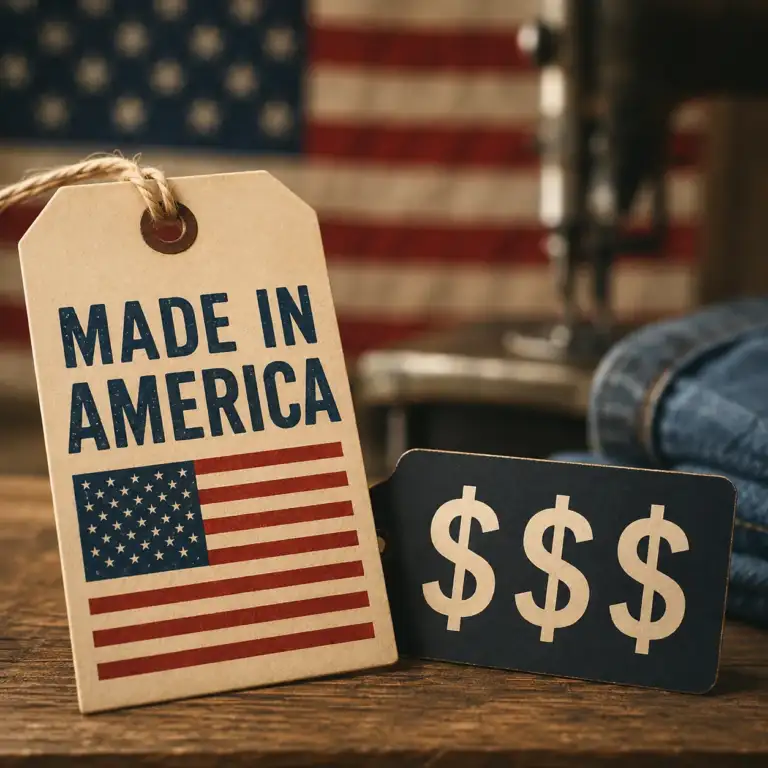
46% of Americans say they would choose a product labeled “Made in America” over an imported alternative. Only 20% say they are actually willing to pay significantly more to do it. That gap, between what Americans say they value and what they are prepared to spend defending it, is the real story behind a decade of “buy American” rhetoric, and this magazine believes it deserves an honest reckoning rather than another round of flag-waving marketing copy.
There is a comfortable version of economic patriotism that costs nothing: nodding along when a commercial invokes American workers, feeling a flicker of pride at a “Made in USA” sticker, sharing a post about supporting domestic manufacturing. There is a far less comfortable version that actually asks something of the person holding the belief, standing at a shelf with two nearly identical products, one costing twelve dollars and the other costing nineteen, and choosing the more expensive one because of where it was made. This magazine has spent the past year writing about family formation, faith, and national character, and this piece belongs in that same tradition, because “buy American” is ultimately a character question dressed up as an economic one. The data on how Americans actually answer it, when a real price tag is involved rather than a survey question, deserves to be looked at honestly.
A Popular Sentiment With an Unpopular Price Tag
The clearest picture of this gap comes from a nationally representative survey of 1,000 consumers conducted by the research firm Zappi in April 2025, at the height of public debate over new tariffs. The results are worth sitting with rather than skimming past. Nearly half of respondents, 46 percent, said they would be most likely to buy a product labeled “Made in America” over a comparable alternative. But when the same survey asked how many were willing to pay significantly more for that choice, the number collapsed to just 20 percent, one in five. Nearly a third of respondents, 28 percent, said plainly that they would choose the cheaper option regardless of where it was made. Only one in five Americans described themselves as financially prepared to absorb the price increases tariffs on imported goods were expected to bring, while nearly a third said they were not prepared at all. This is not a story about Americans lacking patriotic sentiment. It is a story about how much of that sentiment survives the moment it actually costs something.
Fast Facts
46 percent: Americans who say they would most likely buy a product labeled “Made in America”
20 percent: Americans who say they are actually willing to pay significantly more for it
28 percent: Americans who say they would choose the cheaper option regardless of origin
34 percent: Share of businesses now passing on more than half of tariff costs to consumers, up from 13 percent a year earlier
55 percent: Executives planning to raise prices further, by as much as 15 percent, within six months
$10 or 10 miles: The modest threshold most consumers say they will actually pay or travel for American-made goods, per a separate 2025 survey
What “Willing to Pay More” Actually Means in Dollars
A second survey, conducted by the manufacturer DuraPlas in February 2025 among 600 U.S. adults, put a specific dollar figure on the abstraction, and the figure is instructive. Most shoppers surveyed said they were willing to pay up to $10 more, or drive up to 10 miles farther, to buy an American-made product. That is a genuine, meaningful commitment for a lower-cost item, a $15 tool that becomes a $25 one, for instance. It is a considerably smaller commitment relative to a major purchase, a car, an appliance, a piece of furniture, where the actual price gap between domestic and imported manufacturing routinely runs into the hundreds or thousands of dollars rather than single digits. DuraPlas president Paul Phillips summarized his own company’s findings bluntly: “People want to support American-made goods, but price and convenience still drive their decisions,” he said, describing consumer priorities as quality, affordability, and country of origin, “in that order.” That ordering, offered by a company with every commercial incentive to describe American consumers as more patriotically motivated than they actually are, is worth taking as a genuinely honest signal rather than a cynical one.
Where the Tariff Bill Actually Lands
The past year of tariff policy has provided an unusually direct, real-world test of exactly this question, because tariffs function as a forced experiment in exactly the tradeoff this piece is examining: goods become more expensive, ostensibly in service of protecting and reviving domestic production. KPMG’s year-long tracking survey of business leaders, spanning May 2025 through the first quarter of 2026, found the share of companies passing on more than half of their tariff costs directly to consumers rose from 13 percent to 34 percent over that single year, more than doubling. Fifty-five percent of executives surveyed in early 2026 said they planned to raise prices further still, by as much as 15 percent, within the following six months. Brian Higgins, KPMG’s U.S. sector leader for industrial manufacturing, described the shift plainly: “The burden of tariffs has now moved squarely onto the consumer,” he said, noting that businesses had initially absorbed much of the early cost themselves but were now reshaping their pricing models around cost pressures they now treat as permanent rather than temporary. Separately, a YouGov survey found that roughly 27 percent of Americans reported making purchases earlier than planned specifically because they expected tariff-driven price increases, a real, if modest, behavioral response suggesting a meaningful share of the public is treating these price changes as consequential enough to act on, even if not enough to fundamentally alter which products they ultimately buy.
The Partisan Split That Complicates the Patriotic Story
It would be convenient, and misleading, to describe this simply as a partisan divide, with Republicans embracing the sacrifice and Democrats resisting it. The actual data resists that clean story. While 57 percent of Republicans surveyed said they believed tariffs were good for America, considerably higher than the 34 percent of the overall population who agreed, only 27 percent of those same Republicans said they personally felt prepared to absorb the higher costs tariffs would bring, a substantial gap between ideological support and financial readiness within the same group of voters. Meanwhile, majorities of both parties agree on the basic economic mechanism at work: 86 percent of Democrats and 69 percent of Republicans both said they believed tariffs increase the price of everyday goods, a rare point of cross-partisan factual agreement in an otherwise polarized debate. What this suggests is not that conservative voters are being hypocritical when they support tariffs while worrying about their own household budget. It suggests that “buy American” as a policy commitment and “buy American” as a personal spending habit are two genuinely different decisions, made by the same people, under different pressures, and conflating the two does a disservice to how difficult the actual tradeoff is.
“The burden of tariffs has now moved squarely onto the consumer.”
— Brian Higgins, U.S. Sector Leader for Industrial Manufacturing, KPMG
The Real Economics of Reshoring
It is worth being honest about why domestically manufactured goods so often cost more in the first place, because the answer is not corporate greed or inefficiency. American labor costs more than manufacturing labor in most of the countries the United States has historically imported from, a gap that reflects, in significant part, the higher wages, workplace safety standards, and environmental regulations this country has chosen, largely for good reason, to require of employers operating on American soil. Decades of global supply chains were built explicitly to exploit that cost differential, optimizing for the lowest possible landed price rather than for domestic employment or supply chain resilience. Reversing that architecture is not simply a matter of printing new labels. It requires rebuilding manufacturing capacity, supply chains, and skilled labor pools that took decades to dismantle, and doing so while competing against production systems still operating at the lower cost structures the United States chose not to match.
There is a genuinely encouraging thread inside the reshoring data worth highlighting, however, because it suggests this shift may prove more durable than sentiment alone could sustain. A 2025 survey by the Reshoring Initiative found that manufacturers bringing production back to the United States cite reasons considerably more substantive than patriotic branding: nearly half point to proximity to their own engineering teams or lower freight and duty costs, and roughly 38 percent cite a desire to avoid geopolitical risk in their supply chains, a lesson reinforced hard by pandemic-era shortages of medical equipment and protective gear that had been sourced almost entirely overseas. Reshoring driven by genuine cost, risk, and logistics calculations, rather than by patriotic marketing alone, is reshoring that can survive a change in political administration or consumer mood. Reshoring dependent entirely on consumers’ willingness to pay a patriotic premium is reshoring that the Zappi and DuraPlas data above suggests may not survive contact with a real receipt.
What Genuine Economic Patriotism Would Actually Require
This magazine believes the honest challenge for readers who describe themselves as supporters of American manufacturing is not simply to feel that support more strongly, but to test whether it survives an actual price comparison at the register. Previous generations of Americans faced considerably starker versions of this same test and, in genuinely large numbers, passed it: rationing sugar, gasoline, and rubber during the Second World War, purchasing war bonds at real personal cost, accepting real shortages and real inconvenience because the shared national goal was judged worth the individual sacrifice. Nobody reading this magazine is being asked to ration meat. The ask here is considerably smaller, choosing the $10 more expensive tool, the domestically assembled appliance, the American-made pair of boots, when a cheaper alternative sits right beside it on the same shelf, and following through on that choice consistently rather than only when it happens to be convenient. A patriotism that only shows up when it is free is not, in any meaningful sense, patriotism at all. It is preference, dressed in the language of conviction.
Where the Debate Gets Legitimately Complicated
Fairness requires acknowledging a real limit to how far this challenge can honestly be pushed, because not every household facing this choice is declining the American-made option out of weak conviction. This magazine has documented in detail this year how many American families are already stretched by rising grocery, insurance, housing, and childcare costs that have outpaced headline inflation figures for years. A family genuinely struggling to keep up with a grocery bill that has risen 27 percent over five years is not failing some test of national character by choosing the $12 product over the $19 one. The burden of “buy American” idealism, if treated as a purely individual moral obligation rather than a broader policy and industrial question, risks falling hardest on exactly the households who can least afford to carry it, while wealthier consumers, for whom a $10 premium is genuinely trivial, bear the smallest real cost for the same declared conviction. That asymmetry does not undermine the case for rebuilding American manufacturing. It does mean the responsibility for making that rebuilding possible cannot rest on individual consumer willpower alone, and belongs at least as much with policy that makes domestic production genuinely cost-competitive, not merely with a plea for every family to spend more than it can afford at the checkout line.
The Bottom Line
The data on “Made in America” sentiment tells a story this magazine believes deserves to be said plainly rather than flattered away: a large majority of Americans want to believe in domestic manufacturing, and a much smaller number are currently prepared to pay what actually reviving it costs. That gap is not hypocrisy so much as an honest reflection of how difficult real conviction becomes once a price tag enters the picture, a test this country’s own history shows Americans can pass when the stakes and the shared purpose are made clear enough. Rebuilding American manufacturing on a durable footing will require both halves of that equation: reshoring driven by genuine economic and strategic logic rather than sentiment alone, and a public willing, at least sometimes, to let a $10 difference on the shelf reflect the values it claims to hold rather than simply the price it prefers to pay.
References
PR Newswire, “National Consumer Survey: Only 20% of Americans Are Prepared to Absorb Tariff Price Increases,” Zappi, May 2025
Business Wire, “Tariffs Haven’t Shifted Consumer Spending yet, but 79% Say They’re Watching, Finds DuraPlas,” March 2025
KPMG, “KPMG 2026 Tariff Survey: A Year into Tariffs, U.S. Businesses Navigate Declining Margins as 55% Plan Further Price Increases in the Next Six Months,” March 2026
BLS Strategies, “For U.S. Manufacturers and Retailers, Tariffs May Make 2025 An Economic Tipping Point,” March 2025
Statista/YouGov, “Share of Americans who are planning to make purchases because they expect price increases as a result of recent tariffs,” July 2025
Manufacturing Dive/Yahoo Finance, “2025 manufacturing trends by the numbers,” citing the Reshoring Initiative’s 2025 survey
Business Insider/Yahoo News, “Are you buying more American-made brands?”