
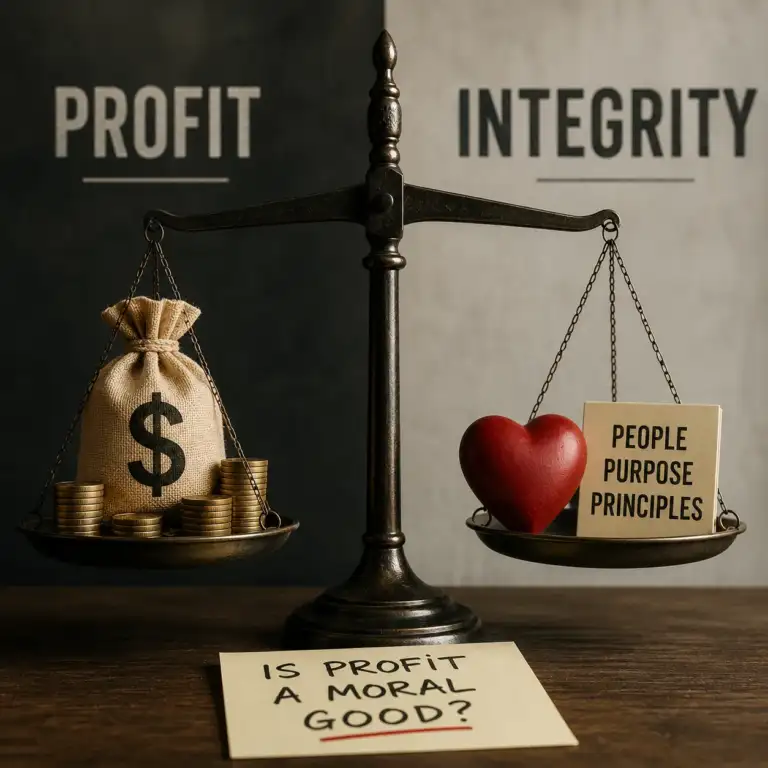
“The love of money is a root of all kinds of evil.” That is the actual verse, 1 Timothy 6:10, and the difference between what it says and what most people think it says, “money is the root of all evil,” is not a minor translation quibble. It is the entire theological question this piece exists to answer. Scripture never condemns profit itself. It condemns what the human heart too often does with it, and understanding that distinction is the difference between building something God calls good and building an idol.
Few misquoted Bible verses have done more quiet damage to how Christians think about work, business, and money than the garbled version of 1 Timothy 6:10. The actual text is precise, and its precision matters: the love of money, not money itself, is the root from which evil grows. John Wesley, the eighteenth century founder of Methodism, made exactly this correction in his own famous sermon on the subject, writing plainly that “the fault does not lie in the money, but in them that use it.” This magazine believes that distinction deserves to be recovered fully, because a great deal of confused, guilt-ridden Christian thinking about business, wealth, and profit traces back to collapsing money itself and the love of money into a single condemned category Scripture never actually merges.
What the Bible Actually Says About Gain
Scripture’s own account of productive work and financial increase is considerably more affirming than the misquoted verse suggests. In the Parable of the Talents, Jesus tells of a master who entrusts his servants with money before departing on a journey, and the servants who invest that money and produce a genuine return are commended directly, told they have been faithful over a little and will be set over much. The servant who does nothing with his talent, who buries it in the ground out of fear rather than risking it toward productive use, is the one rebuked, called wicked and slothful, and stripped even of what little he had. That is a striking parable to build an entire theology of suspicion toward profit on, since the explicit moral center of the story rewards those who took capital and multiplied it, and condemns the one who simply preserved it unused. Proverbs 31 offers a second, equally direct affirmation, describing the excellent wife not merely as a homemaker but explicitly as a businesswoman: she considers a field and buys it, plants a vineyard with her own earnings, and Scripture notes approvingly that “she perceives that her merchandise is profitable.” Her lamp does not go out at night, her hands are never idle, and the passage treats her commercial success not as a spiritual liability to be managed but as straightforward evidence of wisdom and diligence worthy of praise.
Fast Facts
1 Timothy 6:10, correctly rendered: “The love of money is a root of all kinds of evil,” not money itself
1760: John Wesley preaches Sermon 50, “The Use of Money,” outlining his three rules: gain, save, and give all you can
1789: Wesley laments that of 50,000 Methodists, perhaps 500 actually practiced the third rule, giving
250 percent: How much more small businesses donate to local nonprofits and community causes compared with large businesses
75 percent: Share of small business owners who donate an average of 6 percent of their profits to charity annually
90+ percent: Share of small business owners who report actively supporting charities and community activities
John Wesley’s Three Rules, and Why Christians Forgot the Third
No Christian thinker has articulated the proper relationship between profit and virtue more clearly, or more practically, than John Wesley did in his 1760 sermon “The Use of Money.” Wesley organized his entire teaching on the subject into three deliberately sequential rules: gain all you can, save all you can, and give all you can. The first rule alone would surprise many modern Christians expecting a sermon on money to open with a warning rather than a command. Wesley told his largely poor and working-class congregation, dockworkers, coal miners, farmers, that they had a positive obligation to work with “unintermitted diligence” and apply “all the understanding which God has given” them toward honest gain, provided that gain did not come at the expense of their own health, through any trade contrary to God’s law, or by hurting a neighbor, whether through fraud, exploitative pricing, or unfair competition. Gaining money honestly, in other words, was not merely permitted in Wesley’s theology. It was a positive expression of stewardship over the talents and diligence God had given each person.
Where Wesley’s teaching becomes most convicting, and most relevant to the question this piece is asking, is in what he observed happening to his own movement decades later. In 1789, near the end of his life, Wesley wrote with evident grief that while many Methodists had learned to gain all they could, and a smaller number had learned to save all they could, scarcely any had learned to give all they could, guessing that perhaps 500 out of 50,000 Methodists actually practiced the third rule consistently. His conclusion was blunt to the point of severity: those who gained and saved without giving, he warned, would be “twofold more the children of hell” than they had been before ever hearing his teaching, because they had taken instruction meant to produce generosity and used only the portions that produced comfort.
“The love of money, we know, is the root of all evil; but not the thing itself. The fault does not lie in the money, but in them that use it.”
— John Wesley, Sermon 50, “The Use of Money,” 1760
The Line Between Profit and Greed
Wesley’s framework gives this magazine the precise conceptual tool needed to answer the question in this piece’s title honestly. Profit, understood as the return earned from genuinely creating value, employing workers, solving a customer’s real problem, building something the market judges worth paying for, is not merely morally neutral. It is, on the biblical account outlined above, an expression of the same productive stewardship the master in the parable commended and the excellent wife in Proverbs practiced. Greed is something categorically different: not the pursuit of gain itself, but gain pursued without regard for the neighbor it might harm, through deception, exploitation, corner-cutting on safety or quality, or the hoarding of wealth that was always meant, in Wesley’s own words, to flow through a person’s hands rather than simply accumulate in them. The distinguishing question is never the size of the profit. It is whether that profit was extracted from a neighbor or created alongside him, and whether it ultimately serves only the owner’s comfort or becomes, in turn, the capital for someone else’s employment, a family’s stability, or a community’s flourishing.
What Ethical Profit Actually Builds
The practical evidence for this distinction is not merely theoretical. This magazine has documented throughout the past year the concrete goods that genuine, ethically pursued profit makes possible: the employment a small business creates when it grows large enough to hire its first worker, the innovation that emerges when an entrepreneur reinvests profit into a better product or process, the family stability this magazine has traced through the rise of trades business ownership, where a plumber or electrician’s profitable company becomes the foundation for a stable household rather than merely a paycheck. Perhaps the clearest data point of all concerns community investment directly. Small businesses donate an estimated 250 percent more, proportionally, to local nonprofits and community causes than large corporations do, according to research compiled by SCORE, the nonprofit small business mentoring organization. A full 75 percent of small business owners donate an average of 6 percent of their profits to charitable causes annually, and more than 90 percent report actively supporting charities and community organizations in some form. A separate U.S. Chamber of Commerce survey found that 66 percent of small business owners had donated directly to local charities in the past year, and 64 percent had sponsored or donated goods and services to local community events. This is not incidental generosity layered on top of an otherwise self-interested enterprise. It is Wesley’s third rule, give all you can, showing up in measurable form precisely among the business owners closest to their own communities, the ones who see directly, week after week, exactly whose lives their profit touches.
A Warning Against the Opposite Errors
Fairness requires this magazine to name the errors on both sides of this question, because Christians have historically stumbled in two opposite directions. One error, sometimes called the prosperity gospel, treats financial gain itself as evidence of God’s favor and profit as an end worth pursuing for its own sake, quietly inverting Wesley’s order until “gain all you can” becomes the whole sermon and “give all you can” is forgotten entirely, exactly the failure Wesley himself grieved among his own followers within a single generation. The opposite error treats all profit, and sometimes all wealth, with an undifferentiated suspicion that Scripture itself does not support, mistaking the misquoted half-verse for the whole of biblical teaching on money and treating the successful business owner as morally suspect by default rather than examining, as Wesley insisted Christians must, precisely how the gain was made and where it subsequently goes. Both errors collapse the same crucial distinction this piece has tried to restore: profit is not good or evil in itself. It is good when it is earned honestly, without harming a neighbor, and then stewarded generously; it becomes evil only when the love of it displaces the neighbor, the worker, or God himself from the center of a person’s life and business.
The Bottom Line
Is profit a moral good? On the account this magazine believes Scripture and centuries of serious Christian reflection actually support, the answer is yes, when it is earned the way the servants in the parable earned their master’s commendation, honestly, diligently, and without harm to others, and when it is stewarded the way Wesley’s third rule and the modern data on small business generosity both describe, flowing outward into employment, family stability, innovation, and community rather than pooling silently in a single set of hands. The love of money remains exactly what Scripture calls it: a root of evil serious enough to warrant real vigilance. Money itself, and the honest profit that produces it, is something else entirely, a tool Christian business owners across this country are using every day to employ their neighbors, stabilize their families, and fund the causes closest to their hearts. That is not a contradiction of Christian teaching on wealth. Rightly understood, it is Christian teaching on wealth, applied exactly as intended.
References
Wesley Center for Applied Theology, Northwest Nazarene University, “Sermon 50 — The Use of Money,” John Wesley, 1760
ResourceUMC, “John Wesley on giving”
Discipleship Ministries, “‘The Use of Money’ by John Wesley”
Conversable Economist, “John Wesley and the Origins of ‘Earn to Give,'” December 2022
SCORE, “Small Businesses Giving Back Makes a Big Impact on Local Communities”
U.S. Chamber of Commerce, “New Survey Shows Most Small Businesses Prioritize Giving Back to Their Local Communities”
Greater Washington Community Foundation, “From Profit to Purpose: Strategic Charitable Giving Tips for Small Business Owners,” October 2025
Holy Bible, Matthew 25:14-30 (Parable of the Talents), Proverbs 31:16-18, 1 Timothy 6:10, 2 Corinthians 9:6-7