Rick Owens sent models down his runway wrapped floor to ceiling in fabric. A Utah farm wife with eight children became one of the most influential style icons on the internet. And a generation of young women exhausted by dating apps is quietly telling researchers they want something slower, more intentional, and less exposed. None of these threads started in the same place, and none of them mean quite the same thing. But taken together, they point to something real stirring beneath the surface of how young women are choosing to dress, date, and imagine the years ahead of them.
Fashion, dating culture, and lifestyle content rarely move in the same direction at once, which is precisely what makes the past two years worth paying attention to. Runway silhouettes have softened and lengthened. A cross-religious modest fashion movement, long a fixture of Muslim, Orthodox Jewish, and Mormon communities, has gone fully mainstream, with its own fashion weeks in four global cities. Dating app burnout has pushed a measurable share of young singles, women most of all, toward slower, more curated, more traditional ways of meeting a partner. None of this amounts to a single, coordinated cultural movement with a manifesto behind it. But it is not nothing either, and this magazine believes it deserves a genuinely careful look, one that resists the temptation to flatten a complicated, multi-threaded shift into either a triumphant headline or a dismissive one.
A Shift Even the Runways Can’t Ignore
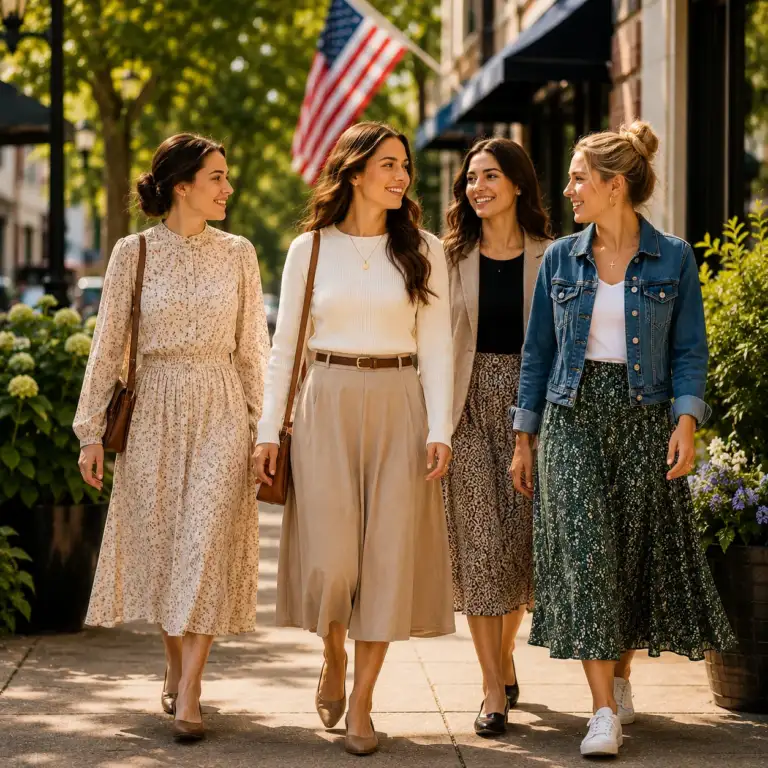
Start with the most visible evidence, because it is the hardest to argue with: the clothes themselves. Fashion critics have noted a genuine and measurable shift away from the low-cut, body-baring “office siren” aesthetic that dominated recent seasons, toward softer silhouettes, longer skirts, and looser, more covering cuts. Even designers known for provocation have moved in this direction; Rick Owens’s Spring/Summer 2025 collection, while retaining his brutal, avant-garde identity, featured oversized blazers reaching to the feet and tops wrapped in layer upon layer of fabric, leaving, as one fashion critic put it, “no space for nudity.” That is a striking image from a designer whose entire career has been built on provocation rather than restraint. Modest Fashion Weeks, now held annually in London, Istanbul, Dubai, and Jakarta, have moved from niche religious showcases to genuine industry events drawing international designers, models, and press coverage. Celebrities including Zendaya, Meghan Markle, and former hijabi model Halima Aden have all been credited with helping normalize and even glamorize covered styles for a mainstream audience that would never have described itself as religiously observant. Hashtags like #modestfashion and #coveredbutconfident have built genuine, active digital communities rather than remaining a fringe corner of the internet.
Fast Facts
Rick Owens SS25: Featured floor-length, fully covering silhouettes from a designer previously known for provocation, not restraint
4 cities: London, Istanbul, Dubai, and Jakarta now host major Modest Fashion Weeks
79 to 80 percent: Share of Gen Z daters, and specifically women, who report dating app burnout, per Forbes-affiliated research
$189: Average all-in cost of a single date in early 2026, up 12.5 percent from $168 the year before
108 percent: Increase in U.S. Google searches for “matchmaker” between January 2025 and January 2026
83 percent: Share of Gen Z women open to discussing long-term relationship goals on a first date
Not One Trend, But Several Converging
It would be a mistake, and this magazine wants to be explicit about avoiding it, to treat all of this as a single, unified movement with one cause. Several genuinely distinct threads are converging at once, and collapsing them together would misrepresent all of them. There is the longstanding, faith-rooted modest fashion movement built primarily by Muslim women, who have spent the past decade using platforms like TikTok and Instagram to reclaim and stylize the hijab and abaya on their own terms, countering outdated stereotypes and turning what outsiders once dismissed as restrictive into a genuinely influential global fashion category worth billions in retail demand. There is a separate, more secular “prairie” or cottagecore aesthetic, popularized by influencers like Hannah Neeleman, known online as Ballerina Farm, whose homesteading, high-necked, floor-length dresses have drawn millions of followers regardless of their own religious commitments. There is the “Ethel Cain” country-gothic look, borrowed from the aesthetic of the musician of the same name, which layers modest silhouettes with a darker, more melancholic sensibility entirely disconnected from any explicit faith framing. And there is simple runway fatigue, designers and audiences alike growing tired of a decade defined by exposure and craving, in the words of one Gen Z fashion observer, “things that jolt us from the slop” rather than more of the same skin-baring uniformity. A hijabi woman styling an abaya for religious reasons and a secular fashion editor bored of the office siren look are participating in aesthetically overlapping trends for entirely different reasons, and honest coverage has to hold both truths at once rather than pretending they’re the same story.
Why Dating Got Exhausting Enough to Change
The dating side of this shift is, if anything, better documented and more directly tied to changed behavior rather than aesthetics alone. Research compiled from Forbes-affiliated surveys found that 79 percent of dating app users report experiencing burnout at some point, with women reporting it at a noticeably higher rate, around 80 percent, than men, at 74 percent, citing a lack of meaningful connection, repeated disappointment, and exhausting, repetitive conversations that rarely translate into anything real. The financial dimension has compounded the fatigue: the average all-in cost of a single date, factoring in grooming, transportation, and the outing itself, reached $189 in early 2026, a 12.5 percent jump from the year before, according to BMO’s Real Financial Progress Index. Faced with rising costs and declining returns, singles have started voting with their search bars: U.S. Google searches for “matchmaker” nearly doubled between January 2025 and January 2026, climbing from 2,370 monthly searches to 4,930, with projections suggesting continued growth toward 6,500 by mid-2026. Professional matchmaking services, offering pre-screened, values-based introductions rather than algorithmic swiping, are seeing a genuine renewed interest that industry analysts describe as singles moving deliberately toward “semi-traditional” approaches to courtship, a phrase that captures the trend’s actual character better than a simpler word like “traditional” would.
“Modest fashion in 2025 is about liberation, not limitation.”
— A modest fashion industry analysis describing the movement’s core appeal
What Young Women Are Actually Saying
It would be easy, and lazy, to read this entire shift as young women simply rediscovering old-fashioned values wholesale. The actual data paints something more specific and, this magazine believes, more interesting: young women pursuing intentionality on their own terms, not a blanket rejection of modern dating or modern fashion altogether. The same surveys documenting rising interest in matchmaking and slower courtship also found that Gen Z women remain broadly comfortable with distinctly modern dating behaviors, 78 percent consider it acceptable to message a potential date directly through social media, well above the acceptance rate among men or older generations, and 83 percent are willing to discuss long-term relationship goals as early as a first date, a level of upfront emotional transparency that would have been considered forward, not old-fashioned, a generation ago. What is emerging is not a wholesale return to 1950s courtship norms, chaperones and all, but something more like a deliberate re-engineering of modern dating tools toward more serious, less transactional ends: use the DM to make contact, but talk about what actually matters faster and more honestly than the swipe-culture script ever encouraged. The modest fashion movement tells a similar story in its own words, describing itself explicitly as being about “intentional living” and “liberation, not limitation,” language that positions the trend as an active choice about self-presentation rather than a retreat into restriction imposed from outside.
A Caution Against Reading Too Much Into It
Fairness requires resisting the urge to declare a sweeping cultural reversal on the strength of a few converging trend pieces, however genuine each individual thread is. Modest fashion, even amid its real growth, remains a minority preference within mainstream Western retail rather than a dominant one, and most major fashion weeks still showcase plenty of exposed, body-conscious design alongside the newly covered silhouettes; this is a meaningful shift in the available options and cultural conversation, not a wholesale replacement of one aesthetic with another. Dating apps, despite genuine and well-documented burnout, remain the primary way most young singles actually meet people; interest in matchmaking has grown substantially in percentage terms while still representing a small slice of the overall dating market compared with the more than 1,500 apps and platforms singles now have available to them. And it is worth stating plainly that modesty means genuinely different things across the movements described here: a devout Muslim woman’s hijab, a secular fashion editor’s runway preference, and a homesteading influencer’s prairie dress are not interchangeable expressions of the same underlying impulse, even when they happen to look similar side by side on a moodboard. Collapsing them into a single triumphant narrative would flatten exactly the nuance this piece set out to preserve.
Why This Matters Beyond Fashion
What ties these genuinely separate threads together, loosely but recognizably, is something this magazine has traced across several of its recent pieces: a quiet, cross-cutting hunger among younger Americans for permanence, intentionality, and depth, in the face of a culture that spent the past decade optimizing nearly everything, dating included, for speed, exposure, and algorithmic engagement instead. It shows up in Gen Z men returning to church pews in numbers researchers are calling a genuine, measurable shift rather than a viral moment. It shows up in young women describing tradwife and cottagecore aesthetics as nostalgia for a domestic stability they never personally experienced but instinctively want. It shows up in singles abandoning infinite swiping for a matchmaker who will actually get to know them first. And it shows up, now, in a fashion industry that spent years rewarding maximum exposure suddenly finding real commercial and critical appetite for garments that cover rather than reveal. None of these trends, examined in isolation, would justify a sweeping claim about where an entire generation is headed. Examined together, they at minimum suggest that a meaningful number of young women are actively reconsidering what performance, presentation, and pace were costing them, and are choosing, deliberately rather than by accident, to slow down.
The Bottom Line
Modesty is not making a simple, single comeback, and this magazine does not want to oversell a trend that is genuinely more layered than any one headline can capture. What is happening instead is a real, measurable convergence of separate movements, faith-rooted modest fashion going mainstream, a secular aesthetic backlash against a decade of exposure-first style, and a documented shift in how young women, exhausted by the costs and disappointments of algorithmic dating, are choosing to seek out relationships, that together suggest something worth taking seriously rather than dismissing as nostalgia or a passing aesthetic. Young women are not, by and large, describing this as a return to restriction imposed on them from outside. They are describing it, in their own words, as a choice toward intentionality after years of a culture that offered them endless options and precious little depth. Whether that instinct holds, deepens, or fades with the next trend cycle remains genuinely unknown. What is not in doubt is that it is real enough, right now, to show up on runways, in search data, and in survey after survey of the young women living through it.
References
nss magazine, “The Rise of Modest Fashion: Inclusive, Elegant, and Market-Driven Trends 2025,” July 2026
Sumissura, “Modest Clothing: The Style of Comfort, Confidence and Culture,” February 2026
Mariam Collection, “Why Modest Fashion Is More Than a Trend: The Movement Redefining Style in 2025”
Mariam Collection, “Modest Fashion in the Digital Age: How Social Media Is Reshaping Muslim Women’s Style”
Moh by Meera, “Top Modest Fashion Trends 2026: Slow, Elegant & Covered,” December 2025
Marie Claire, “A 2010s Revival and Uniform Dressing: Gen Z’s Top 2026 Fashion Trends Signal a Shift in Priorities,” January 2026
National Law Review, “2026 Dating Trends Report: Modern Gents Reveals Shifts in How Singles Date”
PeopleWin Blog, “Dating Trends 2026: Singles Are Redefining Romance with Low-Cost, Meaningful Connections,” April 2026
It’s Just Lunch, “Dating Trends for 2026: How Singles Are Shifting Toward Intentional Relationship-Focused Dating,” December 2025
Masala Thai, “Swipe Fatigue: Why Singles Are Turning to Curated Matchmaking,” March 2026
Modern Gents, “The New Rules for Dating in 2026: Gender & Generation Trends”