
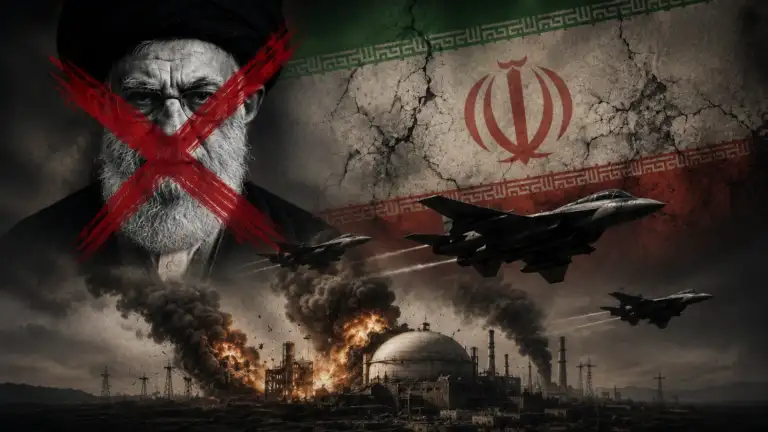
After two wars, a dead supreme leader, and a ceasefire that already asks American taxpayers to help feed the Iranian public, it’s time for the world to see what happens when America stops managing a threat and finishes it.
America does not start fights. We finish them. For nearly half a century the Islamic Republic of Iran has tested that patience, taking our diplomats hostage, arming terrorists who have killed American citizens, chanting for our destruction, and lying to the world about a nuclear weapons program it swore it never wanted. Twice in the last thirteen months, American and Israeli forces have answered that threat with overwhelming, righteous force. Twice, the world has watched American airpower do what decades of failed diplomacy could not. And now, remarkably, our own diplomats are back at a table in Switzerland, handing Tehran sanctions relief and unfrozen billions as though the regime that spent a year murdering its own citizens by the thousands has earned a fresh start. It has not. The moment has come to finish what our military so capably started, and to make sure America, not the regime that started this fight, comes out ahead.
A Regime That Has Never Kept Its Word
The Islamic Republic was born in 1979 by taking American diplomats hostage for 444 days, an act of humiliation this country has never forgotten and should never forget. In the decades since, Tehran has bankrolled Hezbollah, Hamas, and the Houthis, exporting terror across the Middle East while its own people suffered under corruption and misrule. When the world offered Iran an off ramp with the 2015 nuclear deal, the regime spent the years afterward secretly exceeding every limit it agreed to, stockpiling uranium far beyond any civilian need. By November 2024, American intelligence assessed Iran’s fissile stockpile, if further enriched, was sufficient for more than a dozen nuclear weapons. This is not a government that negotiates in good faith. It never has.
That is the backdrop against which American and Israeli forces acted first in June 2025’s Twelve Day War, striking Iran’s nuclear sites, and again on February 28, 2026, when nearly nine hundred strikes in twelve hours eliminated Supreme Leader Ali Khamenei and dozens of regime officials in one of the most successful military operations of this generation. Iran’s answer to American strength was not surrender. It was to fire on our bases and try to choke off the Strait of Hormuz, a fifth of the world’s oil supply, in a reckless attempt to hold the global economy hostage. It failed, because American and allied forces would not let it succeed.
A Regime That Slaughters Its Own People
Every American should understand exactly what kind of government we are dealing with, because it explains everything. This is a regime that has murdered its own citizens by the thousands, and it did so again just months ago. When Iran’s currency collapsed in December 2025 and protests broke out in all thirty one provinces, calling for freedom from the mullahs, the regime’s answer was slaughter. The Iran Human Rights Organisation documented at least 3,428 protesters killed by security forces in just four days that January, with more than 10,000 arrested in the same span. Forensic footage showed close to two hundred bodies piled in a single Tehran morgue, including a sixteen year old boy shot in the head. Iran’s judiciary chief promised swift trials and executions, and delivered on that promise, charging demonstrators with “waging war against God,” a charge that carries a mandatory death sentence.
The killing did not stop there. Amnesty International recorded at least 2,159 executions in Iran in 2025 alone, the highest total in nearly forty years, many for offenses that would never carry a death sentence in a free country. This is a regime with a body count stretching back to its founding, from the estimated 3,400 political executions of 1981 and 1982 to the notorious 1988 prison massacre that may have killed as many as 30,000 dissidents in a matter of weeks, their remains still buried in mass graves the regime refuses to acknowledge. A government with this record does not deserve the benefit of the doubt. It deserves to be removed.
A Regime at War With the Christian Faith
For readers of this magazine, one fact should settle any remaining doubt. Iran ranks tenth in the entire world on Open Doors’ 2026 World Watch List of nations that persecute Christians, scoring 87 out of 100. Converts from Islam to Christianity are hunted by the state as enemies. House churches are raided. Believers are thrown in prison for the crime of following Jesus Christ. In March 2025, three Christian converts received combined sentences of more than forty years, one of them a pregnant woman named Narges Nasri. Since the war began, the regime has started branding Christian converts as foreign spies outright. This is not a government that deserves patience or trust. It is a government that persecutes the church, and its fall would be a mercy to millions of Iranians who simply want the freedom to worship.
Fast Facts
February 28, 2026: American and Israeli forces eliminate Supreme Leader Ali Khamenei in a decisive, successful strike
January 2026: Iranian regime kills at least 3,428 of its own citizens for peacefully protesting, in just four days
2025: At least 2,159 executions carried out by the regime, the highest total in nearly 40 years
June 17, 2026: US and Iran sign a memorandum of understanding, opening the door to sanctions relief
Religious freedom: Iran ranks 10th worst in the world for persecuting Christians, according to Open Doors
America Paid the Price. America Should Collect.
American pilots flew the missions. American sailors kept the Strait of Hormuz open once Iran tried to shut it down. American taxpayers financed every bit of it, and American families felt it at the gas pump when Iran tried to hold the world’s energy supply hostage. We paid that price in full, and we paid it because it was right.
That is exactly why it is so hard to accept what has happened since. Under the June memorandum, Washington has waived sanctions on Iranian oil, released frozen Iranian assets, and reopened Hormuz to the very regime our forces just spent months bringing to its knees. Vice President Vance says the unfrozen funds will flow to American farmers through Iranian purchases of corn, wheat, and soy, which is a fine deal for American agriculture, but it is no substitute for making the regime itself answer for what it cost us. Iran holds tens of billions of dollars in frozen assets abroad. Those funds, along with future energy agreements struck from a position of American strength, should go toward repaying the country that bore every cost of this fight, our troops, our taxpayers, and our allies, not toward propping the regime back up.
“There will be no deal with Iran except unconditional surrender.”
— President Trump, at the outset of the February 2026 strikes
Don’t Let Diplomacy Steal Back What Our Military Won
Here is the pattern that should worry every patriot watching this unfold. American strength creates the leverage. Then, every single time, our own diplomats spend that leverage away at the negotiating table before the job is finished. The February strikes opened with the explicit goal of regime change and a promise of nothing short of surrender. Five months later, the memorandum on the table does not require Iran to give up its nuclear program, does not touch its missile arsenal, and leaves its terror network fully intact. Iran has agreed only to “reaffirm” a promise it already broke once.
This country did not send its finest into harm’s way, and did not ask its taxpayers to foot the bill for two wars, so that career diplomats could hand the regime a lifeline the moment the shooting stopped. The job our military started should be the job America finishes.
Finish It, and Build Something Better in Its Place
The alternative to another round of diplomacy is not recklessness. It is resolve. Having already removed the regime’s supreme leader and shattered its military and nuclear capability, America and her allies should see the mission through, rather than hand the reins to a successor, Khamenei’s own son Mojtaba, who will simply rebuild the same machine of terror, nuclear ambition, and religious persecution under a new face. The Iranian people themselves rose up against this regime at tremendous personal cost. They deserve a government that answers to them instead of to the Ayatollahs, one that does not fund terrorism abroad, execute its own citizens by the thousands, or imprison Christians for their faith.
And any such transition should be built so that America is repaid, not left holding the bill a second time. Reparations and reconstruction financing tied to real reform are standard tools this country has used before. There is nothing unreasonable about insisting the regime that started this fight, not the American taxpayer, pays to finish it.
A Word for the Skeptics
A few voices, including some on our own side, will counsel patience, pointing to Iraq and noting that toppling a regime carries real complications if the follow through is mismanaged. It’s a fair thing to keep in mind. It is not a reason to trust a regime that has broken every promise it has ever made.
The Bottom Line
America did not ask for this fight, but American strength has already won it twice on the battlefield. A regime that executes thousands of its own people, jails Christians for their faith, and has broken its word for forty seven years does not deserve a third chance at the negotiating table. It deserves to be finished, and America deserves to be paid back for the price of finishing it. That is not radical. That is what standing up for our country looks like.
References
Wikipedia, “2025 to 2026 Iran United States negotiations”
Wikipedia, “2025 to 2026 Iran massacres”
Wikipedia, “2025 to 2026 Iranian protests”
Time, “The 60 Day Test: What Iran’s Agreement with the United States Really Means,” June 19, 2026
House of Commons Library, “US Iran ceasefire and nuclear talks in 2026”
Al Jazeera, “Key outcomes of Iran US talks in Switzerland, what next?” June 22, 2026
Britannica, “2026 Iran war”
Human Rights Watch, “Iran: Human Rights Situation Spirals Deeper into Crisis,” February 4, 2026
Amnesty International, “Iran: Deaths and injuries rise amid authorities’ renewed cycle of protest bloodshed”
ECPM and Iran Human Rights (IHRNGO), “Iran: At least 1,639 executions in 2025, a deadly record,” April 24, 2026
Open Doors, “World Watch List 2026: Iran Country Dossier”
Congressional Research Service, “Iran and Nuclear Weapons Production,” via Congress.gov