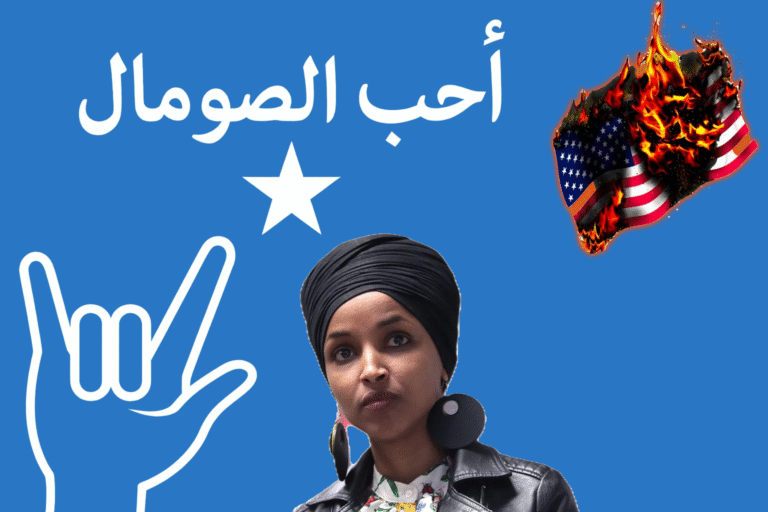
Ilhan Omar is not merely a controversial figure—she is one of the most divisive and destructive forces in American political life. Since arriving in Congress, Omar has made a career out of attacking the very country she represents. Her record is marked by anti-American rhetoric, questionable personal conduct, open hostility toward national security institutions, and an ideology rooted in grievance, division, and radicalism. At a time when the country needs unity, strength, and cultural confidence, Omar represents the exact opposite.
The controversies surrounding Omar’s personal background have never been fully resolved. Chief among them is the allegation that she once entered into a sham marriage with her brother in order to game the U.S. immigration system. While she has denied this, documents and timelines surrounding her marital and tax history raise enough questions that the issue remains open in the minds of many. In any other era, this alone would have disqualified someone from public office. But in today’s politically protected climate, Omar has largely been shielded from real scrutiny.
Even more troubling than the allegations about her personal past is Omar’s consistent and deliberate effort to undermine American cultural values. She has publicly described the United States as systemically oppressive, irredeemably racist, and in decline. She has mocked Americans who speak out against terrorism. She infamously referred to the September 11 attacks as an incident where “some people did something,” minimizing one of the most devastating events in U.S. history. Her language repeatedly frames America as guilty, broken, and to blame—a sharp contrast to the values of patriotism and national pride that most Americans still hold dear.
Omar’s hostility isn’t reserved for domestic issues. On the international stage, she has positioned herself as an opponent of America’s closest allies, most notably Israel. Her repeated remarks—suggesting undue influence of pro-Israel lobbying and questioning the loyalty of Jewish Americans—have been widely condemned as antisemitic. She was ultimately removed from the House Foreign Affairs Committee because of these patterns. Her foreign policy positions consistently downplay threats from hostile regimes while criticizing the very institutions that defend Western values and democratic allies.
On immigration and border policy, Omar has advocated extreme positions that would erase national sovereignty. She has called for the abolition of ICE, broad decriminalization of illegal border crossings, and unrestricted asylum policies that would overwhelm the U.S. immigration system. Her proposals would effectively turn the southern border into an open gate while placing the burden on American taxpayers. Her policies show more concern for illegal immigrants than for the safety and well-being of American citizens.
Perhaps most damaging is what Omar symbolizes: a radical shift away from assimilation, unity, and shared national identity. She represents a brand of politics built on resentment, victimhood, and identity tribalism. Rather than working to bring Americans together, she constantly pits groups against one another—framing every issue through the lens of race, religion, or gender. Her speeches are not meant to unify or solve, but to inflame, shame, and divide.
Ilhan Omar is not a leader committed to American principles. She is a political disruptor committed to tearing down the foundations of the nation in order to replace them with something unrecognizable. She undermines our culture, questions our allies, weakens our laws, and disrespects the values that made America exceptional. That is not courageous. That is corrosive.
The country deserves leaders who love America, believe in its promise, and work to preserve its future—not ones who continually attack its foundations from within. Omar’s presence in Congress is not simply problematic. It is dangerous. Her record is not misunderstood. It is understood all too clearly.
Ilhan Omar is a threat to America’s identity, security, and future—and it’s time the country treated her as such.
Sources & References
- U.S. House of Representatives – Congressional Record, February 2023: Removal of Rep. Ilhan Omar from the House Foreign Affairs Committee.
- Associated Press, “House votes to remove Rep. Ilhan Omar from Foreign Affairs panel,” February 2, 2023.
- CNN Politics, “Ilhan Omar responds to backlash over 9/11 remarks,” April 2019.
- The Washington Post, “Ilhan Omar’s remarks on 9/11 spark renewed Republican criticism,” April 2019.
- The New York Times, “Ilhan Omar and the limits of progressive tolerance,” February 2019.
- The Hill, “Ilhan Omar faces renewed scrutiny over marriage history,” June 2020.
- Minnesota Campaign Finance and Public Disclosure Board, “Findings and Order in the Matter of Representative Ilhan Omar,” June 6, 2019.
- Politico, “Ilhan Omar apologizes for comments condemned as antisemitic,” February 2019.
- Jewish Telegraphic Agency, “Why Ilhan Omar’s comments were seen as antisemitic,” February 2019.
- House Homeland Security Committee archives – Hearings and statements on ICE, border enforcement, and proposals to abolish immigration enforcement agencies (2018–2021).
- U.S. Department of Homeland Security – Policy briefs on border security and asylum system impacts.
- Congressional Research Service, “Immigration Enforcement and the Abolition of ICE: Policy Considerations,” 2020.
- Fox News, “Ilhan Omar’s anti-Israel comments draw bipartisan condemnation,” March 2021.
- BBC News, “Ilhan Omar condemned for comments on Israel and U.S. politicians,” February 2019.
- Pew Research Center, “Views on patriotism, national identity, and America’s role in the world,” 2022.
- Commentary Magazine, “Ilhan Omar and the problem of America-hating progressivism,” April 2021.
- National Review, “Ilhan Omar’s consistent record of anti-American rhetoric,” March 2022.
- Congressional voting records, U.S. House of Representatives – 116th through 118th Congress sessions.