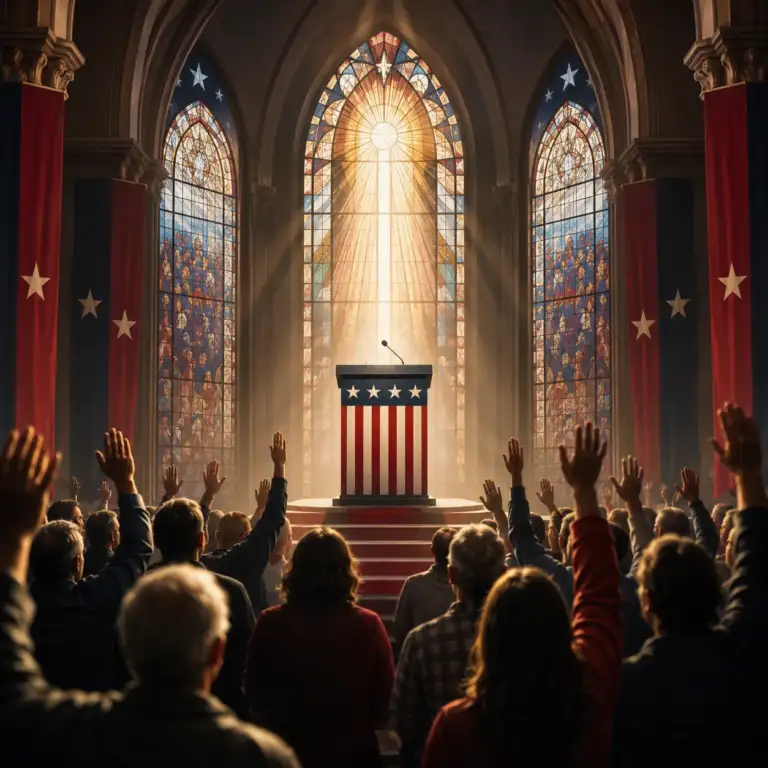
Watch a cable news panel, scroll a social media feed after a controversial statement, or observe how a certain kind of American reacts when a politician they support is criticized, and a pattern emerges that has little to do with policy disagreement. There is certainty that admits no doubt. There is loyalty that survives any contradiction. There is a swift, public punishment for anyone who strays from the approved position, and a genuine sense of moral horror, not mere disagreement, directed at those who dissent. These are not the marks of ordinary political debate. They are the marks of religion, and a growing number of scholars, journalists, and theologians across the political spectrum have started saying so plainly. The uncomfortable question worth asking is not whether this is happening. The data on American religious decline makes clear it is. The question is what it means for a country increasingly worshipping at an altar that was never built to hold that kind of weight.
A Nation Still Searching for Something to Worship
The numbers behind this shift are not subtle, and they point in one direction more than the other. Pew Research Center’s landmark 2023-24 Religious Landscape Study found that only 37 percent of self-described political liberals now identify as Christian, down from 62 percent in 2007, a 25-point collapse in less than two decades. Over that same span, the share of liberals claiming no religion at all rose from 27 percent to 51 percent, meaning religious “nones” now outnumber Christians among American liberals for the first time on record. Conservatives moved in the same direction over that period, but far more modestly, and a large majority still identify as Christian. Gallup’s polling confirms just how politically lopsided this shift has become: among Americans who claim no religious identity at all, 63 percent identify as Democratic or lean that way, compared with just 26 percent Republican, even though the overall population splits almost evenly between the two parties. Human beings do not generally stop needing meaning, moral structure, community, and a sense of ultimate purpose simply because they stop attending services. When traditional religion recedes from a life, or from an entire political coalition, something else typically expands to fill the space it leaves behind. Increasingly, on the American left in particular, that something has been politics itself.
Fast Facts
37 percent: Share of self-described liberals who identify as Christian today, down from 62 percent in 2007
51 percent: Share of liberals who now claim no religion at all, up from 27 percent in 2007, a reversal that makes “nones” more common than Christians among liberals for the first time
63 to 26: The Democratic-to-Republican split among Americans who claim no religious identity, per Gallup
2021: Columbia linguist John McWhorter publishes “Woke Racism: How a New Religion Has Betrayed Black America,” arguing modern anti-racism functions as an actual religious system, complete with original sin, prophets, and excommunication
2018: Writer Andrew Sullivan’s widely cited essay “America’s New Religions” argues political ideology has taken on the structure of the very faiths it claims to have outgrown
When Ideology Grows Its Own Theology
The clearest and most rigorously argued version of this thesis comes from an unlikely source: John McWhorter, a Black linguistics professor at Columbia University who spent years studying how the modern anti-racism movement, which he and others often shorthand as “wokeness,” had come to function less like a political program and more like an actual faith. In his book, McWhorter lays out the structure in detail: the concept of white privilege operates as a kind of original sin, an ineradicable stain a person is born into and can never fully atone for. Figures like the writer Ta-Nehisi Coates are treated less like public intellectuals to be debated than priests whose words carry near-scriptural authority. There is even an eschatology, a promised future “reckoning” with racism, discussed in terms almost indistinguishable from a religious judgment day, a moment when America will finally “come to terms with” its sins, an outcome McWhorter notes is left permanently vague, the same way believers of any faith describe a future salvation they cannot fully picture but hold onto anyway.
And crucially, there is excommunication. Writer Andrew Sullivan, making a closely related argument in his own widely read 2018 essay, put it directly: “Anti-racism,” he wrote, “is a profoundly religious movement in everything but terminology.” Sullivan and McWhorter both point to the same mechanism: a public figure who strays from the approved line does not simply lose an argument. They are cast out, publicly shamed, professionally punished, treated the way a heresy trial once treated a doctrinal violator, with the modern euphemism for the practice, “canceling,” doing little to disguise its actual function. This is not, this magazine wants to be clear, a phenomenon limited to any single issue. It describes a broader pattern in how a certain kind of political conviction now polices itself.
The Rituals Nobody Called Religious
What makes this more than a clever metaphor is how literally the pattern extends into ritual and liturgy, the actual repeated, symbolic practices that mark a person as a believer in good standing. Commentators studying this phenomenon have catalogued specific recurring behaviors: the public confession of one’s own privilege before a group, the ritual declaration of pronouns as a kind of creed, participation in symbolic protest actions understood less as strategic political tools than as demonstrations of loyalty to the community of believers. These are not incidental social customs. They function, as observers of the pattern have noted, as binding liturgical performances that mark a participant as faithful and reinforce the movement’s underlying creed, in precisely the structural role a baptism, a confession, or a public profession of faith plays inside a traditional religious community.
There is a telling theological difference buried inside that parallel, one worth sitting with as a specifically Christian magazine. The gospel of Jesus Christ offers something political religion structurally cannot: actual absolution. Scripture promises that the blood of Christ cleanses believers from all sin, fully, finally, and permanently, the moment genuine repentance is offered. The confession rituals of political ideology, by contrast, tend to offer no such release. There is no true forgiveness available within a system built on original sin defined by group identity rather than personal wrongdoing, only an endless cycle of further confession, further activism, further demonstration of loyalty, because the sin was never a choice that could be repented of in the first place. A worldview that can identify guilt but cannot offer genuine forgiveness is not actually good news for the people living inside it, whatever comfort its rituals seem to provide in the moment.
Unquestioning Loyalty and the Politician as Messiah
The same religious structure shows up in how political leaders themselves are increasingly discussed and defended. Political scientists studying what they call “affective polarization,” the tendency to view one’s own political side not merely as correct but as good, and the opposing side not merely as wrong but as an existential threat, have documented a steady rise in this pattern over the past two decades, with partisan identity now functioning for many Americans as a more central, more emotionally loaded piece of their self-understanding than their actual religious identity does. A leader championed by one’s political tribe stops being evaluated the way a normal public official is evaluated, on the merits of specific decisions, weighed against specific outcomes, and starts being defended the way a religious community defends its own prophet: any criticism reframed as persecution, any failure explained away, any dissenting supporter treated as a lapsed believer rather than simply someone with a different read on a policy question.
“Anti-racism is a profoundly religious movement in everything but terminology.”
— Andrew Sullivan, “America’s New Religions,” 2018
A Warning Worth Applying to Every Side of the Aisle
It would be intellectually dishonest, and this magazine has no interest in dishonesty, to pretend this tendency belongs exclusively to one political coalition. The specific data above shows the religious vacuum opening fastest and widest on the political left, and the specific ideological structure McWhorter and Sullivan describe emerged mainly from progressive activist spaces. But the underlying human temptation, to treat a political leader, a party, or a movement as beyond question, as a source of ultimate meaning rather than a fallible institution to be judged on its actual conduct, is not partisan. It is simply idolatry, and Scripture’s warnings against idolatry were never written with only one political coalition in mind. Any believer, on any side of any aisle, who finds it easier to question a doctrine of their faith than to question a candidate they support has quietly let something other than God occupy the seat only God was ever meant to hold. That is worth every Christian reader sitting with honestly, regardless of which party’s yard sign is currently in their front lawn.
Why the Church Still Has the Better Answer
The deepest problem with treating politics as religion is not that it borrows religious structure. It is that it borrows the structure while discarding the substance that made the structure bearable in the first place. Traditional Christian faith offers moral certainty anchored in something outside human power struggles entirely, a God who does not change with each election cycle, whose forgiveness does not depend on which party controls the House, and whose value for a human being does not rise or fall based on demonstrated ideological loyalty. Political religion, by contrast, offers certainty anchored in something as unstable as the next news cycle, forgiveness that never actually arrives, and a sense of belonging that can be revoked the instant a person expresses one heterodox thought. It asks for the devotion religion asks for while offering none of the grace religion, at its best, actually provides.
This is precisely why the decline of traditional faith and the rise of political religion are not two separate stories happening to coincide. They are the same story. A people built, from the beginning, with a God-shaped need for ultimate meaning will fill that need with something, and if the true object of worship has been set aside, the substitute rarely announces itself honestly. It arrives instead wearing the language of justice, of progress, of patriotism, of righteousness, borrowing every recognizable form of religious devotion while quietly replacing the God at the center of it with whatever cause, party, or leader currently commands the loyalty of the crowd.
The Bottom Line
Politics matters, and Christians are right to engage it seriously, vote their convictions, and advocate forcefully for policies that reflect a biblical vision of justice and human dignity. What Christians cannot do, without doing real spiritual damage to themselves, is let political identity quietly become the thing that organizes their entire moral universe, supplies their sense of righteousness, and demands the kind of unquestioning loyalty that belongs to God alone. The data is clear that millions of Americans, disproportionately on the political left but not exclusively there, have already made that substitution, whether they would describe it in those terms or not. The corrective is not less political engagement. It is remembering, plainly and often, that no party, no leader, and no ideology was ever meant to sit on the throne that Scripture reserves for God alone, and that the emptiness so many Americans are now trying to fill with politics was never actually shaped like a ballot box in the first place. It was shaped like a cross.
References
Pew Research Center, “Decline of Christianity in the U.S. Has Slowed, May Have Leveled Off,” February 2025
Pew Research Center, “Religious & Political Identity in the US,” February 2025
Gallup, “The Politics of Religion,” January 2026
Religion Dispatches, “In a New Manifesto Framing ‘Wokeness’ as Religion John McWhorter Sounds Like Moses Condemning Israel for Worshipping Golden Calf of Black Power”
Columbia News, “Woke Racism: How a New Religion Has Betrayed Black America”
American Enterprise Institute, “The New Religion of Woke Anti-racism”
The Boston Globe, “Is being woke a religion?” November 2021
New Ideal, “The New Religion of ‘Woke'”
MDPI Religions, “Has Partisanship Subsumed Religion? Reassessing Religious Effects on School Prayer in U.S. Politics,” August 2025
MDPI Religions, “Farewell to Faith: Democracy, the Decline in American Public Religion, and the Rise of the Non-Religious,” June 2025