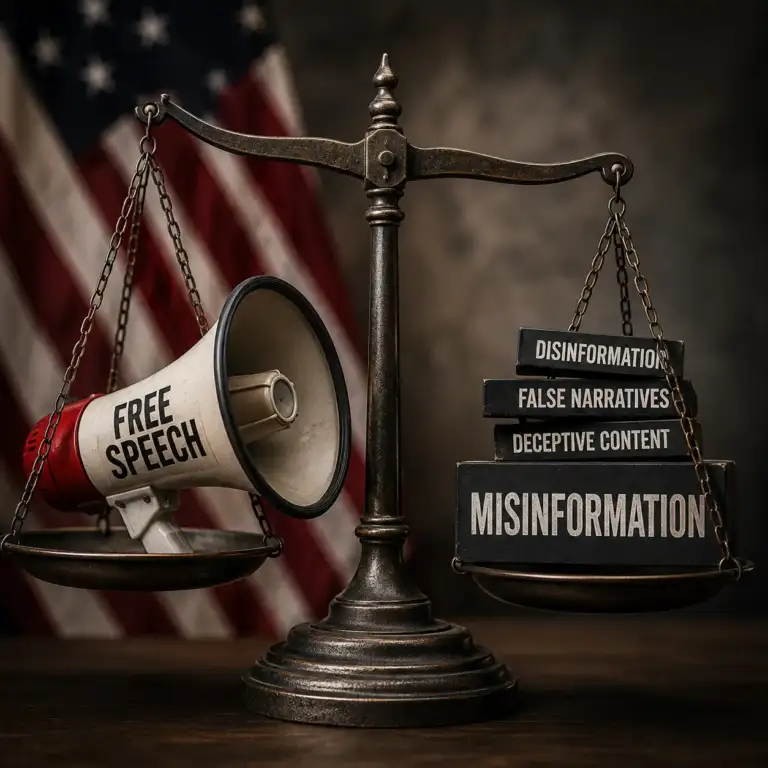
A theory about a lab in Wuhan was censored as dangerous conspiracy in 2020 and now sits on an official government website as the most likely explanation. A story about a laptop was suppressed as Russian disinformation weeks before an election and turned out to be entirely real. Both times, someone had the power to decide what counted as true before the facts were actually in. The uncomfortable question this country has not fully answered is who that someone should ever be again.
“Misinformation” sounds like a simple word. It describes something false, and most reasonable people agree false information circulating widely can cause real harm. The trouble is not the word’s definition. It is the practical question that definition always drags behind it: who gets to decide, in real time, before all the facts are known, what counts as true and what counts as dangerous falsehood, and what happens to the people and platforms that guessed wrong under enormous pressure to guess fast. The past five years gave America a genuine, high-stakes experiment in answering that question, and the results deserve a far more honest accounting than either side of this fight usually offers.
A Word That Became a Weapon
Three distinct questions sit underneath the single word “misinformation,” and collapsing them together is where most arguments about this subject go wrong. The first is definitional: who actually determines what is false, a government agency, a private platform, an independent fact-checker, or the crowd itself? The second is temporal: what happens, and who is accountable, when an official conclusion declared with confidence turns out, months or years later, to have been wrong? The third is constitutional: at what point does a private company’s ordinary editorial judgment about what to allow on its own platform become something closer to government censorship operating through a private intermediary? This piece takes each in turn, using the two cases that did more than any others to force this argument into open court.
Fast Facts
2020 to 2021: The COVID-19 lab-leak origin theory is suppressed and demoted across major platforms as conspiracy content
October 2020: Twitter and Facebook restrict the New York Post’s Hunter Biden laptop story weeks before the election, citing suspected Russian disinformation
2024: The Supreme Court rules in Murthy v. Missouri that the plaintiffs lacked legal standing, without ruling on the underlying censorship claims themselves
2025: A consent decree between Missouri and the federal government formally states the prior administration “trampled free speech rights” by pressuring platforms to suppress disfavored speech
January 2025: Meta ends third-party fact-checking in the U.S. and replaces it with crowdsourced Community Notes
2025-2026: An updated federal government website states a Wuhan lab leak is the “most likely origin” of COVID-19, the theory platforms suppressed years earlier
When “Misinformation” Turned Out To Be True
Start with the two case studies that did more than any court filing to make this argument concrete. The theory that COVID-19 may have originated from a laboratory in Wuhan, rather than emerging naturally from animal-to-human transmission, was treated across major platforms in 2020 as exactly the kind of dangerous conspiracy theory misinformation policies existed to suppress, demoted, flagged, and in some cases removed outright. Congressional investigators and multiple news organizations later documented that senior public health officials, including Dr. Anthony Fauci, worked directly with technology executives during this period to shape what circulated about the virus’s origins. Years later, the very same federal government reversed course entirely: an updated official COVID-19 information website launched under the current administration now states plainly that a Wuhan lab leak is the “most likely origin” of the virus, citing specific scientific evidence and directly criticizing the prior administration for what it calls “outright censorship” of the theory it once suppressed.
The Hunter Biden laptop story followed a strikingly similar arc on a compressed timeline. When the New York Post published its October 2020 story based on files from a laptop reportedly belonging to Hunter Biden, Twitter blocked the article from being shared entirely and Facebook sharply reduced its circulation, citing concern the story reflected a Russian “hack-and-leak” operation designed to interfere in the election. Court filings in the subsequent litigation revealed that the FBI had actually possessed the laptop since December 2019, more than ten months before the story broke, and that when Facebook directly asked the FBI whether the story was Russian disinformation, the bureau’s agent declined to answer, a silence the presiding federal court later called “particularly troubling” given what the FBI already knew. The laptop, and the story built around it, was subsequently confirmed as genuine.
Neither case proves that all suppressed claims eventually turn out true, and this magazine is not arguing that. What both cases prove, decisively, is that confident official pronouncements about what constitutes dangerous falsehood are not infallible, even when they come from the government’s most credentialed scientific and law enforcement institutions, and that platforms acting on those pronouncements suppressed core political speech, about a pandemic and about a presidential candidate’s family, that later turned out to be substantially accurate.
Who Was Actually Pulling the Strings
The deeper question these two stories raised was not simply whether platforms made bad editorial calls. It was whether those calls were genuinely independent editorial judgments at all, or whether the government itself was directing them. Missouri and Louisiana’s attorneys general built exactly that case in the lawsuit that became Murthy v. Missouri, compiling what they described as more than 1,400 supporting facts. A federal district court and, on appeal, the Fifth Circuit found substantial evidence supporting the claim: the court determined that White House officials engaged in “unrelenting pressure” against technology companies at least 22 separate times, that the CDC organized meetings explicitly telling platforms what content to be “on the lookout” for, and that Surgeon General Vivek Murthy’s office coordinated closely with the White House in what the court characterized as a coordinated pressure campaign. The district court’s findings were blunt about the pattern’s political shape, stating that “virtually all of the free speech suppressed was conservative free speech.”
“Faced with unrelenting pressure from the most powerful office in the world, the social-media companies apparently complied.”
— Federal district court finding, Missouri v. Biden, later Murthy v. Missouri
The Supreme Court Ducked the Question, and the Executive Branch Answered It Instead
Here honesty requires a correction to how this case is often described in conservative media, because getting the actual outcome right matters more than the version that feels most satisfying. When Murthy v. Missouri reached the Supreme Court in 2024, the Court did not rule that the government’s conduct was constitutional, and it did not rule that the lower courts’ findings of coercion were wrong. It ruled, 6 to 3, that the specific plaintiffs before it, several doctors, a news website, and two states, had not established that their particular content restrictions were clearly traceable to the specific defendants they sued, and therefore lacked legal standing to bring the case at all. The underlying constitutional question, exactly how much government pressure on a private platform crosses the line from persuasion into coercion, was left unresolved by the nation’s highest court, a genuinely unsatisfying result for a case that had generated such extensive factual findings below.
What the courts declined to settle, the executive branch settled through a different mechanism entirely. In 2025, under new leadership at the Justice Department, Missouri secured a consent decree that did what the Supreme Court would not: it formally acknowledged, in the federal government’s own words, that the prior administration had “trampled free speech rights” by pressuring platforms to suppress disfavored speech, and it legally barred the federal government from pressuring platforms to remove content it deems misinformation going forward. That is a genuine, meaningful concession, and this magazine believes it deserves to be recognized as such. It is also, structurally, a far less durable resolution than a Supreme Court ruling would have been. A consent decree binds the administration that signed it. It does not settle the underlying constitutional doctrine for every future administration, of either party, that might be tempted to apply exactly the same pressure through exactly the same channels the moment public attention moves elsewhere.
The Platforms Tried Fact-Checkers, Then Backed Away
Separate from the government pressure question, the platforms themselves have been genuinely rethinking how they handle contested claims, and that shift deserves its own honest look. Meta ended its third-party fact-checking program in the United States in January 2025, replacing it with a crowdsourced Community Notes system modeled on the one Elon Musk had already implemented at X. Meta’s new chief global affairs officer, Joel Kaplan, explained the reasoning bluntly: “Too much harmless content gets censored, too many people find themselves wrongly locked up in ‘Facebook jail,’ and we are often too slow to respond when they do.” Mark Zuckerberg framed the shift as a response to what he called years of moderation systems that had “gone too far,” shaped by social and political pressures rather than neutral judgment.
Fairness requires including the genuine concerns raised about this shift too. Meta’s own Oversight Board, an independent body the company established to review its content policies, issued a formal advisory opinion warning that Community Notes are “not a proper substitute” for professional fact-checking, finding that delays in note publication and the limited number of notes actually reaching users raised real doubts about whether the crowdsourced model could meaningfully address misinformation linked to genuine harm. The Board also flagged a structural concern worth taking seriously: crowdsourced moderation, by its nature, tends to privilege whatever perspective the dominant group of engaged users on a platform happens to hold, which is not obviously a more neutral outcome than a credentialed fact-checker, merely a differently biased one. Neither model, professional fact-checking nor crowdsourced notes, has proven itself free of bias. What has changed is which bias platforms are currently more worried about.
Where Legitimate Moderation Actually Ends and Censorship Begins
Sorting through all of this, this magazine believes the operative legal and moral distinction is not actually about truth or falsehood at all. It is about who is applying pressure, and how much genuine choice the platform retained. A private company deciding, on its own initiative and using its own judgment, what content to allow or remove on its own property is exercising editorial discretion, protected by the same First Amendment logic that protects a newspaper’s decision about what to print, even when that judgment turns out to be wrong, inconsistent, or driven by commercial incentive. The moment a government official, whether at the CDC, the FBI, or the White House, uses the implicit or explicit threat of regulatory, legal, or reputational consequence to induce that same company to suppress specific viewpoints it would not otherwise have suppressed, the constitutional character of the act changes entirely, regardless of whether the pressure was applied through a public statement or a quiet phone call. Courts call this “jawboning,” government coercion routed through a nominally private intermediary specifically to accomplish what the First Amendment would forbid the government from doing directly. The lower court findings in the Murthy litigation described exactly that pattern in granular, documented detail, even though the Supreme Court ultimately never ruled on whether that pattern was unconstitutional.
Can Free Speech Actually Survive This?
The honest answer is a cautious yes, but only if the country learns the right lesson from the past five years rather than the convenient one. The right lesson is not “our side’s speech was suppressed, so the other side’s speech deserves the same treatment now that the wheel has turned.” That instinct, visible on both sides of this fight depending on which administration holds power, simply rebuilds the same censorship apparatus under new management, waiting for the next election to be pointed in a different direction. The actual, durable lesson is structural: no single institution, government agency, credentialed fact-checker, or platform algorithm should hold unappealable, final authority to declare a contested claim settled truth before the evidence is actually in, because the record of the past five years shows plainly how often that authority gets it wrong, and how selectively it tends to get applied. Real free speech survival requires genuine institutional humility, a willingness on the part of scientists, intelligence agencies, and platforms alike to say “we don’t yet know” rather than manufacturing false confidence to shut down inconvenient discussion, and real transparency, so that when government pressure is applied to a private platform, citizens can actually see it happening rather than discovering it years later through litigation.
The Bottom Line
The lab leak theory and the Hunter Biden laptop story are not simply embarrassing footnotes for the officials and platforms that got them wrong. They are the clearest available evidence that the entire premise underlying years of aggressive misinformation policy, that credentialed authorities could reliably separate true claims from false ones in real time and were entitled to suppress the losing side before the debate had actually finished, was never as sound as its architects claimed. Free speech can survive the age of misinformation, but only if this country resists the temptation every side eventually feels to simply seize that same suppressive machinery for itself the next time it holds power. The better answer, unglamorous as it sounds, was always more speech, more scrutiny, and more patience for the truth to actually emerge, rather than a faster, more efficient way to decide it in advance.
References
Berkeley Technology Law Journal, “Meta’s Fact-Checking Rollback: Governance, Free Speech, and User Safety,” May 2025
NBC News, “Meta is ending its fact-checking program in favor of a ‘community notes’ system similar to X’s,” January 2025
Al Jazeera, “Meta, Facebook to drop fact-checkers: What does this mean for social media?” January 2025
Nieman Journalism Lab, “Meta’s Oversight Board warns that ‘Community Notes’ aren’t a proper substitute for fact-checking globally,” March 2026
Justia U.S. Supreme Court Center, Murthy v. Missouri, 603 U.S. ___ (2024)
United States Court of Appeals for the Fifth Circuit, No. 23-30445, Missouri v. Biden
Office of the Missouri Attorney General, “Missouri Leads In First Amendment Victory”
Office of the Missouri Attorney General, “Missouri Attorney General Andrew Bailey Asks Court To Block Biden From Violating Americans’ 1st Amendment Rights, Citing 1,400 Facts”
House Judiciary Committee, “Testimony Reveals FBI Employees Who Warned Social Media Companies about Hack and Leak Operation Knew Hunter Biden Laptop Wasn’t Russian Disinformation,” September 2024
TheWrap via Yahoo News, “Trump Administration Blasts Biden, Fauci for ‘Outright Censorship’ on Revamped Covid-19 Website”