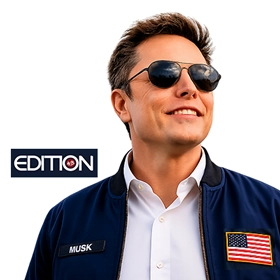
There are Americans by birth, Americans by oath, and Americans by action. Elon Musk belongs to the last two categories. Born in Pretoria, South Africa, educated partly in Canada and at the University of Pennsylvania, and naturalized as a United States citizen in 2002, Musk did not inherit an American identity by geography. He chose it. Then he spent the next quarter-century behaving as though the country’s unfinished work had been personally assigned to him.
That is the real meaning of the title “More American Than Most.” It is not a legal judgment and certainly not an insult to native-born citizens. It is a recognition of conduct. America has always been at its strongest when it rewards builders, risk-takers, inventors, immigrants, industrialists, and restless people who refuse to accept national decline as inevitable. Musk has embodied those traits at a scale rarely seen in modern life. He has placed enormous personal fortunes, professional credibility, and physical energy behind American manufacturing, American space leadership, American technological independence, American communications, and, more recently, the principle that citizens should be able to argue openly about the direction of their country.
He is not flawless. No consequential figure is. But a serious accounting of what Musk has built makes one conclusion difficult to avoid: few private citizens of his generation have done more to expand America’s capacity to make, launch, connect, invent, and compete.
An Immigrant Drawn to the American Frontier
Musk was born on June 28, 1971. As a boy, he read obsessively, taught himself computer programming, and developed the habit of treating difficult problems as systems that could be dismantled and rebuilt. He moved to Canada as a teenager, attended Queen’s University, and later transferred to the University of Pennsylvania, where he studied physics and economics. Those two fields would become the intellectual foundation of his career: an understanding of how the physical world works and how capital can be organized to change it.
He briefly entered a graduate program at Stanford University in 1995, then left before beginning his studies because he believed the commercial internet represented a historic opening. That decision produced Zip2, an early online city-guide and business-directory company built with his brother Kimbal. When Compaq acquired Zip2 in 1999, Musk used his proceeds not to retire into comfort but to attempt something larger.
He founded X.com, an online financial-services company that became part of PayPal. The company helped normalize digital payments at a time when millions of people still considered internet commerce unsafe or impractical. When eBay acquired PayPal in 2002, Musk again could have stopped. Instead, he committed much of his fortune to two ventures that established industries considered almost impossible for a newcomer to penetrate: automobiles and orbital rocketry.
That pattern matters. Musk did not simply invest in fashionable companies after their markets had been proven. He repeatedly entered capital-intensive sectors protected by entrenched competitors, technical barriers, regulatory complexity, and the possibility of total failure. That appetite for productive risk is one of the most recognizably American qualities in his story.
SpaceX and the Return of American Space Power
SpaceX was founded in 2002 with a radical proposition: rockets could be manufactured more efficiently, launched more frequently, and reused rather than discarded after a single flight. At the time, the American launch industry was expensive, slow-moving, and increasingly vulnerable to foreign dependence. Musk believed the United States could do better.
The early record was brutal. The first three Falcon 1 launches failed. A fourth failure could have ended the company. In September 2008, the fourth Falcon 1 reached orbit, making SpaceX the first privately developed liquid-fueled rocket to do so. That success was not merely a corporate milestone. It introduced a competitive force that would alter the economics and tempo of American spaceflight.
SpaceX’s Falcon 9 later made reusable orbital-class rocketry operational rather than theoretical. First-stage boosters began landing vertically and flying again. Reusability reduced the amount of hardware destroyed after each mission and helped drive down launch costs. By the end of 2024, SpaceX reported more than 430 Falcon launches and hundreds of successful booster reflights. The practical result was a dramatic expansion of America’s ability to place satellites, scientific instruments, cargo, and national-security payloads into orbit.
The company’s Dragon spacecraft restored another capability the United States had lost. After the space shuttle retired in 2011, America depended on Russian Soyuz vehicles to carry astronauts to the International Space Station. In 2020, NASA astronauts Bob Behnken and Doug Hurley launched aboard SpaceX’s Crew Dragon from Kennedy Space Center. American astronauts were once again flying to orbit from American soil on an American rocket and spacecraft.
That achievement belongs to NASA, the Commercial Crew Program, thousands of public servants, and the SpaceX workforce. But Musk’s role cannot be minimized. He created the company, served as its chief engineer, pushed the reusable architecture, and kept the enterprise alive through repeated technical and financial crises. NASA now describes its commercial-crew partnership as a means of providing safe, reliable, cost-effective transportation from the United States. SpaceX has become the dependable workhorse of that system.
The national-security consequences are equally important. SpaceX launches GPS, missile-warning, intelligence, and other defense payloads. In 2025, the U.S. Space Force awarded the company a major National Security Space Launch contract with an anticipated value approaching $6 billion, while emphasizing that reliable access to space is essential to both economic prosperity and military readiness. In practical terms, Musk’s company became part of the industrial foundation on which American deterrence depends.
Starlink: Connection When Americans Need It Most
SpaceX also created Starlink, a low-Earth-orbit satellite network designed to provide broadband service without relying entirely on terrestrial cables and towers. The system has given rural households, farms, businesses, emergency responders, and travelers another way to connect in places where conventional service is weak or unavailable.
Its value becomes clearest during disasters. Hurricanes, floods, wildfires, and infrastructure failures can sever fiber lines and disable cellular networks precisely when communication is most urgent. SpaceX has deployed Starlink terminals and, through direct-to-cell technology, supported emergency connectivity following severe disasters in the United States. A satellite network does not replace every local provider, but it gives the nation a resilient communications layer that did not previously exist at comparable scale.
This is one of Musk’s recurring contributions to America: redundancy. He has helped create alternatives when legacy systems fail, stagnate, or become strategically dangerous. Reusable rockets offer an alternative to slow and costly launch systems. Crew Dragon offers an alternative to foreign astronaut transportation. Starlink offers an alternative when ground networks collapse. Tesla offered an alternative to an auto industry that had treated electric vehicles as marginal products.
Tesla and the Rebirth of American Industrial Ambition
Musk joined Tesla’s board in 2004 after becoming its leading early investor and became chief executive in 2008. Tesla did not invent the electric car. Its achievement was making electric vehicles desirable, fast, technologically sophisticated, and manufacturable at scale.
Before Tesla’s rise, electric cars were commonly viewed as compromised vehicles for a narrow market. Tesla changed the category by proving that an electric automobile could deliver acceleration, range, software integration, over-the-air updates, advanced battery management, and an ownership experience different from the internal-combustion model. Competitors around the world were forced to accelerate their own programs.
For the United States, Tesla’s significance goes beyond climate policy. It is an advanced-manufacturing story. The company revived the former NUMMI automobile plant in Fremont, California, and built major operations in Nevada, Texas, and New York. Its factories support engineering, construction, battery production, vehicle assembly, software development, logistics, and a broad supplier network. Tesla reports a global workforce exceeding 100,000, with a substantial American manufacturing footprint.
The federal government helped Tesla at a critical stage through a $465 million Department of Energy loan used for the Model S program and the modernization of the Fremont facility. What followed is equally important: Tesla repaid the loan in 2013, nine years ahead of schedule. The Energy Department later cited the project for creating thousands of full-time jobs and helping bring advanced manufacturing technology back to the United States.
A conservative appreciation of Tesla should begin there. The company took a public loan, built productive capacity, employed Americans, developed exportable technology, and repaid taxpayers early with interest. One can debate subsidies and mandates while still recognizing the industrial achievement.
Tesla’s battery and energy-storage businesses have also strengthened American capacity. Powerwall systems provide household backup and energy management. Megapack installations help utilities store electricity and stabilize grids. The company’s charging network established a nationwide infrastructure that other automakers increasingly chose to use. Tesla did not merely sell vehicles. It created an ecosystem involving batteries, power electronics, software, charging, energy storage, and domestic production.
A Culture of Engineering Rather Than Excuses
Musk’s companies share a management philosophy that is demanding, sometimes abrasive, and undeniably productive. He favors rapid iteration, simplified designs, vertical integration, and direct accountability between engineers and the hardware they create. Rather than accept aerospace or automotive timelines as permanent facts of life, his teams repeatedly test, fail, revise, and test again.
That method has produced spectacular failures in public view, from exploding rocket prototypes to missed production targets. Yet it has also produced results that cautious institutions often declared unrealistic: rockets that land, spacecraft that carry astronauts, mass-produced electric cars, a global satellite network, and implantable brain-computer interfaces tested in human patients.
America needs that culture. A nation cannot preserve technological leadership through press releases, consulting reports, and endless committees. It must build. Musk’s greatest civic contribution may be cultural: he made engineering dramatic again. He gave young Americans visible proof that factories, rockets, robotics, artificial intelligence, and hard physical problems belong at the center of the national story.
X and the Defense of the Digital Public Square
Musk’s 2022 purchase of Twitter, now X, was not an industrial project in the traditional sense. It was an intervention in the public square. He argued that a platform with immense influence over news and politics should permit a wider range of lawful speech and should be more transparent about its rules and government interactions.
The purchase cost him tens of billions of dollars and brought relentless criticism. Yet he proceeded because he believed the platform had become too willing to suppress disputed opinions, particularly those held by conservatives, populists, and institutional skeptics. Under his ownership, previously banned political figures returned, internal records about earlier moderation decisions were released to journalists, and the boundaries of acceptable debate widened.
Reasonable people can criticize specific moderation decisions or the tone of X. The broader principle remains important: democracy requires room for argument, error, dissent, satire, and correction. Musk used private capital to challenge a digital consensus that many Americans believed had become politically one-sided. That decision did not make him universally popular. It made him consequential.
Public Service and the War on Government Waste
In 2025, Musk temporarily stepped away from parts of his business schedule to advise President Donald Trump’s government-efficiency effort. The Department of Government Efficiency sought to identify waste, cancel unnecessary contracts, modernize federal systems, and force agencies to justify spending practices that had often escaped meaningful scrutiny.
DOGE’s reported savings have been debated, and every large claim should be subject to audit. But Musk’s willingness to enter government at substantial personal and commercial cost deserves recognition. He brought engineers and data specialists into a bureaucracy accustomed to measuring success by budgets consumed rather than outcomes delivered. He asked the most basic questions of public administration: What does this program do? Who benefits? What does it cost? Can the same result be achieved faster and more cheaply?
President Trump publicly thanked Musk for his service when his temporary role ended in May 2025. The assignment reflected a broader truth about Musk’s American story. He was not satisfied merely to criticize government from the sidelines. He entered the arena and accepted the political consequences.
Betting His Own Fortune on America
There is another reason Musk’s record resonates so with the American tradition: he repeatedly exposed his own capital to the consequences of his convictions. After the PayPal sale, he did not confine himself to passive investments or guaranteed returns. He poured money into SpaceX, Tesla, and solar-energy ventures until, by his own account, he was borrowing for personal expenses while both flagship companies approached failure in 2008.
That distinction matters. America has no shortage of wealthy commentators who recommend courage to other people. Musk accepted the possibility that his fortune, reputation, and life’s work could disappear together. When the financial crisis struck, he divided his remaining resources between two companies that employed American engineers and factory workers. Both survived, and both later expanded the country’s productive base.
His projects have also pulled private capital toward difficult industries. Investors who once preferred software with minimal physical infrastructure began financing batteries, launch systems, robotics, satellite manufacturing, artificial intelligence, and advanced factories. Competitors responded by hiring engineers, improving products, and increasing research. The benefits therefore extend beyond companies bearing Musk’s name.
Capitalism earns public confidence when wealth is reinvested in useful production rather than protected from risk. Musk’s career offers a vivid example: profit became fuel for the next factory, launch pad, laboratory, or machine.
The Next Frontiers
Neuralink is pursuing brain-computer interfaces that may eventually restore communication or mobility to people with severe neurological injuries. The Boring Company is experimenting with lower-cost tunneling and underground transportation. xAI is building advanced artificial-intelligence systems and computing infrastructure as the United States competes with China for leadership in the most important technological race of the century.
Not every project will succeed. Some may take longer than Musk predicts. That is the nature of frontier work. The value lies partly in attempting what established organizations avoid because failure would be embarrassing.
Musk’s record should be judged by more than wealth, headlines, or personality. He helped transform online payments, revived American ambitions in automobile manufacturing, restored domestic human spaceflight, lowered launch costs, strengthened military access to orbit, connected isolated communities, provided communications resilience, expanded battery technology, reopened debate on a major speech platform, and volunteered his time to challenge federal waste.
America gave Musk the arena in which his ambitions could become real. He repaid that opportunity by enlarging the arena for everyone else.
The most American thing about Elon Musk is not the passport he obtained in 2002. It is his refusal to believe that the country’s best years are behind it. He behaves as though decline is a technical problem, dependence is a design flaw, and the future belongs to the nation willing to build it first.
That conviction is not merely patriotic rhetoric. In Musk’s hands, it has become rockets, factories, satellites, vehicles, batteries, software, and jobs. It has become astronauts lifting off from Florida and boosters returning upright through the sky. It has become proof that one naturalized citizen, armed with an American faith in possibility, can still move the boundaries of the possible.
That is why Elon Musk is more American than most.
Sources
- Tesla’s official leadership biography and investor-relations materials covering Musk’s positions at Tesla and SpaceX; University of Pennsylvania materials covering his education and early entrepreneurial interests.
- SpaceX’s official Falcon User’s Guide, including Falcon launch totals, reflight history, NASA certification, facilities, and national-security operations.
- NASA materials on the Commercial Crew Program, the restoration of astronaut launches from American soil, and SpaceX cargo operations.
- S. Space Force contracting information concerning SpaceX’s National Security Space Launch responsibilities and anticipated contract value.
- S. Department of Energy records concerning Tesla’s $465 million loan, the Fremont manufacturing project, job creation, and repayment nine years ahead of schedule.
- Tesla corporate and impact materials covering manufacturing, employment, energy-storage products, and charging infrastructure.
- SpaceX reporting on Starlink and direct-to-cell communications supplied during hurricanes, floods, wildfires, and other American disasters.
- White House and Department of Government Efficiency materials concerning Musk’s temporary government role and the administration’s reported savings claims.
- Official Neuralink, xAI, and Boring Company materials concerning human brain-computer-interface trials, artificial-intelligence development, and lower-cost tunneling