
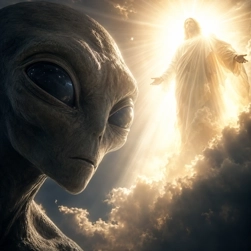
If astronomers confirmed tomorrow that intelligent life exists on a planet orbiting a distant star, it would rightly be the biggest scientific story in human history. It would not shake the foundation of the Christian faith, because that foundation was never built on humanity being alone in the universe. It was built on the God who made the universe in the first place.
Earlier this year, in a moment that briefly consumed social media, a political podcaster asked former President Barack Obama on air whether aliens are real. “They’re real,” Obama answered, “but I haven’t seen them,” adding that he knew of no actual proof extraterrestrials exist. The exchange spread quickly, in part because it landed at a moment when public fascination with unidentified aerial phenomena, congressional hearings on UFOs, and a steady stream of newly discovered exoplanets has pushed the question of life beyond Earth further into mainstream conversation than at any point since the moon landing. Skeptics have long assumed that a confirmed discovery of alien life would deal a fatal blow to Christianity, a faith they imagine depends on humanity being the only rational creature God ever made. That assumption gets the entire faith backward. Christianity was never a religion about how special humanity is compared to the rest of the universe. It is a religion about how great God is, and greatness like that is not threatened by anything He might have made, anywhere, for reasons of His own.
God Was Not Surprised By Outer Space
The starting point for every Christian thinking through this question should be the very first verse of Scripture: in the beginning, God created the heavens and the earth. Not just the earth. The heavens too, the whole of it, the galaxies and stars and, if He so chose, whatever lives on any world He placed within them. The psalmist wrote that the heavens declare the glory of God, and the book of Nehemiah records a prayer praising God as the one who alone made the heavens, the heaven of heavens, and all their host. When God finally answers Job out of the whirlwind, He does not defend Himself by pointing to Earth alone. He points to the breadth of the whole created order, the foundations of the world, the boundaries of the sea, the storehouses of the snow, as evidence of a wisdom too vast for any man to question.
This matters enormously for the alien question, because it means Scripture already assumes a God whose creative work is not confined to one planet. Christians have never claimed Earth is the only place God’s power could have reached. We have claimed that wherever His power reaches, nothing exists apart from His will. If there is life on some other world, in some distant solar system, it is there because God made it, exactly the same way every living thing on this planet is here because God made it. There is no third option. Nothing exists, anywhere, outside of God’s hand. An alien would not be evidence against that truth. An alien would simply be one more thing God made, for His own purposes, which He is under no obligation to explain to us any more than He explained to Job why the wild ox will not serve him or why the ostrich forgets her own eggs in the sand. Some things are simply His business, not ours, and Christians have never had trouble with that arrangement.
Fast Facts
Genesis 1:1: “In the beginning, God created the heavens and the earth”
Nehemiah 9:6: God alone made “the heaven of heavens, with all their host”
Colossians 1:16-17: All things, visible and invisible, were created through Christ and for Him, and in Him all things hold together
Psalm 90:2: From everlasting to everlasting, God exists before the mountains and the earth were ever formed
1958: Christian author C.S. Lewis publishes “Religion and Rocketry,” addressing head on whether alien life would threaten Christian belief
Today: Astronomers have confirmed thousands of exoplanets, and renewed public interest in UFOs has brought this centuries old question back into everyday conversation
Christ Is Not Diminished by a Big Universe
The skeptic’s real argument, when you strip away the science fiction dressing, is an argument from scale. It goes something like this: how could Christians possibly believe God sent His only Son to save one small planet, if that planet turns out to be one among billions, scattered across a universe so vast that light takes billions of years just to cross it? The honest answer is that this objection only works if you believe Christianity claims humanity earned God’s attention by being important. Scripture makes no such claim, and it never has. The Bible has always described God’s love for us as an act of grace toward the small and the undeserving, not a reward for cosmic significance. The psalmist asked the same question three thousand years ago, staring up at the same stars, wondering what man could possibly be that God would even take notice of him, let alone set His affection on him. The wonder was never that we earned it. The wonder is that He did it anyway.
Colossians tells us that in Christ, all things were created, things in heaven and on earth, visible and invisible, and that all things hold together in Him. That is about as large a claim as Scripture ever makes, and it was written in the first century, long before anyone knew the universe contained more than a handful of visible stars. A God big enough to hold every galaxy together in Christ is not made smaller by the possibility that He also made life on some other world. If anything, the size of the universe should make Christians marvel more at the love shown at the cross, not less. A Creator who could have made a billion different rational species, and instead chose to become one of us, to bleed and die for us specifically, has not shrunk in that story. He has grown larger than we ever imagined, because His grace did not have to reach us, and reached us anyway.
What C.S. Lewis Understood
The Christian writer C.S. Lewis addressed this exact question directly in a 1958 essay titled “Religion and Rocketry,” written as the space race was just beginning to capture the public imagination. Lewis took the objection seriously rather than mocking it, which is precisely why his answer still holds up. He pointed out that speculation about alien life, on either side of the debate, tends to be driven by what people already wanted to believe before they ever looked through a telescope. Those hoping to disprove God treat an empty universe as proof we are a cosmic accident, and treat a crowded universe as proof we are not special enough to matter. Both conclusions, Lewis noted dryly, cannot be true at once, and neither one actually follows from what the evidence would show.
Lewis’s deeper point was that Christians do not need to fear whatever answer the universe eventually gives, because our confidence was never resting on being alone. He observed that history is full of discoveries that were supposed to be the final blow against Christian belief, the movement of the earth around the sun, the age of the fossil record, the vastness of geologic time, and that in every case, once the initial commotion settled, believers and unbelievers alike found themselves standing roughly where they started. The truth of Christ’s death and resurrection did not depend on Earth sitting at the center of the universe in the sixteenth century, and it does not depend on Earth being the only inhabited world today.
“Those who do not find Him on earth are unlikely to find Him in space.”
— C.S. Lewis, “Religion and Rocketry”
If Aliens Are Real, They Are God’s Too
Here is the plain truth this magazine wants Christian readers to hold onto: if intelligent life exists somewhere else in creation, it exists because God made it, for reasons that are entirely His own and that He is under no obligation to share with us. Scripture tells us plainly that from Him, and through Him, and to Him are all things, and that His thoughts are not our thoughts, nor His ways our ways, as far above us as the heavens are above the earth. That is not a dodge. It is the actual shape of Christian humility. We do not need to know why God might have made other creatures on other worlds, any more than we need to know why He made a universe so vast that we will never see most of it, or why He chose the particular corner of history and geography He chose for the Incarnation.
And it makes no difference whatsoever where such life might be found, or what form the question ultimately takes. Whether intelligent beings turn out to inhabit a planet in our own galaxy, an entirely separate universe, or some other dimension our science has not yet even discovered a way to detect, none of it changes a single word of what has already been revealed. God does not exist inside space and time the way we do. Scripture describes Him as the one who existed before the mountains were ever formed, from everlasting to everlasting, the Alpha and the Omega, the beginning and the end. Space and time are themselves part of what He created, not boundaries that contain Him or borders He must cross to reach somewhere new. A parallel universe would not be a place God has to travel to in order to exercise His authority over it. It would simply be more of His creation, spoken into being and held together by the same sovereign hand that holds together this one. There is no possible reality, discovered or undiscovered, seen or unseen, in this dimension or any other, that exists outside His rule. What we do know, with total confidence, is that nothing exists, anywhere, that was not made by His hand and does not exist for His purposes. An alien discovered tomorrow, in this universe or in some other one entirely, would not be an exception to that rule. It would be proof of it.
This is a far sturdier foundation than the skeptic’s alternative, which requires the universe, or universes, to somehow exist independent of any Creator at all, an accident of physics vast enough to produce not one but countless forms of intelligent life, all of it meaning nothing, headed nowhere, answerable to no one. Christians do not have to explain away the size or strangeness of the cosmos. We simply attribute all of it, the galaxies, the strange worlds, whatever might live on them, and whatever might exist beyond them entirely, to the same God who spoke light into existence and who holds every one of those stars in place by the word of His power.
Our Faith Was Never Built on Being Alone
It is worth remembering that Christians have quietly wrestled with versions of this question for centuries, long before rockets or radio telescopes existed, and none of it ever produced a crisis of faith. The early Church father Augustine considered questions about the nature of unusual and reportedly non human creatures encountered by travelers of his time, and concluded the Church could simply wait for clear evidence before working out the details, confident that whatever the answer turned out to be, it would not overturn what God had already revealed about Himself in Christ. That is the same posture faithful Christians should hold today. We are not required to have an opinion on whether God made life on other worlds, in this universe or beyond it. We are required to trust that whatever exists, exists because He made it, and that nothing in the discovery of it could ever undo what He accomplished on a Roman cross two thousand years ago.
The Bottom Line
Christianity does not rest on the claim that Earth is the only inhabited speck in the universe, and it never has. It rests on the historical claim that Jesus Christ, God in the flesh, lived, died, and rose again to redeem those He came to save, a truth that does not bend based on what a telescope might someday find orbiting a star a thousand light years away, or what might exist in a universe or dimension we have not yet even imagined. If aliens are ever confirmed to exist, anywhere, in any form, Christians should receive that news the same way we receive every other discovery about the size and strangeness of creation: as one more reminder that our God is bigger, wiser, and more sovereign than we can fully comprehend, existing outside of space and time itself as the creator and ruler of all things, seen and unseen. That truth was settled on the third day, long before anyone thought to ask what else might be out there, and it will still be settled on the day, if it ever comes, that we finally get an answer.
References
CSLewis.com, “Religion and Rocketry,” Rev. Dr. Joel D. Heck
The Silent Planet Wiki, “Religion and Rocketry”
Paul Gould, “C.S. Lewis, Religion, Rocketry, and Other Worlds”
Christian Standard, “Alien Life and Christianity: What C.S. Lewis Can Teach Us,” June 2026
God of the Desert, “Can Extraterrestrials Fit into the Christian Worldview?”
1517.org, “What C.S. Lewis Thought About Aliens”
Religion Unplugged, “Would The Existence of Space Aliens Threaten Christianity?” March 2026
Holy Bible (Genesis 1:1, Psalm 19:1, Psalm 90:2, Nehemiah 9:6, Job 38-39, Colossians 1:16-17, Romans 11:36, Isaiah 55:8-9, Revelation 22:13)