
Introduction
The question of whether the United States was founded as a Christian nation is often framed as a matter of modern politics. However, historical documents and the stated intentions of many of the Founders reflect that Christian principles were deeply embedded in the design, rhetoric, and institutions of the early republic. Christianity did not merely influence the founding of the United States; it was a foundational presence in its moral vision and institutional culture.
Core Evidence of Christian Foundations
Founders’ Writings and Intentions
Many of the Founders expressed, in public and private writings, the belief that the success of the republic depended on a citizenry shaped by Christian morality. One of the most oft-quoted statements comes from John Adams, who in an 1798 address to the Massachusetts Militia stated that the Constitution was made “only for a moral and religious people” and was “wholly inadequate to the government of any other.” Adams, like others, directly connected morality, religion, and the success of self-government.
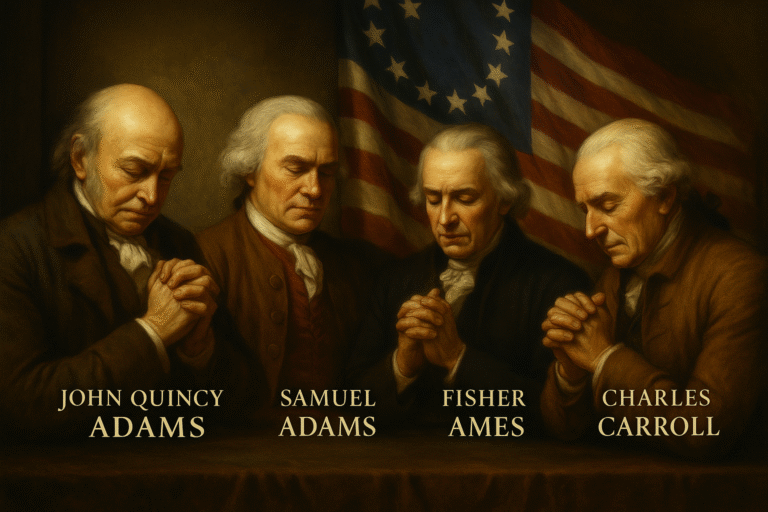
Figures such as John Quincy Adams, Samuel Adams, Fisher Ames, and Charles Carroll regularly invoked Christian teaching, biblical language, or divine providence in political discourse. State constitutional conventions and legislative debates frequently referenced God and Christianity, embedding them into the language of law and public duty.
Legal and Institutional Embedding
Early state constitutions and laws reflected Christian influence. Several required public officeholders to affirm belief in God, to take oaths with explicit Christian references, or to acknowledge the role of Christian morality in civic life. Public schools also emphasized biblical teaching and moral instruction.
Although the federal Constitution avoided establishing a national church, the cultural context of governance assumed that citizens would be formed by Christian values. Prohibitions on theft, perjury, blasphemy, and Sabbath-breaking in early colonial laws reflected inheritance from a Christian moral framework.
The Treaty of Tripoli, ratified in 1797, did contain a clause stating that “the Government of the United States is not, in any sense, founded on the Christian religion.” However, that clause was included to assure Muslim nations that the U.S. would not engage in religious wars or enforce a national church. Its intent was diplomatic rather than a denial of Christianity’s influence within American society.
Cultural and Social Foundations
Christian institutions—churches, seminaries, and Bible societies—played a vital role in shaping social life during and after the founding era. Public prayers, religious ceremonies, and appeals to divine providence were common in government proceedings.
The Declaration of Independence also reflects a Christian-inflected worldview. Phrases such as “endowed by their Creator” and “appealing to the Supreme Judge of the world” echo the theistic assumptions common among Christians of the time. While broad enough to include Deists and other believers in natural religion, the language resonated most with Christian audiences and reflected the religious spirit of the age.
Objections and Complexity
Historians acknowledge that America was never an exclusively Christian nation in its legal framework. The First Amendment prohibited establishment of a national church and guaranteed freedom of religious practice. Some Founders, such as Thomas Jefferson and James Madison, strongly supported separation of church and state, wary of government entanglement with religious authority.
This tension created a dual reality: while the nation’s laws and Constitution upheld religious liberty and pluralism, the cultural and social fabric was undeniably rooted in Christian values. The United States was thus shaped by Christian moral assumptions, even while protecting space for non-Christian belief.
Conclusion
The historical evidence demonstrates that Christianity was not incidental at the founding of the United States. The rhetoric, institutions, and social practices of the early republic reflected a conviction that Christian virtue was essential for the success of self-government. While the legal framework of the Constitution ensured religious freedom and avoided establishment of a national church, the cultural heritage of America was decisively Christian.
America’s founding was not religiously ambiguous. It was distinctly grounded in a Christian vision that shaped its earliest ideals, institutions, and culture. Recognizing this heritage allows us to better understand the values that gave rise to the American experiment in liberty.
Sources
- John Adams, Address to the Massachusetts Militia, October 11, 1798, Founders Online, National Archives.
- John Quincy Adams, Oration on the Declaration of Independence, July 4, 1837.
- Samuel Adams, The Rights of the Colonists, 1772.
- Fisher Ames, Writings and Speeches on Religion and Morality.
- Charles Carroll, Letter to James McHenry, November 4, 1800.
- Early State Constitutions, compiled in The Public Statutes at Large of the United States of America.
- Treaty of Tripoli, ratified June 7, 1797, United States Statutes at Large, Volume 8.
- The Declaration of Independence, July 4, 1776.
- Thomas Jefferson, Letter to the Danbury Baptists, January 1, 1802.
- James Madison, Memorial and Remonstrance Against Religious Assessments, 1785.